The Desert Fathers and Works Righteousness? Say it ain’t so!

In my last post, I mentioned that there were some theological tools I picked up from my mentor that I’m not sure I want to keep. For the most part, they’re Eastern Orthodox. Since I didn’t have classical Protestant thinkers at my fingertips when I connected with so many of these resources, they were great for that period of my life, but now that I’ve had some time to get a little more classical Protestant thinkers under my belt, I think it’s time to say goodbye to some of the things from my past that I have more disagreements with than I fully understood at the time.

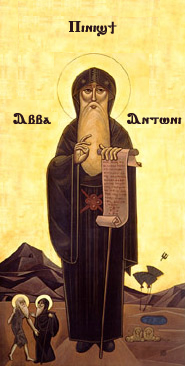
And this first one is a hard one: the Desert Fathers. SAY IT AIN’T SO! If you haven’t read The Sayings of the Desert Fathers before, let me just affirm that it is one of the most beautiful books I’ve ever read. Selections from this book were a part of my morning devotions for a long time. Here’s one of my favorites:

A brother came to see Abba Macarius the Egyptian, and said to him, ‘Abba, give me a word, that I may be saved.’ So the old man said, ‘Go to the cemetery and abuse the dead.’ The brother went there, abused them and threw stones at them; then he returned and told the old man about it. The latter said to him, ‘Didn’t they say anything to you?’ He replied, ‘No.’ The old man said, ‘Go back tomorrow and praise them.’ So the brother went away and praised them, calling them, ‘Apostles, saints and righteous men.’ He re- turned to the old man and said to him, ‘I have complimented them.’ And the old man said to him, ‘Did they not answer you?’ The brother said no. The old man said to him, ‘You know how you insulted them and they did not reply, and how you praised them and they did not speak; so you too if you wish to be saved must do the same and become a dead man. Like the dead, take no account of either the scorn of men or their praises, and you can be saved.’ (The Sayings of the Desert Fathers, trans. Benedict Ward, 132)

Isn’t that wonderful? Each of these sayings balance wittiness and wisdom, and they’re always focused on living Christianity, not just theorizing about it. I ran across this book for the first time while I was in seminary, studying abstract (and unorthodox) theories about how the Bible was written in my Bible class. I randomly plucked it off a shelf in the library, and when I opened it up? Boom. It felt like the Holy Spirit was right there next to me, encouraging me to live a Christian life, not just theorize about things that will never be edifying for real Christians.

As much as I love this collection of sayings, I’ve come to see its limitations. You can even see one of them in this piece. Did you catch what the man said when he asked for help? “Give me a word that I may be saved.” There’s only one word that can save you, dude, and that’s Jesus himself (Jn 1). And I know some would argue that I’m nitpicking here, since that little saying is just a standard part of the Desert Father’s story formula and there’s ways you can try to justify it, but on the whole, I think it’s pretty honest. A massive portion of the Desert Father’s stories are about how to develop a virtuous character, and they usually open with someone asking, “Father, give me a word that I might be saved.” A virtuous character is key to their understanding of salvation. And my logic here isn’t random or unfounded. The deadly edge of monasticism, as expressed by Luther so often and so clearly, is works righteousness. That’s incompatible with the Christian faith that you see in John 3:16 or Ephesians 2:8-9. There’s a big, glaring disagreement with most monastic literature and the Protestant battlecry of Sola Fide (by faith alone).

I may not have fully understood this when I picked up The Sayings, but it did rub off on me. I started reading more and more monastic literature, which pointed me towards Aristotle and his virtue-based ethics. His work is the philosophical underpinning of monastic thought. He argues that practicing good character traits consistently slowly molds you into a just person. I read up on that and thought it was pretty good! Just like the monks, really. So I decided to share my new leanings with my wife. I told her that Protestantism was probably a little wrong in parts. After all, it’s not just faith that makes you what you are! It’s what you do that molds you. It’s faith AND works that save you, when you think about it. Aristotle told me so.

While the monks would have approved of my thoughts, my wife certainly didn’t. She doesn’t often go all-out in arguments against me, but saying, “We might not be saved by faith alone,” was something she absolutely went all-out to defend. And I’m thankful that she did, because when your husband says, “I think Aristotle might be more right than the Bible,” you probably need to set him straight.

I’ve bounced back a lot since then. I’ve come to see that as much as I love the monks, they didn’t always focus on things in a way that reflects what the Bible clearly teaches. To use another Protestant phrase, I genuinely believe that Sola Scriptura (by Scripture alone) is true. Everything we need for salvation is in the Bible. Unfortunately, I can’t find anything that looks like what the Desert Fathers were doing. I think they have a logic to their actions that doesn’t reflect the heart of Scripture. Does that mean I think they’re all garbage? Absolutely not. But it does mean I think some of their emphases are a little off. If I want to read them, I have to be aware of the points where we diverge so I can get the best and leave out the worst.

So what to do with the Desert Fathers. Are they perfect? No, but here’s still a lot that I appreciate about them. I’ve just shifted my level of enthusiasm. Whereas historically, I would unapologetically have loved to do whole a sermon series that focuses on the Desert Fathers and their stories, now I’d rather keep Scripture at the center and maybe occasionally use them for a fun devotional or illustrative story. Am I throwing out these tools? Absolutely not. But they’ve gone from a core part of my toolbox that I used every day to some tools that stay up on their hooks until a special occasion comes out.

The Prosperity Gospel

In worship, I’ve been preaching through John 6. In overview, Jesus makes bread for hungry people, the people get excited, the people chase Jesus down for more miracle bread, Jesus says he’s the bread of life and all they really need, and finally people get disappointed and leave. Here’s a crowd of people that legitimately witness a miracle, but instead of bowing down before Jesus, they want to put him to work. They don’t really want the bread of life; they want a life of bread.

Naturally, I started thinking about people that have that sense of religiosity today. There are plenty of popular speakers who claim that God wants to lead you to a life of bread. The prosperity gospel preachers are the most obvious example. I didn’t want to misrepresent them when talking about them, so I started digging through some of the their writings to get a sense for the kinds of things they say and believe. Let me tell you, it was a wild ride. Not only was it broadly ickier than I expected (you’ll see), but there were a lot of little dots I got the chance to connect.

Prosperity gospel preachers are overwhelmingly nondenominational. They’re also well represented by people of every race. Neither of these first two items surprised me. I can’t imagine most of these pastors being open to denominational oversight, and no race is immune from the temptation of money. What did catch me off guard was the religious background that most of these preachers had. There’s a surprisingly strong tie between prosperity gospel preaching and the Charismatic/Pentecostal tradition. Not every prosperity gospel preacher has a Pentecostal background, but the modern American prosperity gospel did get its start there (Oral Roberts tends to be the usual starting place for religious historians), and it still has really, really strong ties to it today. As a non-Pentecostal/Charismatic looking at their tradition from the outside, the connection seems pretty logical when I think about it. Charismatics often put a really high premium on miracles in a Christian’s life today. It’s not wild to assume that you can get to, “God wants to give me money if I have enough faith,” pretty quickly from there if you go off the rails. Pentecostalism also lacks the clear denominational structures that can prevent obvious false teachings from reaching the pulpit, and it tends to have a really low emphasis on (and even active skepticism about) education. I didn’t expect the connection between those two entities, but it makes good sense.

History aside, I was shocked at how shameless prosperity gospel preachers can be. Legitimately, wholeheartedly, shameless. Here are some quotes that just broke my heart:

  • “Sow a seed on your MasterCard, your Visa or your American Express, and then when you do, expect God to open the windows of heaven and pour you out a blessing.” -Oral Roberts (“Success in Life” broadcast on the Trinity Broadcasting Network September 21, 1990)
  • “The best thing you can do for the poor is not become one of them.” -Rev. Ike (“The Gospel According to Rev. Ike,” Ebony Magazine, Dec. 1976)
  • “Don’t wait for the pie in the sky by-and-by when you die. Get yours now with ice cream and a cherry on top!” -Rev. Ike (“The Gospel According to Rev. Ike,” Ebony Magazine, Dec. 1976)
  • “If you’ve got one-dollar faith and you ask for a ten-thousand dollar item, it ain’t going to work.  It won’t work!  Jesus said, ‘according to your [faith,]’ not according to God’s will for you, in His own good time, if it’s according to His will, if He can work it into his busy schedule.  He said, ‘According to your faith, be it unto you.’  Now, I may want a Rolls Royce, and don’t have but bicycle faith.  Guess what I’m going to get?  A bicycle.” -Rev. Frederick Price (Fredrick K. C. Price. “Praise The Lord” broadcast on TBN. 21 Sept. 1990)
  • “God works by faith. You must believe first, and then you’ll receive” -Joel Osteen (Your Best Life Now, p. 33)
  • “You will often receive preferential treatment simply because your Father is the King of kings, and His glory and honor spill over onto you” -Joel Osteen (Your Best Life Now, p.40)
  • “Remember, only what you give can God multiply back. If you give nothing, and even if God were to multiply it, it would still be nothing!” -Oral Roberts (The Miracle of Seed-Faith, p.27)

And my personal favorite, when Oral Roberts told all of his followers that he was going to die unless they sent him eight million dollars. There are a million newspaper articles about it, but that wasn’t enough for me. I wanted something more incriminating. I wanted to read about the incident in his own words. I didn’t have to look far. He literally wrote about it in his own autobiography:

  • “The Lord spoke to me near the end of 1986 and said, ‘I told you to raise $8 million to carry on My medical work. You have from January 1 to March 31 to get it done. If you don’t then your work is finished, and I am going to call you home.'” -Oral Roberts (Expect a Miracle: My Life and Ministry, p.289)

Yikes.

You read quotes like this and can’t help but feel angry. When the anger subsides, you worry about the people that they’re taking advantage of. Sure, some of them might be able to afford a donation here and there to support a charismatic speaker, but what about the people who are desperate? What about the woman who has cancer, trying to juggle her medical bills, sending “Rolls Royce faith” checks in the hope that thing will turn around? What about the poor man with brain damage who sends in any little bit of cash that he can in the hopes that God will miraculously restore him? I believe in miracles and tithing as much as the next pastor, but I’ve known people in these circumstances, and I’ve seen the damage that prosperity gospel preachers can cause. Here is a pack of wolves on the prowl for desperate, down-on-their-luck people. Not everyone has the gift of discernment, and they’re counting on that. It reminded me of another certain historical preacher that assured people that God would give them blessings if they forked over some cash:

You should know that all who confess and in penance put alms into the coffer according to the counsel of the confessor, will obtain complete remission of all their sins…. Why are you then standing there? Run for the salvation of your souls! Be as careful and concerned for the salvation of your souls as you are for your temporal goods, which you seek both day and night…

Don’t you hear the voices of your wailing dead parents and others who say, ‘Have mercy upon me, have mercy upon me, because we are in severe punishment and pain. From this you could redeem us with a small alms and yet you do not want to do so.’ Open your ears as the father says to the son and the mother to the daughter, ‘We have created you, fed you, cared for you, and left you our temporal goods. Why then are you so cruel and harsh that you do not want to save us, though it only takes a little?

-Johann Tetzel , Sermon on Indulgences

Where’s a Martin Luther when you need him?

Reformation Day

This entry is part of a series called “The Gospel in a Postmodern World.” Learn more about the series here.
Preached at The Plains United Methodist Church on October 30, 2022
Scriptures: 2 Peter 1:10-21, Romans 1:8-17

Happy Reformation Day, everyone!

I’ve noticed a lot of Methodist churches don’t regularly celebrate Reformation Day, which is a shame.  It’s a great opportunity to look back at our own history; to see where we’re from and what some of our core DNA is.  We need to give it the attention it deserves.  At one of my past appointments, I spoke about Martin Luther during the sermon, and afterwards a woman came up to me and said, “Wow, Martin sounds great!  I haven’t met him yet.  Does he go to the other service?”  Who can’t blame her for what she doesn’t know?  It’s on us pastors for not teaching it enough.

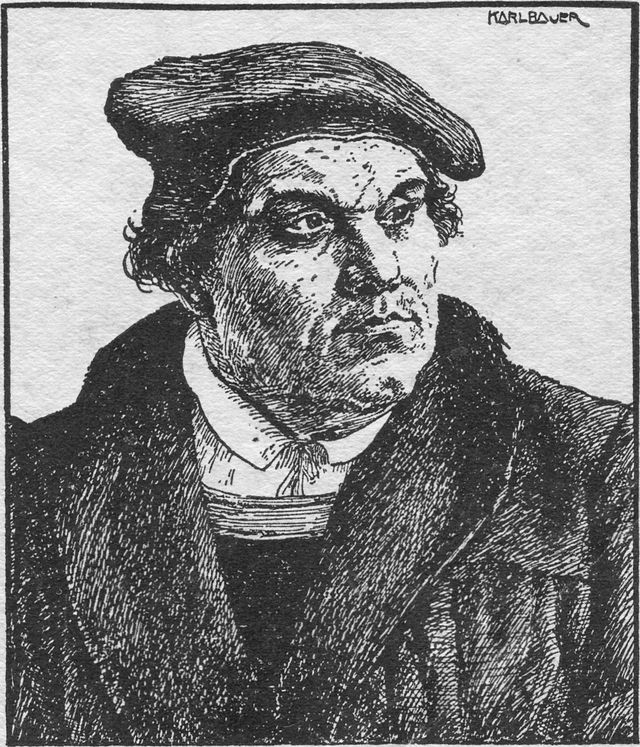
For those curious, Martin Luther did not go to the other service. Martin Luther lived in the 16th century.  He was the founder of Protestantism.  Without him there would be no Methodists!  There would be no Anglicans from which Methodists could come!  Not only would there be no Protestants, but what we know today as the Roman Catholic Church would look different as well.  Martin Luther is a big deal so I think it’s worth a little time to tell his story and remember about one of the great Protestant heroes.  

I want you to imagine that the year is 1521. You are in an imperial court in the city of Worms, a city that’s in what we know today as Germany, but was known back then as a part of the Holy Roman Empire.  This room is full of some of the most powerful people in the world.  Among them is Charles V, the singular man who is the archduke of Austria, the Prince of Spain, the lord of the Netherlands, the duke of Burgundy, and the emperor of the Holy Roman Empire.  He is a big deal.  There’s also a papal envoy dressed in some of the finest clothes imaginable.  In front of that envoy, a monk stands next to a pile of books.

The envoy speaks: “Martin Luther, this court has reconvened.  Yesterday we asked you two questions.  The first: ‘Are you the author of these books in front of you?’  You answered yes.  Our second question: “Do you renounce the ideas contained therein and recant your heresy?’  You asked to be granted a 24-hour recess.  This was granted, but we are back today, Mr Luther, and we need an answer.  Do you renounce the ideas contained within these books and recant your heresy?”

You wouldn’t have expected things to turn out like this given where this story starts.  It starts in a little kingdom called Saxony.   Saxony was not the kind of place where life-altering things tended to happen.  It was in Northern Germany.  Northern Germany wasn’t well developed.  It was really rural.  Southern Germany had a lot of stuff.  Northern Italy had a lot of stuff.  Northern Germany?  Not so much.  There were no ruins of an old Empire to build on.  There were no great trade routes.  Most of their top items to sell were natural resources; grain, fish and minerals.  Saxony wasn’t the kind of place where big things happened. 

None of that was helped by the politics of Saxony only a few generations back.  When King William II of Saxony died, his two sons split the kingdom and each inherited half of it.  The elder brother got to choose how the lands were split, and the younger brother got to choose which area he wanted to inherit.  And so the elder split the lands: one of the two parcels was a long, twisty portion of land that was mostly rural, and the other was a little clump of land that had all of the major cities in it.  The choice fell to the younger brother: did he want to rule the urban center of the lands, or the larger rural area?  He took the urban area, leaving the elder brother, a man by the name of Ernest, the jaggedy rural strip.

Since Ernest was the elder and got second pick of the lands, he got something extra: the title “Elector of the Holy Roman Empire.”   I don’t want to get too far into the weeds describing the political system of 16th century Germanic kingdoms, but here’s a really basic understanding: imagine if the United States had a weak federal government and strong state governments.  In this model, the president would still exist, but he would appear on the global stage to represent the collective interest of the states.  Individual states would have a lot of autonomy.  The president wouldn’t really have much say over them.  That’s basically what the Holy Roman Empire was.  There were a bunch of really small kingdoms, some so small that they were just singular cities, all bound together in mutual interest and represented by an emperor that they got to elect.  Not everyone got to vote for the emperor though.  Only a very small group called “the electors” got to vote.  Ernest may have inherited the rural lands, but he was an elector, and that made him, strangely, an important man with a somewhat unimportant kingdom.

That’s the legacy of 16th century Saxony.  Not exactly the center of the world.  But when Ernest passed away, his son, Frederick the Wise, was looking to change all that.  Frederick was bound and determined to make little Saxony the kind of place where things happened.  The capital of Saxony, Wittenberg, only had 2,000 people in it and 400 buildings, but it was the biggest city there was in Saxony, so that’s where he started.  He created two plans to make Wittenberg a destination for people all over the world.

The first was to create the biggest collection of relics the world had ever seen.  Relics were basically Christian artifacts.  The presiding theory of the day was if you looked at a relic God would bless you.  It was a very mechanistic process.  Look at the thing?  Get the blessing.  Frederick started collecting relics and managed to get his hands on over eighteen thousand of them.  He even managed to collect a vial of milk from the Virgin Mary and a twig from the burning bush.  Now, you can decide if you think those relics were legitimate or not, but people at the time thought they were VERY legitimate.  Pilgrims started flocking to Saxony to see all of his relics laid out in Wittenberg’s chapel.  They wanted to soak up all of God’s grace that they could!

Frederick’s other plan was to build a university in Wittenberg.  He’d build a massive, top-notch university and people would come from all over the place to attend!  Maybe, some of them would even stick around and become citizens of Saxony.  So he started hiring professors.  He even bought one of those newfangled printing presses!  Printing presses were a bit of a curiosity at this point.  Books weren’t all that common.  They weren’t even written in language that the average person understood.  They were only in Latin, the language of scholars.  Frederick wasn’t sure how exactly this printing press was going to help him, but new things were exciting and his university would have nothing less but the very latest in technology.

Even with Frederick’s ambitious plans in full swing, the average person would not have expected much from little Saxony.  Nor would people have looked at the hero of the Reformation, Martin Luther, and expected great things from him.  Martin was from a middle-class family.  His dad owned a mining business and managed the business side of things, which was both expensive and risky.  He had to take out loans to buy the mining rights to a piece of land and he never knew when there might be a cave-in or flooded tunnel that would impact his ability to pay off the loan properly.  He spent most of his life in debt as he took out and paid off different loans, but all things considered, he was pretty good at what he did.  The mining business did well enough, so he sent his son, Martin, off to college in a place called Erfurt, a big city in the area, in the hopes that he would become a lawyer.  If he was a lawyer, Martin would be able to help the family business a lot.

That was not to be.  Martin went to college, and one day, while he was coming back to campus from a little trip, there was a storm.  We’re not just talking about a little rain. We’re talking about howling winds crashing thunder!  Lightning struck right next to him!  He was sure he was going to die.  He prayed to God, “Let me live through this and I will do whatever you want. I will give my whole life to you,” and the storm subsided.  So, true to his word, he gave his life to God and became a monk.  His father was not particularly enthusiastic at first, but he warmed up to it over time. He saw his son’s sincerity and wanted what was best for him.  So, Martin started living in his local Augustinian monastery there in Erfurt.  He found a mentor that he really admired.  Things were going well!  Unfortunately, his mentor moved away.  There was this little university that was just getting started up in Saxony’s capital, Wittenberg, and it was hiring up all of the professors that it could.  Since Martin’s mentor was both a monk and a professor, he took a job and transferred over to a monastery in Wittenberg.  Unfortunately, Martin didn’t have a lot of friends around the Erfurt monastery after his mentor left.  The other monks weren’t on the same page as him.  They decided to transfer him to their branch in Wittenberg so that he would be near his old friend and out of their way.  When you’re a monk, you don’t really get a say in the matter.  They’re not asking if you’d like to be transferred; they’re telling you that you’re getting transferred.

You might think that Martin would be overjoyed to be back with his friend.  He was not.  He was really frustrated.  Wittenberg was full of nothing!  All of Saxony was full of nothing!  That was the kind of place where barbarians settled!  Nonetheless, as he settled in, things turned out pretty well for him.  He became a pastor and worked at the local church.  His mentor helped him get on-staff at the university where he taught as the professor of biblical theology.  Everything was slowly turning out ok.

Now we have the right person (Martin) in the right place (Wittenberg) for the Reformation to kick off, but there’s one critical element we haven’t discussed: the powder keg.  The event that blew up and kicked everything off.  At the time, the Catholic Church was selling something called indulgences.   An indulgence was basically a little certificate from the pope that said all of your sins were forgiven.  They were also transferable.  You could buy one and apply the forgiveness to someone else.  A lot of people would buy them for their dead relatives.  The popular assumption of the day was that your dead relatives were probably in purgatory.  Heaven was only for the super holy Christians, Hell was for non-Christians, and purgatory was for Christians that were too sinful to make it into Heaven.  God would purify them over the course of a few thousand years until they had been fully cleansed of their sins.  That process of purification was said to be pretty unpleasant, so you wanted to help your dear sweet relatives get out of there in any way you could.  Buying the pope’s indulgences was the best way to get grandma to Heaven.

I’m sure many of you find that thought process unthinkable, but there’s a long series of ideas that were accepted over time before selling indulgences started to make sense.  I won’t go through all of it, but it starts with ideas like, “Well, if you go to a holy site, isn’t it reasonable to think that God would bless you?”  Sure, ok, that makes sense.  God probably blesses pilgrims that go to holy sites.  “Well, what if Christians do something to help others?  Like defending them from persecutors by going on crusade?  Will God bless them for doing that?”  Ok, sure, intellectual baggage of the crusades aside, maybe it’s reasonable that God would bless people that set out to help others in unfortunate circumstances.  “Well now, what if you donate a large amount of money so that someone else can do those things?  Wouldn’t that also deserve a blessing?  Because you’re the reason someone else can do it.”  Right there, you’ve already got the fundamental framework for indulgences.  You’re just a hop, skip, and a jump away from writing certificates. 

Martin hated the church’s sale of indulgences.  They were getting ready to sell them in Saxony for the third time in five years.  Saxony wasn’t wealthy!  Why did they keep selling them there?  And all the money from the indulgences was going to fund repairs of Saint Peter’s Basilica, a really fancy church in Italy.  Why did the pope need the money of peasants to fund a church for the wealthy?  And Martin saw the negative effects that indulgence sals had on people, both rich and poor.  Poor people that had to scrimp and save so they could buy a certificate for grandma to go to Heaven.  The rich, on the other hand, didn’t worry as much about living a Christian life when indulgences were around.  They could do whatever they wanted as long as they made sure to grab a certificate for themselves when they were done.  The whole thing had gotten completely out of hand.

As this was happening, Martin had a rapid spurt of spiritual growth.  He was someone who seemed to have it all: he was a professor, he was a monk, and he knew his Bible forward and back!  But he had a dark secret: he hated God.  Martin hated God because he thought that he would never be good enough for him.  The popular theory to explain how law and grace functioned in the Christian’s life was via something called “imbued grace.”  They thought that God gave you enough of his grace to go out and keep the law pretty well.  If you made mistakes, well, then God would be angry.  If you asked for forgiveness, he might punish you a little less severely, but you would still be punished to some degree.  And after it was done, you were expected to go and live a perfect life again.  Martin believed it, just like everyone else, and so he tried very hard to live a life without sin.  He realized that when he really thought about what he had done on a given day, there was always sin to be uncovered.  There was always a moment when he was jealous or when he was short with someone, and so God was always angry and waiting for him to do better.  His best wasn’t good enough.

But everything changed when he was teaching a class on Romans.  Romans is like that.  Some of the most famous Christians of all time converted while reading Romans. Saint Augustine, one of the most famous Christians of the 4th Century, converted while reading Romans.  Martin Luther converted while reading Romans.  John Wesley converted while reading Romans.  The book of Romans is powerful.   Let’s look at one of the passages that was on the top of his mind.  This is Romans 1:8-17:

First, I thank my God through Jesus Christ for all of you,because your faith is being reported all over the world.

This is a letter from Paul to Roman Christians and you can see that he’s impressed with them.  He’s impressed that they have such incredible faith in a place like Rome.  Christians in Rome endured a lot of persecution.  Torture and even death, depending on who was in charge at the time.  It would have been incredibly dangerous.  You would need an impenetrable faith!  But this is the kind of church where people had impenetrable faith.  They didn’t stumble; they endured.

God, whom I serve in my spirit in preaching the gospel of his Son, is my witness how constantly I remember you in my prayers at all times; and I pray that now at last by God’s will the way may be opened for me to come to you.

In other words, he wants to visit them.

I long to see you so that I may impart to you some spiritual gift to make you strong— that is, that you and I may be mutually encouraged by each other’s faith. 

I love the humility here.  One of the great apostles says, “I want to give you a gift and the gift… is that you and I get to sit down and build each other up.” Faith is not just a one-way street!  It’s something that takes people coming together.  People that are mature and very wise and people that are brand new!  We all stand to learn and be built up by one another.

I do not want you to be unaware, brothers and sisters, that I planned many times to come to you (but have been prevented from doing so until now) in order that I might have a harvest among you, just as I have had among the other Gentiles. I am obligated both to Greeks and non-Greeks, both to the wise and the foolish. That is why I am so eager to preach the gospel also to you who are in Rome. For I am not ashamed of the gospel, 

The gospel would have seemed pretty ridiculous by a lot of the popular philosophies of the day.  The average Roman would think that the gospel was nonsense! “Your God’s so great? Well, why’d he get crucified then?  A powerful god doesn’t end up dying on a cross.  I can find a god more worthy of my worship than that.”  The average Jewish person would have been equally disinterested: “Your god is supposedly great, but he hasn’t delivered us from the Romans.  I don’t see any grand miracles that he’s done.  He rose from the dead and apparently did nothing worthy of note for me.”

But Paul is not ashamed of the gospel, regardless of what others think! He goes on to say why:

because it is the power of God 

How often do you think about the gospel in that way?  How often do you understand it not just as a collection of words, but as something powerful?  As words that crackle with energy?   The gospel is the power of God!  It’s not just something for us to mull over in our spare time.  It’s the kind of force that changes hearts and minds.

For in the gospel the righteousness of God is revealed—a righteousness that is by faith from first to last, just as it is written: “The righteous will live by faith.”

This whole time, Martin had been trying to be good enough.  And here we see one of the major themes that comes up again and again throughout Romans: you’ll never be good enough to earn salvation.  On our own, we are not capable of perfectly keeping God’s law.  God grants us salvation not because of our works, but through faith in Christ.  When we reach out and trust in him, that makes all the difference.  Our salvation isn’t through legalism.  It’s through love! God looks down and sees not a guilty person, but someone who has been cleansed!  Who is innocent!  Who is pure!  Someone covered by the perfection of Christ.

We are saved by faith, not works.  Does that mean we should go on sinning?  By no means!  Paul specifically says that later in this same letter to the Romans.  But if our salvation isn’t based on legalism, we should be able to act however we want, right?  No!  Paul says that a true Christian should be transformed through their encounter with God.  We shouldn’t want to sin anymore.  We should be totally different creatures, empowered by God to seek what is right instead of what is wrong. And besides that, our motivations for doing what’s right should change.  We don’t keep the law out of fear of God’s punishment.  We do it out of fear of hurting our relationship with him.  We want to make him happy.  We should naturally want to honor and cherish the one we love.  Our relationship with God may not be based on maintaining a code of conduct, but we should still want to honor the God who saved us with everything we do.

And here, inspired by the words of Scripture, we see Martin articulate one of his big ideas: sola fide.  We are saved by faith in Christ alone, not by our works.  Not our abilities.  Not because we’re good enough, but because we have faith in Jesus.  We reach out to him and accept the sacrifice he made on our behalf.  Martin’s big idea didn’t come from the intellectual trends of the day, but through scripture alone.  There’s another one of his big ideas: sola Scriptura.  That’s Latin for “by Scripture alone.”  Scripture is the only authority that we can rely on to ensure that we’re practicing real Christianity and not just something that we made up.

Now we’ve got the who, the where, and the what.  Everything is in place.  Martin Luther started preaching what he had learned in Romans.  And the indulgence sellers came into Saxony and started preaching their doctrines.  This is a selection from the sermon of a man named Johann Tetzel.  He was selling indulgences in Wittenberg, and this is what he preached:

You should know that all who confess and in penance put alms into the coffer according to the council of the confessor, will obtain complete remission of all of their sins…  Why are you standing there?  Run for the salvation of your souls!…  Don’t you hear the voices of your wailing dead parents and others who say, “Have mercy on me, have mercy on me, because we are in severe punishment and pain.  From this you could redeem us with small alms and yet you do not want to do so.”  Open your ears as the father says to the Son and the mother to the daughter, “We created you, fed you, cared for you, and left you our temporal goods.  Why then are you so cruel and harsh that you do not want to save us, though it only takes a little?”  (20-21, A Sermon, Johann Tetzel, as found in The Protestant Reformation, Hillerbrand)

THAT was the last straw.  THAT was what made Martin Luther write his ninety-five theses.  Ninety-five reasons why indulgences were bad! Ninety-five reasons that the pope was wrong! Ninety-five ways the church was failing!  And he didn’t just keep this debate in academic halls. He started writing books.  These were books written in a language that regular people could actually read.  He wrote for the average person because he thought they deserved to know what was going on.  He also made sure that people had access to the Bible in their own language so they didn’t have to take his word for it.  They could go to the Word of God and look for themselves!  He looked to Scripture alone (sola Scriptura) to find the truth, and now everyone else could do the same.  Because even if he was eloquent, his words weren’t worth anything.  God’s word was worth something.  It was and still is the final authority on all things.

Some people get a little confused about Luther’s relationship with tradition They think he brought this new, unheard of understanding to the Scriptures and represented a radical break in Christianity from its past.  That is not the case.  Yes, he trusted Scripture alone as the ultimate authority, but that doesn’t mean he was ignorant of tradition or uninterested in the Christians that went before him.  Read some of his writings sometime!  You won’t make it far without finding a citation from one of the great thinkers from the first 1500 years of the faith.  The man was a professor that sold books.  His goal wasn’t to prevent people from reading and learning from those who went before him!  His goal was to reconnect with early Christianity and recover the faith from people who had slowly twisted it over the years.  Sola Scriptura doesn’t mean separating yourself from the collected body of Scriptural knowledge and just believing whatever you want to believe about the Bible.  It means learning as much about it as you can about God’s word, educating yourself on what it’s saying to you, and taking it as the authority above any earthly thinker, regardless of how popular they might be.

Well, after he posted his ninety-five theses, things got difficult.  It turns out posting ninety-five reasons why the pope is wrong doesn’t exactly put you in his good graces, and in those days, the pope was shockingly powerful.  Pope Leo X wrote a papal decree called Exsurge Domine, which is Latin for “Arise, O Lord.”  It basically said: “Martin Luther, turn from your heresy or burn for your heresy.  The choice is yours.”  And that brings us back to where we started: an imperial court where a monk is being questioned.  He was asked, “Do you recant your heresy?”  Here is how he responded:

“Unless I am convinced by the testimony of the holy Scriptures or someone can reasonably prove to me that I have erred (for I neither believe in the pope nor the councils alone since it has been established that they often erred and contradicted themselves) I am bound by the Scriptures which I have cited at length and my conscience has been taken captive by the word of God. I am neither able nor willing to recant. Here I stand. I can do no other.”

From there, things got really crazy.  He was whisked back to Saxony, where he went into hiding.  Remember how Frederick the Wise was deeply invested in making Saxony a place where things happen?  Turns out that no matter how devoutly Catholic he was, he wasn’t willing to give over someone who attracted as much attention and sold as many books as Martin Luther.  Martin’s big ideas kept spreading, and more and more people started hearing the things that he was saying.  That is how Protestantism started.

Why do I think this story is worth our consideration?  It’s not like anybody is going around selling indulgences today, right?  After all, why would they?  The average person isn’t convinced they’re particularly sinful.  They may not perceive themselves to be perfect, but they don’t think they’re a bad person, and that ought to be good enough for God.  Works righteousness has made a significant comeback in the modern era; the bar for salvation-worthy works is just a lot lower than it was in Luther’s day.

People simply don’t understand the seriousness of sin anymore!  In an environment like this, we need to remember our solas: sola fide and sola Scriptura.  From whence comes our salvation?  Not from ourselves!  Contrary to popular belief, we’re not particularly good.  We’re saved because God is particularly good.  He’s the only one with the power to save us.  The best thing we can do is to trust our lives in his hands.  To have complete and total faith in him, rather than ourselves.  Sola fide.  And how do we know that this is the case?  Not because we’ve kept up with the philosophical trends of the day particularly well or because we’ve read the articles that have harvested the most clicks.  No.  Our authority is not the shifting sands of public opinion.  It’s Scripture alone. Sola Scriptura.  We look to the word of God and that is our rock and our anchor.

Aside from the solas, Luther’s boldness is so incredible.  He stands for what’s true, even knowing that he might be killed for it.  That’s the level of boldness that the church desperately needs to reclaim today.  Only a few generations ago, it was socially advantageous to participate in a church.  It didn’t matter if someone believed any of it; they were happy just to be participating in a normative institution of American culture and reaping the benefits that came along with it.  You can find records where businessmen with almost no interest in religion move to a new town and immediately join the local church.  Why?  So that they can promote their business and be seen talking to the right sort of people.  People gave up their Sunday mornings to get something tangible.  Churches that participated in that cultural quid pro quo are in a hard place today.  Why?  Because things don’t work that way anymore.  Nobody stands to gain new clients or a good reputation because they go to a local church.  At best, the church is neutral on both of those axes, and at worst, it may actually cost them a good reputation to be a regular participant in an orthodox church.  The next generation of Christians will not be enticed into Christianity because they stand to gain anything in the secular world.  To the contrary, they will have to pay something.

Martin Luther was willing to pay any price when it came to keeping the word of God.  I pray that each of us would be willing to do the same should it fall to us.

Amen.

One Point Per Parable: Julicher is Overrated

I knew a pastor that used to preach that every parable had precisely one meaning. They never explained why that was the case. Of course, making declarations like that from the pulpit isn’t uncommon. Pastors have a terrible habit of just kind of declaring that their school of thought is self-evident and there’s no other possibilities out there. Or worse yet, they use the dreaded, credibility-grabbing phraise “scholars say…” Which scholars? Why do they say that? What are my other options? Don’t get me wrong, I get the instinct. Sermons aren’t intended to be a comprehensive history of religious thought. At the same time, I do wonder how often we cause problems by not fully explaining why we’re preaching what we are. In any case, I just assumed the “one point per parable” idea was a weird quirk of that pastor and ignored it. Until now. Lo and behold, I found the history of the idea. And it turns out the guy behind the theory was pretty influential! But not quite as influential as many claim.

Adolf Julicher was the guy who started telling people that there was “one point per parable.” He’s a 19th century German professor. I stumbled across the name while I was reading Kenneth Bailey’s Jesus through Middle Eastern Eyes (which is a phenomenal resource for anyone looking to learn about Middle Eastern culture and Christ, by the way). He cited Julicher’s work as the fundamental turn away from the allegorical approach which dominated thought in the medieval era. This would be a pretty major accomplishment. Allegorical interpretations are often pretty weird to modern eyes. For example, Bailey points to Augustine interpreting the parable of the Friend at Midnight (Luke 11:5-13). In that particular parable, Jesus tells everyone to imagine trying to knock on their neighbor’s door to borrow three loaves of bread at midnight. What would your neighbor say? Probably nothing nice. But if you keep pestering them, eventually they’ll get out of bed and give you some bread. He follows up with some of his classic thoughts on prayer: “Ask and it will be given to you; seek and you will find,” (Lk 11:9). Augustine reads this story and says that the person waking up in the story is actually intended to represent anyone who is seeking meaning in life. They’re up at midnight because they’re so world-weary and desperately seeking something more. The friend is Scripture, which we should always go to in times of need. And the bread? That’s the life-giving knowledge of the trinity. Needless to say, it’s a bit of a stretch. (If you want to know more about the best and the worst of the allegorical approach, see my posts on the best of it and the worst of it)

Adolf Julicher is presented as the anti-allegorist. He says Jesus told parables not to obscure the meaning of things, but to make them clear. Jesus wasn’t some kind of weirdo mystic; he was just a relatable storyteller trying to get simple points across. Consequently, there are no hidden meanings in parables. They have one meaning, and it should be obvious.

I’m sure some of you are thinking, “Hold up! But Jesus was specifically asked why he kept speaking in parables and he said:”

Because the knowledge of the secrets of the kingdom of heaven has been given to you, but not to them. Whoever has will be given more, and they will have an abundance. Whoever does not have, even what they have will be taken from them. This is why I speak to them in parables:

“Though seeing, they do not see;
though hearing, they do not hear or understand.”

Matt 13:11-13

Fair point. That passage definitely favors the allegorists more than Julicher. But that’s where Julicher’s modernist background comes across the strongest. The modernists were a group that thought the core of religion had been corrupted by centuries of mythology and tradition, and it had to be recovered by stripping away the weird parts of religious doctrine to get back to the pure ideas of Jesus. Julicher is right in those footsteps. He says that the apostles were all wrong about the parables. They quoted them out of context. They mythologized them way more than Jesus intended. They didn’t understandJesus at all. Rather than take him at face value and accept him as a sweet, simple rabbi that could help them grow, they mythologized him and made it incredibly complicated for the modern person to see the true simplicity that Jesus was getting at. What Julicher sees in Scripture is a sort of fanciful take on the true idea that was planted by the original Jesus:

The authenticity of the Gospel parables is not absolute. They did not emerge from the mouth of Jesus as we now read them. They are translated, displaced, and internally transformed. . . . Without careful examination, one can nowhere identify the voice of Jesus with voices of the Gospel authors.

Jülicher 1963: I.11. as cited at
https://parablesreception.blogspot.com/2015/08/adolf-julicher-1857-1938.html

As you can tell, Julicher’s comes with a lot of baggage. If we’re seriously claiming to rely on his work as a cornerstone of our own thought, we’ve got this whole, “Don’t trust the Bible, it’s full of misunderstandings,” overtone above everything else. We are forced to fumble through the mistakes of the authors when we pick up our Bibles, rather than to be informed about anything we didn’t come in with. We end up on this quest for a historical Jesus, which is ironically different from the story of Jesus that came down to us through history. Because that guy does miracles and was the son of God, and that’s just silly.

Is this really the cornerstone of modern parable interpretation? It seems like a lot of people out there think so. Not only did Bailey directly contrast him with the allegorical approach, citing him as the cure for the past’s goofiness, but a lot of professors in seminaries out there seem to hold up Julicher as the start of contemporary parable scholarship. And I think they’re wrong. If you’re a theological modernist, Julicher is absolutely core to that tradition, but there are a lot of Protestants out there who certainly aren’t intellectual descendants of Julicher and somehow avoid the highly allegorized approach. To know why, we need to look between these two eras to find a school of thought that was infinitely more influential and far less controversial.

What happened between the Middle Ages and the modern era? The Reformation! You know, that big period where people specifically started avoiding allegorical readings and focusing on what Jesus meant in his context when he said things. It was that era in which John Calvin and Martin Luther dominated. To be fair to Julicher, he seems to have suggested that these men were on the right track before their followers delved back into allegory, but I don’t think he’s right. To the contrary, I think that the fundamentals of the Protestant Reformation set out a path that’s normative for most Protestant preachers to this day. Let’s use Calvin as an example. Just glance through Calvin’s commentaries on any parable. He’s consistently logical (by modern Protestant standards). He pays attention to the cultural context and the implications of the words in Greek. He often gains several meanings from a parable, but they’re ideas that all seem theologically connected to the circumstances at hand and the major themes Jesus is speaking to. Calvin does all this without devolving into the fullness of allegorical wackiness. When he looks at the warning from Jesus that parables are deliberately unintelligible to some people, he doesn’t read that at a license to go wild speculating about the hidden meaning, nor does he dismiss it as a piece of obscurantism from some befuddled disciples. He goes in a different direction:

 These words were intended partly to show that all were not endued with true understanding to comprehend what he said, and partly to arouse his disciples to consider attentively that doctrine which is not readily and easily understood by all. Indeed, he makes a distinction among the hearers, by pronouncing some to have ears, and others to be deaf. If it is next inquired, how it comes to pass that the former have ears, Scripture testifies in other passages, that it is the Lord who pierces the ears, and that no man obtains or accomplishes this by his own industry.

Calvin’s Commentary on Matthew, ch. 13 v. 9

The challenge in understanding the parable is that no person is capable of understanding any part of God’s truth on their own. Only through God’s grace are we capable of understanding any of it. Anyone listening to the parables without the grace of God hears little more than nonsense. And just to make sure Arminians out there aren’t outraged by the choice of Calvin as normative, I gave Wesley a quick check and he says almost the same thing with the caveat that all people could listen to that grace, but some won’t because they’re so stuck in their worldly ways. Either way, the assumption that the parables are generally capable of being explored through logic and knowledge of Jesus’ cultural context and are ultimately legitimized through faith made possible by grace is pretty normative for most of the sermons on parables I’ve ever heard. And that methodology was around way before Julicher.

I hate to contribute to creating these big categorizations in history. It’s always unpleasant dividing thinkers between different eras. Whenever we categorize things, we inevitably simplify them to a degree that rarely does justice to the subject matter. Nevertheless, I was delighted to find Julicher and solve the mystery of where that pastor got the “one point per parable” theory, but I do think it’s necessary to keep a wider scope when considering his legacy. He’s not the first one to advocate intensely for less allegorized approaches to the parables, nor is he the most popular. He’s got his place in his tradition, for sure. But it’s not quite as massive as the average article seems to claim.

Apologies for the indirect citations for Julicher. Most of his key stuff remains in German, so it’s tough to get at. If you want to know more, check out this site, which has links to some great secondary sources in English and even one in German: https://virtualreligion.net/primer/julicher.html.

An Odd Mix of Joy and Sorrow: Christ Jesus Lay in Death’s Strong Bands

A few weeks back, I wrapped up a class about hymns at the church.  We looked back at how music was used in worship throughout the ages and looked at some particularly famous hymns along the way.  If you’re interested in that kind of thing, we used the book Then Sings My Soul: Book 3 by Thomas Nelson, which is not only approachable and concise, but does a nice job of blending history and music. 

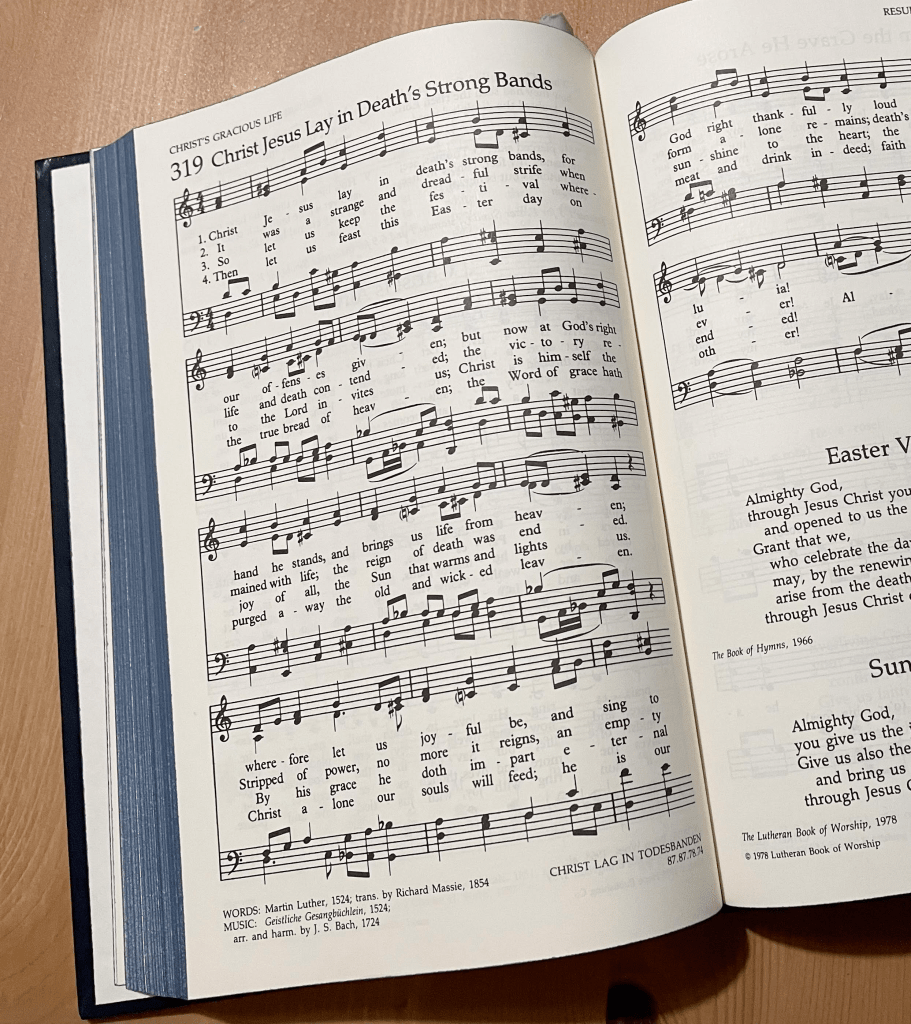
There’s one hymn that really stuck with me from that class: “Christ Jesus Lay in Death’s Strong Bands” by Martin Luther (sheet music and full copy of the lyrics here).  I have no idea how common this hymn is among Lutherans.  For all I know, they sing it every week.  Goodness knows Methodists know more than their fair share of Charles Wesley hymns.  However common it might be in other traditions, it was totally foreign to me, which means I could appreciate just how weird (and wonderful) it was. Here’s a great rendition by Concordia Publishing House:

First off, it’s an Easter song in A minor.  Who writes an Easter song in a minor key?  Easter is a celebration!  It’s glorious!  I don’t expect sad music!  But here’s Death’s Strong Bands, full of melancholy, proudly announcing Easter.  It’s a mix of joy and sorrow that I didn’t expect on Easter.

The lyrics have that same tension.  Just look at verse 1:

Christ Jesus lay in death’s strong bands
for our offenses given;
but now at God’s right hand he stands
and brings us life from heaven.
Therefore let us joyful be
and sing to God right thankfully
loud songs of alleluia! Alleluia!

The first two lines are intensely melancholy, so much so that I’m surprised by the heavenly triumph that follows! And before you say, “Hold on, Vincent!  What if Martin Luther was only saying something like ‘Christ died for us,’ in the first verse?  That could certainly be considered joyful,” hear me out.  The whole hymn vacillates between triumph and sorrow:

  • Verse two is about how all of humanity was enslaved to sin and death (mournful)

  • Verse three is about Jesus destroying death and taking its crown (triumphal)

  •  

    Verse four is about the “strange and dreadful strife” when good and evil fought and good won (triumphal, but with mournful undertones)

  • Verse five compares Jesus to the paschal lamb that died so his blood could save others (could be played either way; suffering love is a complex theme)

  •  

    Verse six and seven switch into high celebration, explicitly saying that it’s Easter and we should remember it with food, drink, and celebrations (highly triumphal)

When I talked to the class about this particular hymn, it turned out to be a lot less popular than I expected.  The most popular complaint was that it was just too gloomy to sing on Easter and too perky to sing on Good Friday. Maybe it could fit in on a Palm/Passion service? But even then you’d have to cut out the verse that explicitly says it’s Easter. It came off like a hymn with some problems that would need solved before it saw it’s day in Sunday worship.

Apparently the people who compiled the United Methodist Hymnal felt the same way.  They cut verses two, three, and five, removing the themes of death, sin, and atonement (the stuff we usually associate with Good Friday). What’s left is significantly more triumphal. Given that verse six and seven are the only two “very triumphal” verses, the percent of the hymn dedicated purely to celebration rockets up from 28% pre-edit to 50% post-edit. This is a common edit of the hymn shared by most mainline denominations and a few evangelical ones.

I can’t help but feel we’re losing something with edits like this. The tension between joy and sorrow and the battle between good and evil are what made the song interesting to begin with! If we ditch that, what are we left with? A weird, subpar Easter hymn that’s arbitrarily in a minor key. Gross. But I get what they were trying to do! They wanted to tip the balance between joy and sorrow in favor of joy! They wanted to resolve the tension and make it a little more Eastery! But resolving that tension made it boring and odd.

If were going to give it some tweaks to help it find a place in worship, a better solution (in my mind) is showcased by efforts like the band Koine. Rather than remove the tension between the celebratory stuff and the mournful stuff, they leaned into that tension. They removed verses 6 and 7 (the explicit references to Easter) and basically turned it into a Good Friday hymn:

Now that’s worth singing!  The minor key makes sense.  I get it.  The sweetness of salvation and the bitterness of Christ’s death are properly intermingled.  It feels a lot more loyal to Luther’s original intent as well. I can’t fathom someone asking him if they could ditch the stuff about Christ’s death and sin and him saying, “Oh, for sure!  Now that I think about it, it was a little gloomy.”  Not a chance.

I do have to admit that the original draft is definitely an odd hymn and a tough sell for Easter.  I almost wonder if you could split the verses and make two versions: the Good Friday edit would have verses 1 through 5, and the Easter Sunday edit would have verses 1, 6 and 7.  If you sang those different versions on their appropriate days during Holy Week, it might give a sense of continuing work that works really well. But maybe I’m working too hard to make an odd hymn work.  Or maybe I’m not properly appreciating what Martin did in the first place! Either way, this hymn’s mix of joy and sorrow hit me just right. I’ll keep pondering this hymn for weeks to come.

The History of Mary Veneration: A Protestant Perspective

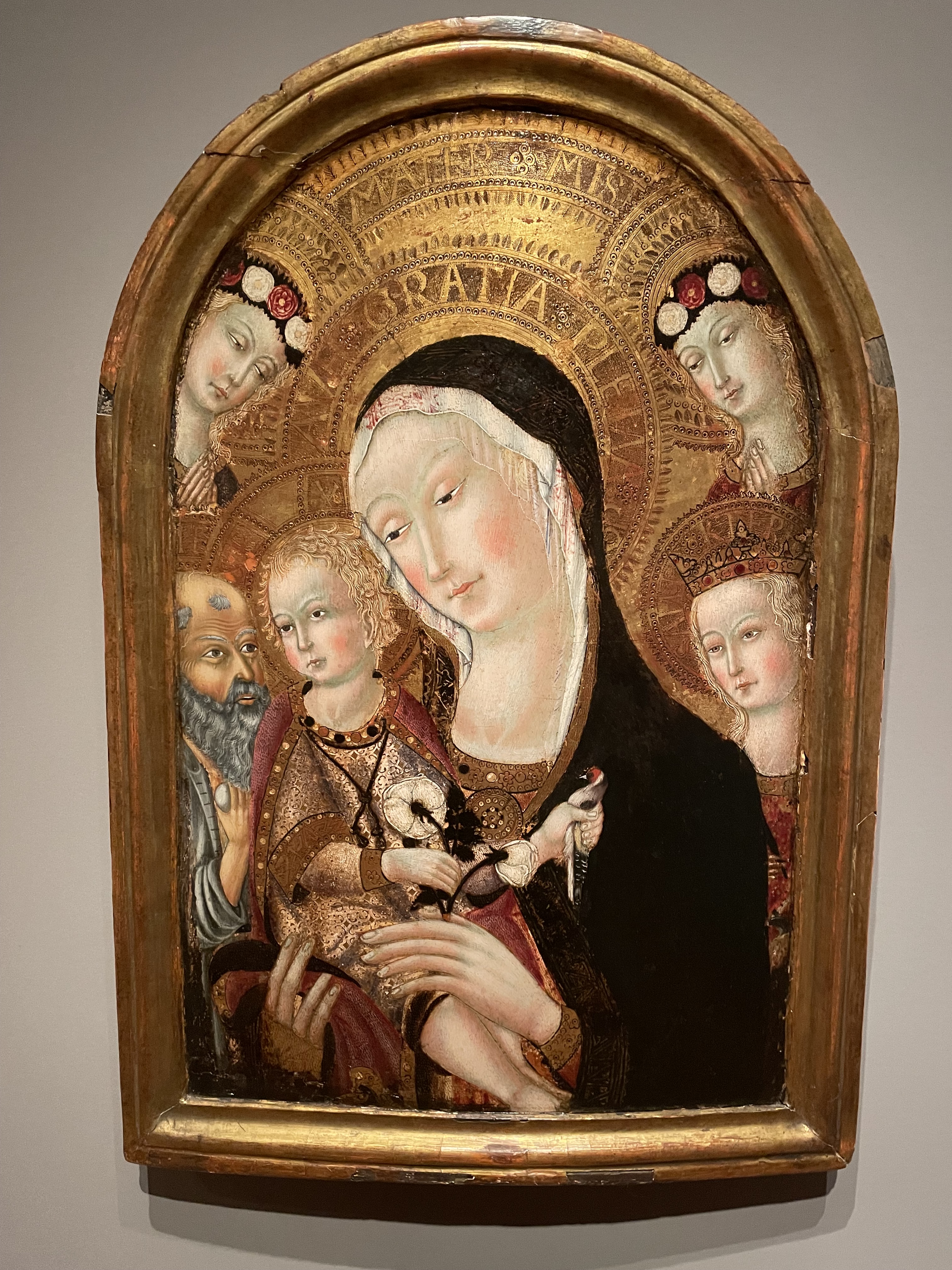
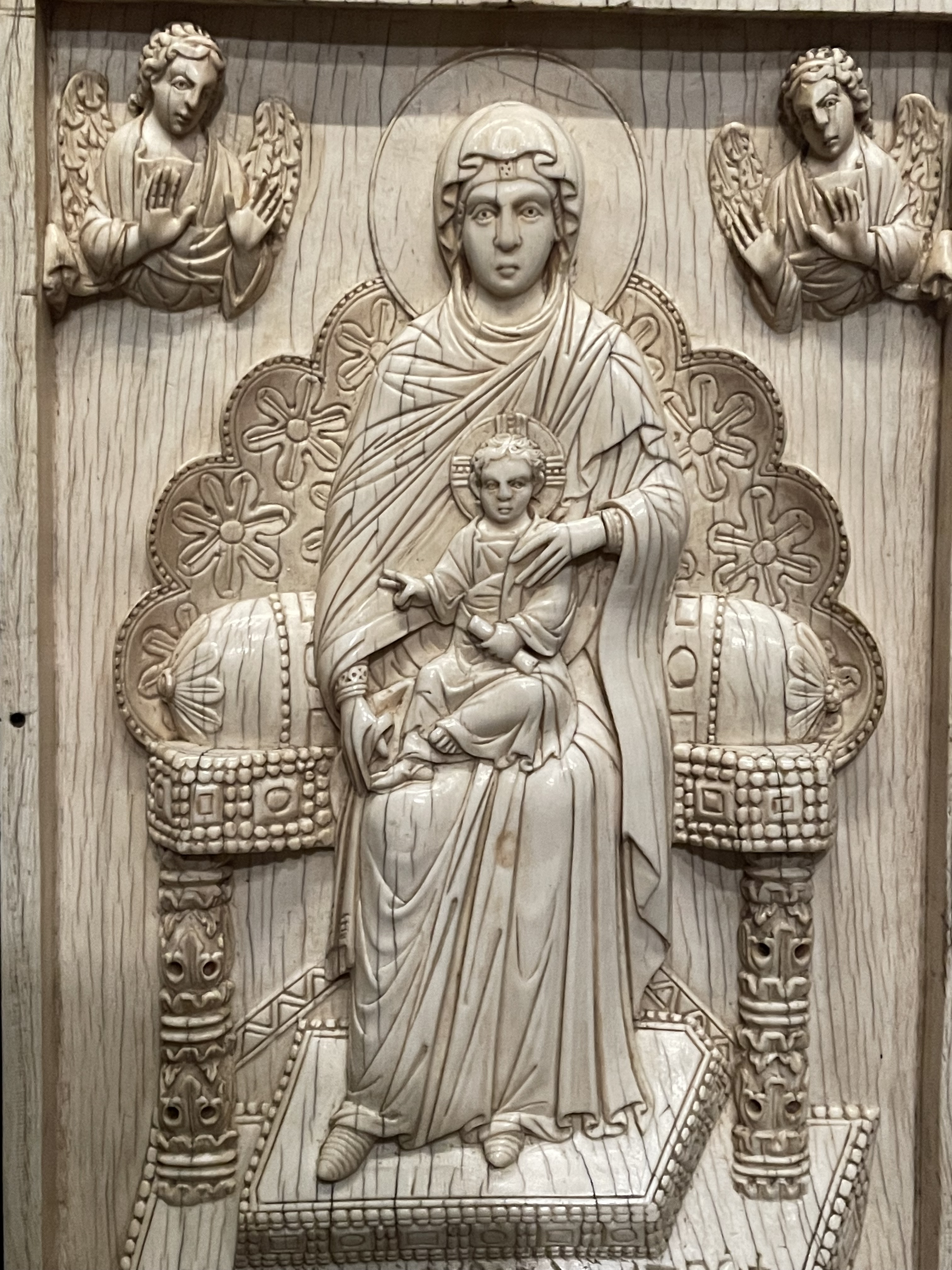
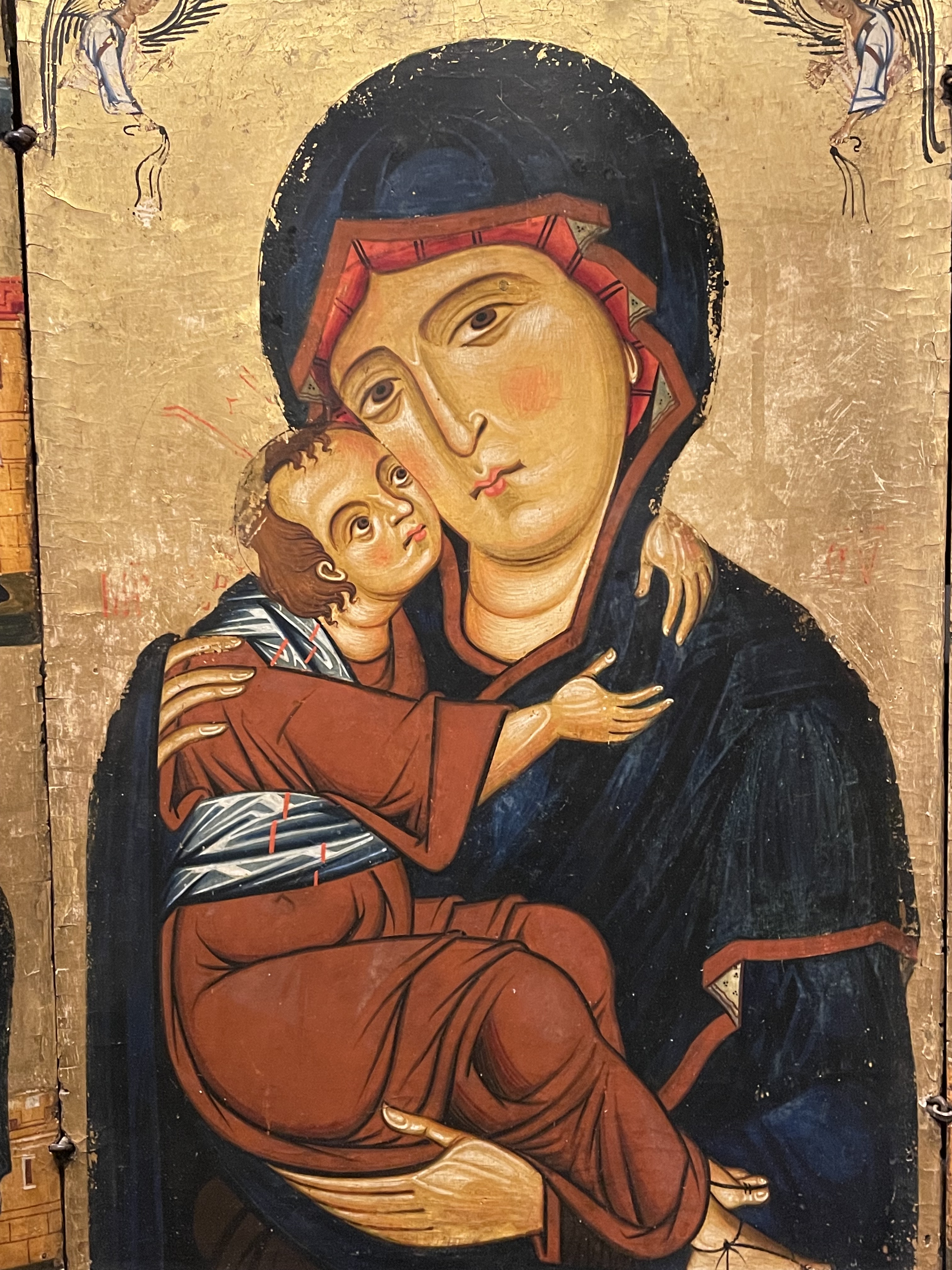
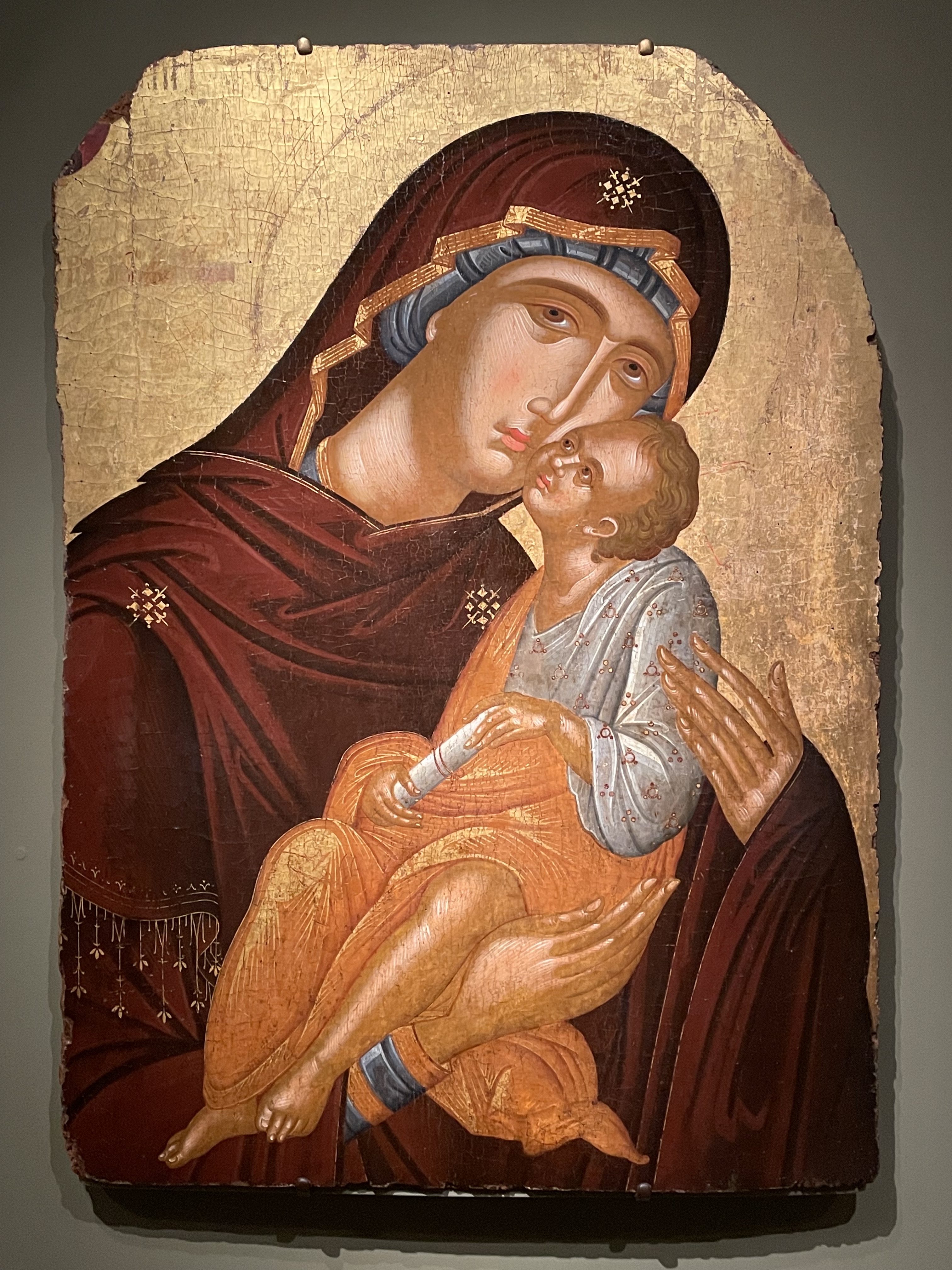
My wife and I went to the Cleveland Museum of Art a few weeks ago. As a theology nerd, I went straight to the Christian art section hoping to have a little bit of a mini-retreat there in the gallery. Unfortunately for me, a MASSIVE portion of the art focused on Mary:

And this one that really took the cake…

Mary’s coronation as the Queen of Heaven.

It was hard to have a spiritual response when everything was so Mary-centric! When I looked up, Mary’s gaze was the first thing I encountered. Jesus wasn’t even looking at me most of the time! If he wasn’t looking off in the distance, he was looking up at Mary, drawing even more attention to her. Naturally, that led to the question, “when did Christians start venerating Mary and why did Protestants stop doing it?” Some Protestants might agree that Mary is uniquely worthy of admiration, but even the most intense Protestant admiration is a far cry from the veneration that she enjoys in Catholicism or Eastern Orthodoxy. So what happened? Did we ditch something that was passed down from the beginning, or did we actually manage to strip away a medieval innovation that had little to do with the Christianity of the apostles?

The uncomfortable truth about Mary veneration is that the historical evidence is a lot less black or white than most parties would like it to be. The veneration of Mary started waaaaay earlier than your average Protestant would hope, but it also happened waaaay later than your average Catholic assumes. First and second century Christians would have found any prayers to Mary a totally alien practice, but in the midst of the raging battles against heresy in the 3rd, 4th, and 5th centuries, it started to develop as a way of preserving the same orthodoxy that Protestants and Catholics share today. In the centuries that followed, it continued to grow and intensify, leading to eventual skepticism from Protestants that wanted to go back to the basics. Even though our tradition ceased the practice of Marian veneration (and had a reasonable claim on recovering early orthodoxy in doing so), a study of how the practice came to be can help us appreciate how that veneration helped our theological ancestors cling to orthodoxy at a time when the nature of Jesus was under fire.

Let’s start our journey with the first century. Easy enough, since there’s no evidence for Marian veneration in this era at all. If we take the Scriptures as the clearest evidence of first-century Christian thought and practice, there’s just not much there. The gospels bring up Mary sparingly, usually during the birth narrative, and the epistles only reference her a handful of times, usually indirectly (for example, Galatians 4:4  reads “God sent forth his Son born of a woman“). If you’re going Sola Scriptura, Mary is a relatively minor Bible character that exists within the narrative as Jesus’s mom. You can definitely find some commentaries out there that try to push the mystical importance of certain passages. For example, some Catholic commentators make much about John 19:26-27: “When Jesus saw his mother there, and the disciple whom he loved standing nearby, he said to her, ‘Woman, here is your son,’ and to the disciple, ‘Here is your mother.’ You can read that to mean that Jesus is mystically speaking to every disciple today, encouraging them to accept Jesus as their own mother… or you can conclude that Jesus was worried about his mom and sent her off with John. The latter seems a great deal more likely than the former. Emphasizing the small passages that Mary does appear in doesn’t solve the big problem: nobody in the Scriptures is venerating Mary or explicitly telling others to do it.

There aren’t a ton of indisputably first-Century Christian documents readily available outside of the Scriptures. We could look at documents like the Didiche (also known as The Teachings of the Apostles) and the Epistle of Barnabas (both of which tend to be considered first-century) and note that neither of them mention Mary at all. First-century Christians just don’t seem particularly concerned with the place of Mary within the order of Christianity. She was Jesus’ mom and that’s about it.

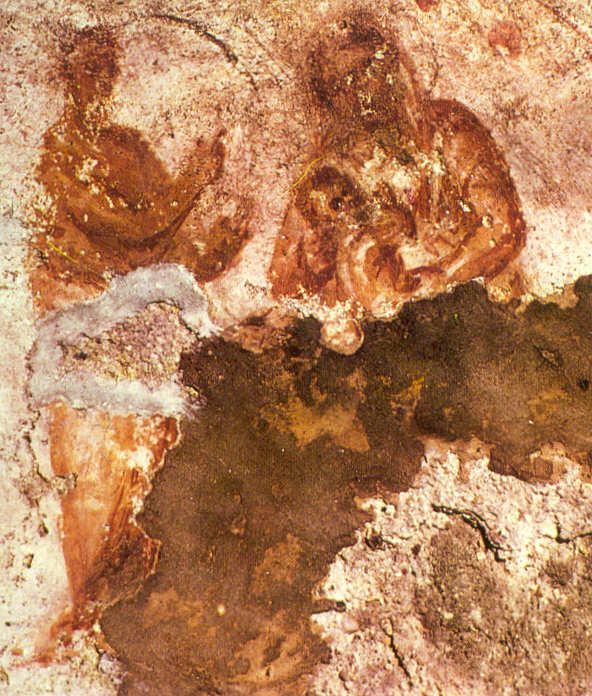
So, onwards to the second century… in which evidence is still pretty scant, all things considered. The Catacomb of Priscilla has the first recorded painting of Mary and Jesus:

There’s a few other paintings from the second century as well, all of which depict Mary as the mother of Jesus. Nothing really new here, but they do speak to the broader concern regarding Mary in this era: was Mary actually Jesus’ mom? The big heresy in the second century was docetism; the belief that Jesus wasn’t really human, so much as he was a spiritual being that looked human. Was he born? Not really. Spiritual beings can’t be born. There wasn’t a consensus among the docetists as to where Jesus did come from. Some claimed that Jesus only appeared to live among us while others suggested that Jesus was just an average man that was born by Mary and the spirit of the Christ descended upon him at his baptism. One famous heretic by the name of Marcion went so far as to totally remove all birth stories from the Scriptures, solving the problem of Jesus’ birth by just having him show up on the scene as a fully-grown man. Regardless of the specifics, the basic message of docetism was the same: Jesus Christ wasn’t really a man, but he was really God. Mary starts to garner more interest from orthodox Christians because she establishes both the human-ness and the divinity of Jesus.

The big theologians in this era reference Mary while they’re making arguments against the docetists. For example, take this passage from Tertullian’s On the Flesh of Christ:

Why is Christ man and the Son of man, if he has nothing of man, and nothing from man? Unless it be either that man is anything else than flesh, or man’s flesh comes from any other source than man, or Mary is anything else than a human being?

Ch. 5

One popular technique used to emphasize the crucial role of Mary is recapitulation (retelling the story of humanity but with all of the bad things from the fall being fixed by similar events during salvation). For example, here’s Tertullian again: “As Eve had believed the serpent, so Mary believed the angel,” (On the Flesh of Christ, Ch.17). And here’s a longer example from the famous second-century apologist, Justin Martyr::

[Jesus] became man by the Virgin, in order that the disobedience which proceeded from the serpent might receive its destruction in the same manner in which it derived its origin. For Eve, who was a virgin and undefiled, having conceived the word of the serpent, brought forth disobedience and death. But the Virgin Mary received faith and joy, when the angel Gabriel announced the good tidings to her that the Spirit of the Lord would come upon her, and the power of the Highest would overshadow her: wherefore also the Holy Thing begotten of her is the Son of God; and she replied, ‘Be it unto me according to your word,’ (Luke 1:38).

Justin Martyr, Dialogue with Trypho, Ch 100

Recapitulation holds to that same anti-docetist thought pattern: if Eve sinned and humanity was doomed through the error a woman, how can humanity saved without the faithfulness of a woman? We need a Mary that genuinely participated in the story of salvation to reverse the damage that was done during the fall. Similar ideas float around in the works of other theologians in this era (Irenaeus, for example) and even start to pop up in some of the apocryphal writings. The Gospel of James, for example, is a retelling of the story of Christ’s birth which explicitly includes a (really uncomfortable) section in which a midwife inspects Mary’s hymen after the birth to make sure that she was genuinely a virgin. Jesus isn’t just a regular baby; he’s a miracle baby! He’s a man that’s also God! She’s genuinely his mother, but the birth is miraculous and mysterious.

Onward to the third century! Mary continues to increase in stature. The teacher of teachers, Origen of Alexandria is supposedly the very first person to write the word “theotokos” (mother of God) down as a title for Mary. Not only would this be remarkable because of the level of authority a title like that naturally bestows upon the listener (it’s a fair bit more impressive sounding than “disciple” or “deacon”), but because this is the exact title that will start to normalize Mary veneration in the 5th century. Tying this title to such an ancient and dignified teacher would lend an incredible amount of legitimacy to the practice! But in all of his recorded writings, Origen never used the word “theotokos.” Not even once. A 5th century author, Socrates of Constantinople, made that claim while he was attempting to dismiss the objections of someone named “Nestorius”:

Origen also, in the third volume of his Commentaries on the Apostolic Epistle to the Romans, gives an ample exposition of the sense in which the term Theotokos is used. It is therefore obvious that Nestorius had very little acquaintance with the old theologians[.]

Ecclesiastical History 7.32.17

Unfortunately for Socrates of Constantinople, we have a copy of Origen’s commentary on Romans and can clearly see that no such passage exists. Not only does it not exist, but Origen never uses the same language of high veneration that later authors will use. Despite some poor claims that continue forward into modernity, Origen’s writings don’t have any real jumping off point that naturally leads to the veneration of Mary.

I bring up this false claim because it indicates that things are really starting to get moving. The water is starting to get muddied. Even though the claims don’t have much legitimacy, the fact that someone made such a claim specifically targeting this era reflects that Mary’s status within the faith is growing. Origen may not use that particular power-phrase, but he does focus on Mary even more than most previous theologians. We start to see Mary stuff start to pop up more and more in the late 3rd and early 4th centuries. Somewhere in this timeframe (depending on which person is doing the dating), we even see see the Sub tuum praesidium hymn pop up for the first time:

Beneath your compassion,We take refuge, O Theotokos [God-bearer]:do not despise our petitions in time of trouble:but rescue us from dangers, only pure, only blessed one.

Sub tuum praes., earliest manuscript of which is from a Coptic fragment known as John Rylands papyrus 470

We still regularly see theologians say that Mary was sinful and there are very few clear recommendations of praying to her from leading Christian figures, but language about perpetual virginity that started popping up in the second century is carrying forward. She is not only a mother, but she is a mother that remained ever-virgin. And again, we have the odd scraps of evidence (like the Sub tuum papyrus) that seem to suggest that some communities are starting to pray to Mary and hold her in particularly high esteem. As we get more thoroughly into the fourth century, big-name theologians like Athanasius and Gregory of Nazianzus start using the phrase “theotokos.” The mother of God has officially arrived.

We could spend ages looking at the slow evolution of the practice of Marian veneration, but I think I’ve already established the trend— Marian veneration slowly developed as a way of battling heresies that claimed that Jesus was not both all-man and all-God. She established both realities; her miraculous birth established Christ’s divinity, while her humanity established Christ’s humanity. But the fifth century offers one more large leap in the history of Mary veneration: the Council of Ephesus and their official endorsement of the title “theotokos.”

A fifth-century archbishop by the name of Nestorius didn’t approve of the title “theotokos” that some Christians had started using (yes, this is the same Nestorius that Socrates of Constantinople made up a fake quote to argue against). Mary couldn’t have given birth to God. God is eternal! God has neither beginning nor end! So he recommended the title “Christotokos” (mother of Christ) as a more accurate title for Mary. She gave birth to the human aspect of Jesus, but was not truly the mother of the divine trinity. The ancestors of orthodox Christianity noted that this effectively split Jesus into two parts: the human and the divine. The human part was born, but the divine part wasn’t. Mary was the mother of half of Jesus, but the other half descended after the fact. If Jesus’ divinity and humanity could be isolated and held responsible for different events, did Jesus work miracles, or was that just his divine half? Did Jesus die on the cross, or was that just his human half? A split Christ was no Christ at all. They insisted that Jesus had to be both God and man, not two separate aspects that could be split for the sake of certain events. Cyril of Alexandria, acting in accordance with both the Pope and a synod of Egyptian bishops, wrote the famous Twelve Anathemas Against Nestorius, the first of which openly affirmed the language of the theotokos:

If anyone will not confess that the Emmanuel is very God, and that therefore the Holy Virgin is the Mother of God, inasmuch as in the flesh she bore the Word of God made flesh [as it is written, The Word was made flesh] let him be anathema.

The First of Cyril’s Twelve Anathemas Against Nestorius

When Nestorius didn’t relent, the Council of Ephesus officially followed through on Cyril’s anathemas. There’s a lot of politics and lofty theological argumentation behind all of that, but note the true focus of the argument: the nature of Christ. While Mary’s title is the most obvious sticking point, in all of the official documentation surrounding this controversy, almost all of it is primarily concerned with the nature of Christ. Only the first of the twelve anathemas mentions Mary, and none of the canon judgements of the Council of Ephesus mention her at all. What we’re seeing here is that same tendency to use Mary to establish Christ’s divine and human nature, but elevated to the highest point thus far. Now Mary has been given an obligatory title, and one that carries a fair amount of prestige at that.

Now, you might say, “Wait, that just establishes that it’s legitimate to call Mary the mother of God. What about the veneration? That’s what we’re here for!” It continues to ramp up over time after this decision. We’re still a long way off from our Salve Reginas, Hail Marys, and the title “the Queen of Heaven,” all of which start popping up between the 11th and 13th century, but the Council of Ephesus really does kick off a period of renewed emphasis on Mary and the first really decisive evidence of large-scale veneration. After this event, churches started being named in honor of Mary and influential theologians like Augustine of Hippo started focusing even more time and attention on doctrines elevating the position of Mary. What was born out of a conflict regarding establishing Christ’s nature resulted in new titles, new theological lines in the sand, and new heresies defined around Mary. In the following centuries, the veneration of Mary would continue to increase. Devotional practices would be oriented towards Mary. Theologians would continue to make even bolder claims about Mary’s importance. Monasteries especially would introduce worship practices to appeal to Mary. What we’ve observed here in the fifth century is the first bud that would eventually bloom into full high Marian veneration during the Middle Ages.

Now onto the big question: why did Protestants reject Mary veneration? If it was built up over centuries specifically to avoid certain heresies, why get rid of it? Perhaps the simplest reason is that they were trying to reform the faith in the pattern of early Christianity. They thought the medieval church had strayed too far from the pattern set out by early Christianity, and so they turned to the Scriptures and tried to get back to the basics, but now they weren’t asking the same questions they were 500 years before. There was no doubt that Jesus was both God and man. Nobody wondered if he was some kind of purely spiritual being or a really nice guy who was acting in cooperation with a divine spirit. Conversations about Mary were no longer necessary to battle active heresies about Christ’s nature, and with the new radical emphasis on Scripture, a suspicion of tradition, and an emphasis on the priesthood of all believers, many of the core tenants of Mariology were completely removed. Why should anyone pray to Mary? It’s not modeled in the Scriptures or in the writings of the early church fathers. Besides that, what would make her more important than anyone else? In Luther’s words:

Your prayers, O Christian, are as dear to me as hers. And why? Because if you believe that Christ lives in you as much as in her, then you can help me as much as she.

Luther’s 1522 sermon on the Feast of our Lady’s Nativity;
Unfortunately, there’s no good English translation readily available, but excellent details are available through Grisar’s work on Luther: “Werke,” Weim. ed., 10, 3, p. 321 f. 499. as Cited in Hartmann Grisar, Luther, trans. E. M. Lamond (Project Gutenberg, 2015) p. 503.

There was a radical equality being emphasized in Protestantism, and the elevation of Mary did not fit. The hundreds of years of debate that crafted this practice seemed more like years of embedded pagan influence and error than compelling doctrinal formulation.

As I poured over articles to gather all of this info, I found more than a few cries from within Protestantism that Mary needs to be returned to a prominent role (if not her rightful historic role) within our theology. Perhaps… and perhaps not. There can be little doubt that there’s no harm in emphasizing the role of Jesus’ mom within the Scriptures. It is doubtless that she was a person of outstanding faith and moral character on top of being a person intimately involved in God’s work of salvation. At the same time, I don’t know that I’m eager to return to praying special prayers to the “high queen of heaven.” The major Protestant creeds all keep Christ enshrined as both 100% God and 100% man. While I readily concede that there are plenty of self-proclaimed Christians today that disagree with that basic point of orthodoxy, they’re certainly not uniquely Protestant. The early Protestants set out to turn away from medieval innovations and return to the basics Christianity while preserving Christian orthodoxy, and I think they did a reasonably good job of it in the case of Mary veneration. I think it’s lovely that the first few centuries of Christians share our view of Mary and could pray alongside us without any qualms. At the same time, I like to think we can appreciate where some of the emphasis on Mary came from in the case of our Catholic and Eastern Orthodox siblings. Their practices were born out of a defense of the same orthodoxy that we hold dear. Even if we don’t agree with their specific expression of piety, I think we can at least appreciate where those practices came from and how they’re trying to preserve orthodox Christianity in their own way.

Mind you, I’m still probably not about to have a spiritual experience at the Cleveland Art Museum.

THE NEPHILIM! A Word Study and History of Interpretation

Be there giants?

2 Timothy 3:16 famously says that all scripture is useful for teaching, rebuking, correcting, and training in righteousness.  Unfortunately, not all of it is easy to understand.  So let’s pick out a really weird verse and see what God has to say in it!  We’ll take a good look at the verse itself, explore the history of its interpretation, and see what we can make of it.

Genesis 6:1-8

6 When human beings began to increase in number on the earth and daughters were born to them, 2 the sons of God saw that the daughters of humans were beautiful, and they married any of them they chose. 3 Then the Lord said, “My Spirit will not contend with humans forever, for they are mortal; their days will be a hundred and twenty years.”

4 The Nephilim were on the earth in those days—and also afterward—when the sons of God went to the daughters of humans and had children by them. They were the heroes of old, men of renown.

5 The Lord saw how great the wickedness of the human race had become on the earth, and that every inclination of the thoughts of the human heart was only evil all the time. 6 The Lord regretted that he had made human beings on the earth, and his heart was deeply troubled. 7 So the Lord said, “I will wipe from the face of the earth the human race I have created—and with them the animals, the birds and the creatures that move along the ground—for I regret that I have made them.”8 But Noah found favor in the eyes of the Lord.

What on earth is happening in this passage?  For me, the pinnacle of weirdness is in verse 4: “The Nephilim were on the earth in those days—and also afterward—when the sons of God went to the daughters of humans and had children by them. They were the heroes of old, men of renown.” What the heck?

To make heads or tails of this passage, we have to be able to identify 3 different groups: the sons of God, the daughters of man, and the Nephilim.  Unfortunately, it’s incredibly hard to translate the Hebrew here with any level of certainty.  Not only are the words and phrases vague enough that they leave several interpretive possibilities on the table, but exact phrases like these are used so rarely in the Bible that we don’t have a lot of clues to help us out.

First, we have the sons of God or “bene haelohim”.  The phrase appears two other times in the Bible (Job 1:6 and Job 2:1) and in each instance it clearly means “angels.”  That being said, Genesis and Job weren’t written at the same time, and there are several other translations that would be well within the bounds of reason.  It could mean something like “men who follow God” or “men who are like God,” (aka godly men).  To add even more confusion to the matter, the word “elohim” can mean “God” or it can be used to refer to any being that’s particularly impressive.  It could mean “king.”  It could mean “angel.”  You get the picture.  Bene haelohim could easily mean “sons of kings” or “sons of warlords.”

Clearly the “daughters of humans” (a phrase uncommon in Scripture and more clearly rendered “daughters of man” in Hebrew) are intended to be the opposite of whatever the sons of God are.  If we say that the sons of God are angels, then thinking of them as human women makes the most sense.  If the sons of God are godly men, the daughters of man are intended to be worldly women.  If we say that the sons of God are the sons of kings or warlords, then they are intended to be peasant women.

Finally, we have the Nephilim.  You know a word is bad when Bible translators don’t even touch the thing.  There’s a few options here as well.  The literal translation from the Hebrew is “the fallen ones,”  It appears in two other places in the Bible: once in Numbers when the Hebrew spies look over at Canaan to see if it is safe to inhabit and they see nephilim (usually rendered “giants” in English) and again in Ezekiel 32 to describe warriors that have fallen on the battlefield.  In a battlefield context, the word could also be used to talk about strong attackers, or those who “fall upon” their opponents with attack after attack.  The giants idea might seem out of left field, given the English translation, but an ancient Greek manuscript grants us a little insight.  The Septuagint (a Greek translation of the Old Testament from the 3rd century BC) has Nephilim translated as “gigantes” or giants, so there’s some kind of cultural or linguistic link there, even if it’s not immediately apparent.

Where does that leave us?  Well, we have three story options starting to emerge.  This could be a story about angels coming to earth, having children with humans, and giants being born as a result of that union.  It could be a story about righteous men of God having children with worldly women, leading to a slow compromise of faith over the generations.  Then there’s the option that it could be about the sons of rich merchants mistreating peasant women and raising a generation of fierce warriors.  Each of these seems viable.

So what now?  Well, time to look at tradition.

The oldest interpretation I could find was from the Book of Enoch.  This little apocryphal book (book that didn’t make it into the Bible) was probably written between 200 and 300 BC.  And obviously Enoch didn’t write it.  Enoch is the guy who was famously “taken away” by God in Genesis 5:24 (and there’s much speculation about what THAT means, but that’s a story for another time), so someone else must have written it and popped his name on it.  The book is basically an attempt to retell the story of Genesis more thoroughly, filling in all the plot holes that the original has.  In the retelling of this story, the sons of God are DEFINITELY angels that come to Earth to have children with human women:

And it came to pass when the children of men had multiplied, in those days were born unto them beautiful and comely daughters. And the angels, the children of heaven, saw and lusted after them, and said to one another: ‘Come, let us choose wives from among the children of men and beget us children.’

1 Enoch 6:1-2

Not only do they have children with human women; they give humans science and technology!  Unfortunately for them, God is not best pleased with this development:

Bind Azazel hand and foot, and cast him into darkness: and make an opening in the desert, which is in Dudael, and cast him therein. And place upon him rough and jagged rocks, and cover him with darkness, and let him abide there for ever, and cover his face that he may not see light. And on the great day of judgment he shall be cast into the fire.

1 Enoch 10:4-6

Bad times for Azazel.

Does the story sound familiar to you?  It sounds suspiciously like the Greek myth of Prometheus to me!  A lesser divine being comes to Earth, hands out some tech, and gets banished to torment in a barren wasteland for their sin against the divine being/beings in charge.  I don’t think it’s any coincidence that this book starts showing up around 200-300 BC considering that Alexander the Great did his grand crusade of the world between 356 BC and 323 BC.  Would it be so crazy if an Israelite that heard the Greek myth was looking for greater clarity in their Scriptures and took a little inspiration from the Greeks?  I don’t think so.  Mind you, that’s a disputed point, but the dates and the narratives are too similar for me to dismiss.

In any case, we’ve got the angels and giants theory on the table.  How does mainstream Judaism react in the coming years?  They don’t seem to care for it much.  Not only is the Book of Enoch never canonized, but a majority of rabbinic writings that emerge tend to favor readings that cast the sons of God as tyrants and the Nephilim as powerful warriors.  These readings gain more and more momentum over time.  Nonetheless, the apocryphal books have their supporters.  There are certainly people, especially at the fringes, that strongly support a supernatural reading.

When Christians start popping up, they’re a little more interested in the whole angels and giants thing.  After all, a lot of early Christians were on the fringes of Judaism.  Apocalyptic Judaism was a fringe movement that focused heavily on the coming of the messiah, and the Book of Enoch was very popular with them.  If mainstream groups didn’t like the Book of Enoch, it was because they were scared of its prophecies concerning the messiah!  And so early Christians inherited the angels/giants theory from some of their earliest supporters.

Mind you, its momentum didn’t last long.  After about the year 300, the angel/giant theory seems to take a nosedive in popularity within the Christian community.  Not only did they slowly accept 1 Enoch as “not legit,” but they started asking questions.  What is an angel?  What can an angel do?  Are angels all male?  When did angels fall?  Why does the term say “angels” when clearly disobedient angels are devils?  Jesus said specifically in Mark 12 that Angels have no interest in procreation.  Why did the angels do that?  What happened to them? And what happened to the giants, because if you render that word “giants” to resolve their appearance in Numbers, you need them to survive a world-ending flood that the Bible deliberately says they would not have survived.  The whole interpretation is just incredibly bizarre and doesn’t make logical or narrative sense. So theologians started speaking out against it.  You have heavy hitters like Clement and Augustine weighing in against it.  Chrysostom goes so far as to call the theory “blasphemous.” 

To read the passage well, Christians looked back at what happened previously in Genesis and tried to think about how this puzzle piece fit.  Genesis 5 is highly interested in genealogies.  Seth is born to Adam “in his image and likeness.”  Genesis 1:26 previously established that Adam was made in God’s image and likeness.  To some interpreters, this was a symbolic passing of the torch.  Seth inherited his godliness from his father, and his people would continue to strive for godliness in the coming generations.  There became two types of people on the Earth: the children of Seth, and the children of Cain.  These two branches seem to be symbolic, more than biological.  The devout and the worldly both lived on the earth, though living in very different ways.  This, then, is a story in which people of faith decide to compromise their beliefs to intermingle with the attractive people of the Earth.  As Eve tempted Adam, so now the daughters of man tempt the children of God.  The resulting offspring are fallen; they do not know God, even though they know the ways of the world quite well.  The only truly devout man left is Noah.  You know how the story goes from there.

By the time the reformation rolls around, there seems to be broad consensus that this view is correct.  Martin Luther presents it as the obvious meaning.  John Calvin only brings up the angels and giants thing only to ponder why ancient thinkers would possibly have thought something so odd:

That ancient figment, concerning the intercourse of angels with women, is abundantly refuted by its own absurdity; and it is surprising that learned men should formerly have been fascinated by ravings so gross and prodigious.

Calvin’s Commentary on Genesis 6:2

The matter seems settled.  But lo and behold, the angels and giants make their way back into popular Christian thought around the 18th century.  At this point, modernists (a group that considered their Bibles to likely contain large amounts of mythology) started re-investigating the issue.  If the Bible is full of myths that aren’t literally true, why can’t this be a story about angels and giants?  Ironically, some fundamentalists reached the same conclusion, but through very different methodology.  If the Bible is always true and you don’t need tradition to understand it, then why shouldn’t you be willing to believe a fantastical story about angels and giants?  It’s one of those weird points in history where really conservative people go one way and really liberal people go another, and somehow they end up making a giant loop and meeting up at the same point.

But now we’ve looked at all the interpretive options and poked around all the major strands of tradition.  What do I believe?  Well, you ought to know that I’d rather be wrong with the likes of Augustine, Aquinas, Luther, and Calvin than right with anybody else.  Not only is their interpretation the most well-represented in Christian tradition, but it just makes sense.  It’s logical.  It fits the Biblical narrative leading from genealogy to flood, and it addresses a constant theme in the Bible: don’t compromise your faith to fit into this world more comfortably (Deut 7:3, 2 Corinth. 6:14, Deut 16:21, etc).  To be a true disciple of Christ, you can’t afford to compromise any part of the truth.  You have to live your whole life in constant worship and obedience.  Not only do I think this is a good interpretation, but I think it’s something that’s an important reminder as we try to live out our faith today.  We live in a world that’s increasingly secular.  Our culture is more than happy to accommodate Christians that are willing to compromise on the things that they believe.  If you’re willing to make a few concessions, you’ll fit in easier.  You’ll be the “right kind” of Christian. Your life will be significantly attractive on the outside.  If you don’t?  Well, things might get difficult. 

As people made in the image and likeness of God, we can’t afford to compromise truth for temporary gain.  After all, we know truth itself in the person of Jesus Christ. The only way for us to live well is to hold fast to truth and to continually honor God, rather than ourselves.

That’s my take!  But rather than end on a dramatic note, I’ll end with some humility.  It’s a tough passage!  If you think I missed something or want to dig around on your own, check out some of the resources below!  See what you think!   Either way, wrestle with those tough verses when you find them.  If all Scripture is useful for teaching, rebuking, correcting, and training in righteousness, sometimes we have to do a little bit of wrestling to see what God is saying.

Great articles if you want to know more:
https://www.biblicalcyclopedia.com/B/bene-elohim.html
https://biblehub.com/interlinear/genesis/6.htm
https://lutheranreformation.org/get-involved/bible-study-luther-genesis-61-8/

Exaggerated Exegesis (Part Two on Wacky Patristic Interpretations)

In my last post, I chatted a little about some of the wackier interpretations of Scripture that I’ve come across from the patristic era. I ended on a pretty positive note regarding it’s legitimacy: “Maybe the Holy Spirit has some crazy things to show us in our Bibles if we keep our minds open.” Despite me wrapping things up with a happy ending, it was still an open question in my head. Are these interpretations legitimate? Or are they wrong?

I remember one friend telling me, “Well, they don’t violate any of the creeds. Why can’t the Holy Spirit speak in creative, unexpected ways in the Scriptures? I think churches today have a lot to learn about exegesis from the Church Fathers!” Now, by no means do I want to “roast” his answer. In a lot of ways, I don’t think it’s far from what I suggested last week. Nonetheless, it struck me as troublesome when I heard someone else say it. There are a lot of things that the creeds don’t address at all. Should wacky Bible readings get a pass just because they don’t violate a creed? And it sounds really neat to say that we have a lot to learn from the creative interpretations of the Church Fathers, and on some level it’s certainly true, but if something they did looks a little weird, why not question it? Nobody is above critique! We aren’t obligated to repeat patristic mistakes out of a sense of duty to tradition. That’s coming from someone who identifies as a “tradition guy.” The name of the blog is “Classic Christianity,” for crying out loud! But I can’t shake the nagging feeling that we’re giving the Church Fathers a pass on some stuff that we would absolutely reject if someone tried to do today.

Imagine me going into a church and saying this during a sermon on Sunday morning:

“Your teeth are like a flock of sheep just shorn, coming up from the washing. Each has its twin; not one of them are alone.” (Song 4:2)

Does the hearer learn anything more than when he listens to the same thought expressed in the plainest language, without the help of this figure? And yet, I don’t know why, I feel greater pleasure in contemplating holy men, when I view them as the teeth of the Church, tearing men away from their errors, and bringing them into the Church’s body, with all their harshness softened down, just as if they had been torn off and masticated by the teeth. It is with the greatest pleasure, too, that I recognize them under the figure of sheep that have been shorn, laying down the burdens of the world like fleeces, and coming up from the washing, i.e., from baptism, and all bearing twins, i.e., the twin commandments of love of God and neighbor, and none among them barren in that holy fruit.

Augustine, On Christian Doctrine, Trans. J.F. Shaw

I legitimately don’t think I could get away with that. People in the pews would squint their eyes and say, “What? That’s not what it says at all. What’s wrong with Pastor Vincent this week? He’s going off the rails!” If I try to do that or anything like it without name dropping the quote’s originator, it looks like total nonsense. Meanwhile, if I name drop the author, “As the great Saint Augustine said…” I might get a pass based on his name value alone. If an interpretation is totally reliant on it’s famous originator to sound reasonable, is it really reasonable at all?

On some level, I guess my protestant expectation of plain sense readings is shining through. I have the voice of Luther in my ear, “Each passage has one clear, definite, and true sense of its own. All others are but doubtful and uncertain opinions.” Not that I hate allegory as much as he claims he did, but I do expect an attempt to interpret Scripture to seem… well… reasonable. If Scripture says that a woman had nice teeth, it seems distinctly unreasonable to say that it clearly and definitely means that the church ought to have sinless saints. But if I’m rejecting that, then I have to say what I think IS a reasonable reading of that passage. What does it mean that this man’s beloved had nice teeth? What religious truth is being conveyed by God in these words? How does that edify my soul? Apparently, Martin Luther, famed allegory hater, said that the whole of Song of Songs was actually an allegory about politics (an interpretation that doesn’t seem to have caught on). I can’t find what he said about the teeth specifically without paying a lot of money for a book that I’ll only use once for this express purpose, but I get the sense that white teeth probably had an equally weird meaning in his mind. Go figure.

NO ALLEGORY! Well… maybe just a bit….

There’s some passages that are incredibly hard to interpret. Since I’ve been doing a sermon series at church about Song of Songs, those are the ones that have been nagging at me lately, but there’s lots of similar passages throughout the Bible. Sometimes, literal readings of these passages seem so shallow that we have to turn to allegory. The Church Fathers gave us a wealth of allegorical readings to consider, but I think it’s fair to be a little critical of them. The interpretive moves that they made are often wild by our modern standards. Last time, I was enamored by their creativity. After some thinking, I still respect their writings. I’m just a little more cautious about borrowing from them without a nice, critical look at the primary text itself.