Reformation Day

This entry is part of a series called “The Gospel in a Postmodern World.” Learn more about the series here.
Preached at The Plains United Methodist Church on October 30, 2022
Scriptures: 2 Peter 1:10-21, Romans 1:8-17

Happy Reformation Day, everyone!

I’ve noticed a lot of Methodist churches don’t regularly celebrate Reformation Day, which is a shame.  It’s a great opportunity to look back at our own history; to see where we’re from and what some of our core DNA is.  We need to give it the attention it deserves.  At one of my past appointments, I spoke about Martin Luther during the sermon, and afterwards a woman came up to me and said, “Wow, Martin sounds great!  I haven’t met him yet.  Does he go to the other service?”  Who can’t blame her for what she doesn’t know?  It’s on us pastors for not teaching it enough.

For those curious, Martin Luther did not go to the other service. Martin Luther lived in the 16th century.  He was the founder of Protestantism.  Without him there would be no Methodists!  There would be no Anglicans from which Methodists could come!  Not only would there be no Protestants, but what we know today as the Roman Catholic Church would look different as well.  Martin Luther is a big deal so I think it’s worth a little time to tell his story and remember about one of the great Protestant heroes.  

I want you to imagine that the year is 1521. You are in an imperial court in the city of Worms, a city that’s in what we know today as Germany, but was known back then as a part of the Holy Roman Empire.  This room is full of some of the most powerful people in the world.  Among them is Charles V, the singular man who is the archduke of Austria, the Prince of Spain, the lord of the Netherlands, the duke of Burgundy, and the emperor of the Holy Roman Empire.  He is a big deal.  There’s also a papal envoy dressed in some of the finest clothes imaginable.  In front of that envoy, a monk stands next to a pile of books.

The envoy speaks: “Martin Luther, this court has reconvened.  Yesterday we asked you two questions.  The first: ‘Are you the author of these books in front of you?’  You answered yes.  Our second question: “Do you renounce the ideas contained therein and recant your heresy?’  You asked to be granted a 24-hour recess.  This was granted, but we are back today, Mr Luther, and we need an answer.  Do you renounce the ideas contained within these books and recant your heresy?”

You wouldn’t have expected things to turn out like this given where this story starts.  It starts in a little kingdom called Saxony.   Saxony was not the kind of place where life-altering things tended to happen.  It was in Northern Germany.  Northern Germany wasn’t well developed.  It was really rural.  Southern Germany had a lot of stuff.  Northern Italy had a lot of stuff.  Northern Germany?  Not so much.  There were no ruins of an old Empire to build on.  There were no great trade routes.  Most of their top items to sell were natural resources; grain, fish and minerals.  Saxony wasn’t the kind of place where big things happened. 

None of that was helped by the politics of Saxony only a few generations back.  When King William II of Saxony died, his two sons split the kingdom and each inherited half of it.  The elder brother got to choose how the lands were split, and the younger brother got to choose which area he wanted to inherit.  And so the elder split the lands: one of the two parcels was a long, twisty portion of land that was mostly rural, and the other was a little clump of land that had all of the major cities in it.  The choice fell to the younger brother: did he want to rule the urban center of the lands, or the larger rural area?  He took the urban area, leaving the elder brother, a man by the name of Ernest, the jaggedy rural strip.

Since Ernest was the elder and got second pick of the lands, he got something extra: the title “Elector of the Holy Roman Empire.”   I don’t want to get too far into the weeds describing the political system of 16th century Germanic kingdoms, but here’s a really basic understanding: imagine if the United States had a weak federal government and strong state governments.  In this model, the president would still exist, but he would appear on the global stage to represent the collective interest of the states.  Individual states would have a lot of autonomy.  The president wouldn’t really have much say over them.  That’s basically what the Holy Roman Empire was.  There were a bunch of really small kingdoms, some so small that they were just singular cities, all bound together in mutual interest and represented by an emperor that they got to elect.  Not everyone got to vote for the emperor though.  Only a very small group called “the electors” got to vote.  Ernest may have inherited the rural lands, but he was an elector, and that made him, strangely, an important man with a somewhat unimportant kingdom.

That’s the legacy of 16th century Saxony.  Not exactly the center of the world.  But when Ernest passed away, his son, Frederick the Wise, was looking to change all that.  Frederick was bound and determined to make little Saxony the kind of place where things happened.  The capital of Saxony, Wittenberg, only had 2,000 people in it and 400 buildings, but it was the biggest city there was in Saxony, so that’s where he started.  He created two plans to make Wittenberg a destination for people all over the world.

The first was to create the biggest collection of relics the world had ever seen.  Relics were basically Christian artifacts.  The presiding theory of the day was if you looked at a relic God would bless you.  It was a very mechanistic process.  Look at the thing?  Get the blessing.  Frederick started collecting relics and managed to get his hands on over eighteen thousand of them.  He even managed to collect a vial of milk from the Virgin Mary and a twig from the burning bush.  Now, you can decide if you think those relics were legitimate or not, but people at the time thought they were VERY legitimate.  Pilgrims started flocking to Saxony to see all of his relics laid out in Wittenberg’s chapel.  They wanted to soak up all of God’s grace that they could!

Frederick’s other plan was to build a university in Wittenberg.  He’d build a massive, top-notch university and people would come from all over the place to attend!  Maybe, some of them would even stick around and become citizens of Saxony.  So he started hiring professors.  He even bought one of those newfangled printing presses!  Printing presses were a bit of a curiosity at this point.  Books weren’t all that common.  They weren’t even written in language that the average person understood.  They were only in Latin, the language of scholars.  Frederick wasn’t sure how exactly this printing press was going to help him, but new things were exciting and his university would have nothing less but the very latest in technology.

Even with Frederick’s ambitious plans in full swing, the average person would not have expected much from little Saxony.  Nor would people have looked at the hero of the Reformation, Martin Luther, and expected great things from him.  Martin was from a middle-class family.  His dad owned a mining business and managed the business side of things, which was both expensive and risky.  He had to take out loans to buy the mining rights to a piece of land and he never knew when there might be a cave-in or flooded tunnel that would impact his ability to pay off the loan properly.  He spent most of his life in debt as he took out and paid off different loans, but all things considered, he was pretty good at what he did.  The mining business did well enough, so he sent his son, Martin, off to college in a place called Erfurt, a big city in the area, in the hopes that he would become a lawyer.  If he was a lawyer, Martin would be able to help the family business a lot.

That was not to be.  Martin went to college, and one day, while he was coming back to campus from a little trip, there was a storm.  We’re not just talking about a little rain. We’re talking about howling winds crashing thunder!  Lightning struck right next to him!  He was sure he was going to die.  He prayed to God, “Let me live through this and I will do whatever you want. I will give my whole life to you,” and the storm subsided.  So, true to his word, he gave his life to God and became a monk.  His father was not particularly enthusiastic at first, but he warmed up to it over time. He saw his son’s sincerity and wanted what was best for him.  So, Martin started living in his local Augustinian monastery there in Erfurt.  He found a mentor that he really admired.  Things were going well!  Unfortunately, his mentor moved away.  There was this little university that was just getting started up in Saxony’s capital, Wittenberg, and it was hiring up all of the professors that it could.  Since Martin’s mentor was both a monk and a professor, he took a job and transferred over to a monastery in Wittenberg.  Unfortunately, Martin didn’t have a lot of friends around the Erfurt monastery after his mentor left.  The other monks weren’t on the same page as him.  They decided to transfer him to their branch in Wittenberg so that he would be near his old friend and out of their way.  When you’re a monk, you don’t really get a say in the matter.  They’re not asking if you’d like to be transferred; they’re telling you that you’re getting transferred.

You might think that Martin would be overjoyed to be back with his friend.  He was not.  He was really frustrated.  Wittenberg was full of nothing!  All of Saxony was full of nothing!  That was the kind of place where barbarians settled!  Nonetheless, as he settled in, things turned out pretty well for him.  He became a pastor and worked at the local church.  His mentor helped him get on-staff at the university where he taught as the professor of biblical theology.  Everything was slowly turning out ok.

Now we have the right person (Martin) in the right place (Wittenberg) for the Reformation to kick off, but there’s one critical element we haven’t discussed: the powder keg.  The event that blew up and kicked everything off.  At the time, the Catholic Church was selling something called indulgences.   An indulgence was basically a little certificate from the pope that said all of your sins were forgiven.  They were also transferable.  You could buy one and apply the forgiveness to someone else.  A lot of people would buy them for their dead relatives.  The popular assumption of the day was that your dead relatives were probably in purgatory.  Heaven was only for the super holy Christians, Hell was for non-Christians, and purgatory was for Christians that were too sinful to make it into Heaven.  God would purify them over the course of a few thousand years until they had been fully cleansed of their sins.  That process of purification was said to be pretty unpleasant, so you wanted to help your dear sweet relatives get out of there in any way you could.  Buying the pope’s indulgences was the best way to get grandma to Heaven.

I’m sure many of you find that thought process unthinkable, but there’s a long series of ideas that were accepted over time before selling indulgences started to make sense.  I won’t go through all of it, but it starts with ideas like, “Well, if you go to a holy site, isn’t it reasonable to think that God would bless you?”  Sure, ok, that makes sense.  God probably blesses pilgrims that go to holy sites.  “Well, what if Christians do something to help others?  Like defending them from persecutors by going on crusade?  Will God bless them for doing that?”  Ok, sure, intellectual baggage of the crusades aside, maybe it’s reasonable that God would bless people that set out to help others in unfortunate circumstances.  “Well now, what if you donate a large amount of money so that someone else can do those things?  Wouldn’t that also deserve a blessing?  Because you’re the reason someone else can do it.”  Right there, you’ve already got the fundamental framework for indulgences.  You’re just a hop, skip, and a jump away from writing certificates. 

Martin hated the church’s sale of indulgences.  They were getting ready to sell them in Saxony for the third time in five years.  Saxony wasn’t wealthy!  Why did they keep selling them there?  And all the money from the indulgences was going to fund repairs of Saint Peter’s Basilica, a really fancy church in Italy.  Why did the pope need the money of peasants to fund a church for the wealthy?  And Martin saw the negative effects that indulgence sals had on people, both rich and poor.  Poor people that had to scrimp and save so they could buy a certificate for grandma to go to Heaven.  The rich, on the other hand, didn’t worry as much about living a Christian life when indulgences were around.  They could do whatever they wanted as long as they made sure to grab a certificate for themselves when they were done.  The whole thing had gotten completely out of hand.

As this was happening, Martin had a rapid spurt of spiritual growth.  He was someone who seemed to have it all: he was a professor, he was a monk, and he knew his Bible forward and back!  But he had a dark secret: he hated God.  Martin hated God because he thought that he would never be good enough for him.  The popular theory to explain how law and grace functioned in the Christian’s life was via something called “imbued grace.”  They thought that God gave you enough of his grace to go out and keep the law pretty well.  If you made mistakes, well, then God would be angry.  If you asked for forgiveness, he might punish you a little less severely, but you would still be punished to some degree.  And after it was done, you were expected to go and live a perfect life again.  Martin believed it, just like everyone else, and so he tried very hard to live a life without sin.  He realized that when he really thought about what he had done on a given day, there was always sin to be uncovered.  There was always a moment when he was jealous or when he was short with someone, and so God was always angry and waiting for him to do better.  His best wasn’t good enough.

But everything changed when he was teaching a class on Romans.  Romans is like that.  Some of the most famous Christians of all time converted while reading Romans. Saint Augustine, one of the most famous Christians of the 4th Century, converted while reading Romans.  Martin Luther converted while reading Romans.  John Wesley converted while reading Romans.  The book of Romans is powerful.   Let’s look at one of the passages that was on the top of his mind.  This is Romans 1:8-17:

First, I thank my God through Jesus Christ for all of you,because your faith is being reported all over the world.

This is a letter from Paul to Roman Christians and you can see that he’s impressed with them.  He’s impressed that they have such incredible faith in a place like Rome.  Christians in Rome endured a lot of persecution.  Torture and even death, depending on who was in charge at the time.  It would have been incredibly dangerous.  You would need an impenetrable faith!  But this is the kind of church where people had impenetrable faith.  They didn’t stumble; they endured.

God, whom I serve in my spirit in preaching the gospel of his Son, is my witness how constantly I remember you in my prayers at all times; and I pray that now at last by God’s will the way may be opened for me to come to you.

In other words, he wants to visit them.

I long to see you so that I may impart to you some spiritual gift to make you strong— that is, that you and I may be mutually encouraged by each other’s faith. 

I love the humility here.  One of the great apostles says, “I want to give you a gift and the gift… is that you and I get to sit down and build each other up.” Faith is not just a one-way street!  It’s something that takes people coming together.  People that are mature and very wise and people that are brand new!  We all stand to learn and be built up by one another.

I do not want you to be unaware, brothers and sisters, that I planned many times to come to you (but have been prevented from doing so until now) in order that I might have a harvest among you, just as I have had among the other Gentiles. I am obligated both to Greeks and non-Greeks, both to the wise and the foolish. That is why I am so eager to preach the gospel also to you who are in Rome. For I am not ashamed of the gospel, 

The gospel would have seemed pretty ridiculous by a lot of the popular philosophies of the day.  The average Roman would think that the gospel was nonsense! “Your God’s so great? Well, why’d he get crucified then?  A powerful god doesn’t end up dying on a cross.  I can find a god more worthy of my worship than that.”  The average Jewish person would have been equally disinterested: “Your god is supposedly great, but he hasn’t delivered us from the Romans.  I don’t see any grand miracles that he’s done.  He rose from the dead and apparently did nothing worthy of note for me.”

But Paul is not ashamed of the gospel, regardless of what others think! He goes on to say why:

because it is the power of God 

How often do you think about the gospel in that way?  How often do you understand it not just as a collection of words, but as something powerful?  As words that crackle with energy?   The gospel is the power of God!  It’s not just something for us to mull over in our spare time.  It’s the kind of force that changes hearts and minds.

For in the gospel the righteousness of God is revealed—a righteousness that is by faith from first to last, just as it is written: “The righteous will live by faith.”

This whole time, Martin had been trying to be good enough.  And here we see one of the major themes that comes up again and again throughout Romans: you’ll never be good enough to earn salvation.  On our own, we are not capable of perfectly keeping God’s law.  God grants us salvation not because of our works, but through faith in Christ.  When we reach out and trust in him, that makes all the difference.  Our salvation isn’t through legalism.  It’s through love! God looks down and sees not a guilty person, but someone who has been cleansed!  Who is innocent!  Who is pure!  Someone covered by the perfection of Christ.

We are saved by faith, not works.  Does that mean we should go on sinning?  By no means!  Paul specifically says that later in this same letter to the Romans.  But if our salvation isn’t based on legalism, we should be able to act however we want, right?  No!  Paul says that a true Christian should be transformed through their encounter with God.  We shouldn’t want to sin anymore.  We should be totally different creatures, empowered by God to seek what is right instead of what is wrong. And besides that, our motivations for doing what’s right should change.  We don’t keep the law out of fear of God’s punishment.  We do it out of fear of hurting our relationship with him.  We want to make him happy.  We should naturally want to honor and cherish the one we love.  Our relationship with God may not be based on maintaining a code of conduct, but we should still want to honor the God who saved us with everything we do.

And here, inspired by the words of Scripture, we see Martin articulate one of his big ideas: sola fide.  We are saved by faith in Christ alone, not by our works.  Not our abilities.  Not because we’re good enough, but because we have faith in Jesus.  We reach out to him and accept the sacrifice he made on our behalf.  Martin’s big idea didn’t come from the intellectual trends of the day, but through scripture alone.  There’s another one of his big ideas: sola Scriptura.  That’s Latin for “by Scripture alone.”  Scripture is the only authority that we can rely on to ensure that we’re practicing real Christianity and not just something that we made up.

Now we’ve got the who, the where, and the what.  Everything is in place.  Martin Luther started preaching what he had learned in Romans.  And the indulgence sellers came into Saxony and started preaching their doctrines.  This is a selection from the sermon of a man named Johann Tetzel.  He was selling indulgences in Wittenberg, and this is what he preached:

You should know that all who confess and in penance put alms into the coffer according to the council of the confessor, will obtain complete remission of all of their sins…  Why are you standing there?  Run for the salvation of your souls!…  Don’t you hear the voices of your wailing dead parents and others who say, “Have mercy on me, have mercy on me, because we are in severe punishment and pain.  From this you could redeem us with small alms and yet you do not want to do so.”  Open your ears as the father says to the Son and the mother to the daughter, “We created you, fed you, cared for you, and left you our temporal goods.  Why then are you so cruel and harsh that you do not want to save us, though it only takes a little?”  (20-21, A Sermon, Johann Tetzel, as found in The Protestant Reformation, Hillerbrand)

THAT was the last straw.  THAT was what made Martin Luther write his ninety-five theses.  Ninety-five reasons why indulgences were bad! Ninety-five reasons that the pope was wrong! Ninety-five ways the church was failing!  And he didn’t just keep this debate in academic halls. He started writing books.  These were books written in a language that regular people could actually read.  He wrote for the average person because he thought they deserved to know what was going on.  He also made sure that people had access to the Bible in their own language so they didn’t have to take his word for it.  They could go to the Word of God and look for themselves!  He looked to Scripture alone (sola Scriptura) to find the truth, and now everyone else could do the same.  Because even if he was eloquent, his words weren’t worth anything.  God’s word was worth something.  It was and still is the final authority on all things.

Some people get a little confused about Luther’s relationship with tradition They think he brought this new, unheard of understanding to the Scriptures and represented a radical break in Christianity from its past.  That is not the case.  Yes, he trusted Scripture alone as the ultimate authority, but that doesn’t mean he was ignorant of tradition or uninterested in the Christians that went before him.  Read some of his writings sometime!  You won’t make it far without finding a citation from one of the great thinkers from the first 1500 years of the faith.  The man was a professor that sold books.  His goal wasn’t to prevent people from reading and learning from those who went before him!  His goal was to reconnect with early Christianity and recover the faith from people who had slowly twisted it over the years.  Sola Scriptura doesn’t mean separating yourself from the collected body of Scriptural knowledge and just believing whatever you want to believe about the Bible.  It means learning as much about it as you can about God’s word, educating yourself on what it’s saying to you, and taking it as the authority above any earthly thinker, regardless of how popular they might be.

Well, after he posted his ninety-five theses, things got difficult.  It turns out posting ninety-five reasons why the pope is wrong doesn’t exactly put you in his good graces, and in those days, the pope was shockingly powerful.  Pope Leo X wrote a papal decree called Exsurge Domine, which is Latin for “Arise, O Lord.”  It basically said: “Martin Luther, turn from your heresy or burn for your heresy.  The choice is yours.”  And that brings us back to where we started: an imperial court where a monk is being questioned.  He was asked, “Do you recant your heresy?”  Here is how he responded:

“Unless I am convinced by the testimony of the holy Scriptures or someone can reasonably prove to me that I have erred (for I neither believe in the pope nor the councils alone since it has been established that they often erred and contradicted themselves) I am bound by the Scriptures which I have cited at length and my conscience has been taken captive by the word of God. I am neither able nor willing to recant. Here I stand. I can do no other.”

From there, things got really crazy.  He was whisked back to Saxony, where he went into hiding.  Remember how Frederick the Wise was deeply invested in making Saxony a place where things happen?  Turns out that no matter how devoutly Catholic he was, he wasn’t willing to give over someone who attracted as much attention and sold as many books as Martin Luther.  Martin’s big ideas kept spreading, and more and more people started hearing the things that he was saying.  That is how Protestantism started.

Why do I think this story is worth our consideration?  It’s not like anybody is going around selling indulgences today, right?  After all, why would they?  The average person isn’t convinced they’re particularly sinful.  They may not perceive themselves to be perfect, but they don’t think they’re a bad person, and that ought to be good enough for God.  Works righteousness has made a significant comeback in the modern era; the bar for salvation-worthy works is just a lot lower than it was in Luther’s day.

People simply don’t understand the seriousness of sin anymore!  In an environment like this, we need to remember our solas: sola fide and sola Scriptura.  From whence comes our salvation?  Not from ourselves!  Contrary to popular belief, we’re not particularly good.  We’re saved because God is particularly good.  He’s the only one with the power to save us.  The best thing we can do is to trust our lives in his hands.  To have complete and total faith in him, rather than ourselves.  Sola fide.  And how do we know that this is the case?  Not because we’ve kept up with the philosophical trends of the day particularly well or because we’ve read the articles that have harvested the most clicks.  No.  Our authority is not the shifting sands of public opinion.  It’s Scripture alone. Sola Scriptura.  We look to the word of God and that is our rock and our anchor.

Aside from the solas, Luther’s boldness is so incredible.  He stands for what’s true, even knowing that he might be killed for it.  That’s the level of boldness that the church desperately needs to reclaim today.  Only a few generations ago, it was socially advantageous to participate in a church.  It didn’t matter if someone believed any of it; they were happy just to be participating in a normative institution of American culture and reaping the benefits that came along with it.  You can find records where businessmen with almost no interest in religion move to a new town and immediately join the local church.  Why?  So that they can promote their business and be seen talking to the right sort of people.  People gave up their Sunday mornings to get something tangible.  Churches that participated in that cultural quid pro quo are in a hard place today.  Why?  Because things don’t work that way anymore.  Nobody stands to gain new clients or a good reputation because they go to a local church.  At best, the church is neutral on both of those axes, and at worst, it may actually cost them a good reputation to be a regular participant in an orthodox church.  The next generation of Christians will not be enticed into Christianity because they stand to gain anything in the secular world.  To the contrary, they will have to pay something.

Martin Luther was willing to pay any price when it came to keeping the word of God.  I pray that each of us would be willing to do the same should it fall to us.

Amen.

Christian Whimsy

This is a brief departure from my current series. I’ve been chipping away at the fundamentalist/modernist debates, but this came up and it was too fun not to write about.

I don’t know that Christianity is usually associated with whimsy.  Sure, you have your happy-clappy Christians that play guitar while they sing who are a good deal more relaxed than their high church counterparts, but even they’re pretty serious in the grand scheme of things.  They seriously implore people to love their neighbor.  They seriously talk about the need to emulate Jesus.  Though they may be chipper and informal, they’re still not exactly playful on average.  Whimsy seems not to come naturally when your centerpiece is a crucified God.  That’s the thing I love about the Christian apologist G.K. Chesterton. He taps into a level of whimsy that is so rare within Christian communities. 

For example, in his book Orthodoxy, he recalls an incident in which he was working in a publishing house and his boss had just turned someone’s manuscript down.  This boss muttered, “He’ll be ok.  He believes in himself.”  Chesterton promptly argued that point with him:

Shall I tell you where the men are who believe most in themselves? For I can tell you. I know of men who believe in themselves more colossally than Napoleon or Caesar. I know where flames the fixed star of certainty and success. I can guide you to the thrones of the Super-men. The men who really believe in themselves are all in lunatic asylums.

(Ch. 2, Orthodoxy, Chesterton)

Sure enough, when we’re logical about it, when recognize that believing in ourselves doesn’t actually make us any more likely to succeed than anyone else.  Every would-be pro-athlete and aspiring instagram influencer believes in themselves.  Some delusionally so!  We’ve all known someone who has no ability to sing and yet insists that they will be the next great pop-star.  We’ve all known someone who wrote “the next great American novel” without being able to handle simple sentence structure.  But telling them that they won’t hit it big won’t change their plans one iota.  Why?  Precisely because they believe so strongly in themselves.

Our individualist society says that if you believe in yourself, you’ll get somewhere, but Chesterton takes that secular dogma and flips it on its head.  Logically, we are the least trustworthy people when it comes to evaluating our own ability.  We’re incredibly biased, either for or against ourselves.  We need to believe in something more secure than our own ego.

He does the same flip with our faculty of reason.  We assume that if you use your reason, you’ll figure things out sooner or later.  But how flawed is that assumption?  Some of the most rational people in the world are the least reasonable:

If a man says (for instance) that men have a conspiracy against him, you cannot dispute it except by saying that all the men deny that they are conspirators; which is exactly what conspirators would do. His explanation covers the facts as much as yours. Or if a man says that he is the rightful King of England, it is no complete answer to say that the existing authorities call him mad; for if he were King of England that might be the wisest thing for the existing authorities to do. Or if a man says that he is Jesus Christ, it is no answer to tell him that the world denies his divinity; for the world denied Christ’s.

Ch. 2, Orthodoxy, Chesterton

Again, the tables are turned!  We assume that a keen sense of rationality can make sense of the world, but none of the people in this scenario are illogical!  They all make perfect sense!  And yet, we know they’ve reached the wrong conclusions.

The world we’ve constructed in our minds is far too narrow.  We assume that we need to set out with our brain and our ego to conquer a largely stagnant world.  But in the process, we miss all of the delightful joy that surrounds us.  For example, we fail to celebrate the greenness of a leaf.  We all assume that leaves ought to be green because they’re always green.  But what if that leaf were polka-dotted?  Or puce?  Or teal?  Why not?  Things could have been any way imaginable!  And yet, the leaf is green.  What a delight!  What a pure, unpredictable delight to see the greenness of a leaf and know that it could have been any other way, but it is green.  It’s only our own self-centeredness that stops us from seeing the joy in that leaf!  We assume that things are the way they are because “logically” that’s what they have to be.  Or we assume that the green leaves are just backdrops for our grand story that we’re responsible for making.  But these leaves are more than that!  Once we start to delight in the crazy random joy of green leaves, we can start to wonder, why are they like that?  Is it all just mechanistic detail to be relegated to the background?  Or is there a joyful logic to it?  Is there a god that happens to delight in green leaves?

The world we live in is so dreary.  There’s so rarely anything greater than ourselves.  We are expected to go out in all of our power and make something out of both ourselves and this mixed-up world.   But Chesterton tells us to stop.  There’s so much more at work in this world than what our little minds can perceive.  Rather than drawing the limits at our own horizons, he invites us to rediscover a world infinitely larger than our own perception.  A world in which a green leaf is a miracle and in which we are a tiny speck in the plans of an infinite God.

Chesterton’s works are all in the public domain, so if you’re intrigued, check out a free copy of his work on Amazon or google.  And if you don’t have the time for a new read right now, reawaken your sense of whimsy.  Don’t believe the narrow constraints that modern philosophy places on the world.  The good news of Christianity isn’t all somber.  A creative, world-creating God is real, and he’s in charge of every little thing you see.  That truth makes mundane existence more of a fairy tale than you might expect.

One Point Per Parable: Julicher is Overrated

I knew a pastor that used to preach that every parable had precisely one meaning. They never explained why that was the case. Of course, making declarations like that from the pulpit isn’t uncommon. Pastors have a terrible habit of just kind of declaring that their school of thought is self-evident and there’s no other possibilities out there. Or worse yet, they use the dreaded, credibility-grabbing phraise “scholars say…” Which scholars? Why do they say that? What are my other options? Don’t get me wrong, I get the instinct. Sermons aren’t intended to be a comprehensive history of religious thought. At the same time, I do wonder how often we cause problems by not fully explaining why we’re preaching what we are. In any case, I just assumed the “one point per parable” idea was a weird quirk of that pastor and ignored it. Until now. Lo and behold, I found the history of the idea. And it turns out the guy behind the theory was pretty influential! But not quite as influential as many claim.

Adolf Julicher was the guy who started telling people that there was “one point per parable.” He’s a 19th century German professor. I stumbled across the name while I was reading Kenneth Bailey’s Jesus through Middle Eastern Eyes (which is a phenomenal resource for anyone looking to learn about Middle Eastern culture and Christ, by the way). He cited Julicher’s work as the fundamental turn away from the allegorical approach which dominated thought in the medieval era. This would be a pretty major accomplishment. Allegorical interpretations are often pretty weird to modern eyes. For example, Bailey points to Augustine interpreting the parable of the Friend at Midnight (Luke 11:5-13). In that particular parable, Jesus tells everyone to imagine trying to knock on their neighbor’s door to borrow three loaves of bread at midnight. What would your neighbor say? Probably nothing nice. But if you keep pestering them, eventually they’ll get out of bed and give you some bread. He follows up with some of his classic thoughts on prayer: “Ask and it will be given to you; seek and you will find,” (Lk 11:9). Augustine reads this story and says that the person waking up in the story is actually intended to represent anyone who is seeking meaning in life. They’re up at midnight because they’re so world-weary and desperately seeking something more. The friend is Scripture, which we should always go to in times of need. And the bread? That’s the life-giving knowledge of the trinity. Needless to say, it’s a bit of a stretch. (If you want to know more about the best and the worst of the allegorical approach, see my posts on the best of it and the worst of it)

Adolf Julicher is presented as the anti-allegorist. He says Jesus told parables not to obscure the meaning of things, but to make them clear. Jesus wasn’t some kind of weirdo mystic; he was just a relatable storyteller trying to get simple points across. Consequently, there are no hidden meanings in parables. They have one meaning, and it should be obvious.

I’m sure some of you are thinking, “Hold up! But Jesus was specifically asked why he kept speaking in parables and he said:”

Because the knowledge of the secrets of the kingdom of heaven has been given to you, but not to them. Whoever has will be given more, and they will have an abundance. Whoever does not have, even what they have will be taken from them. This is why I speak to them in parables:

“Though seeing, they do not see;
though hearing, they do not hear or understand.”

Matt 13:11-13

Fair point. That passage definitely favors the allegorists more than Julicher. But that’s where Julicher’s modernist background comes across the strongest. The modernists were a group that thought the core of religion had been corrupted by centuries of mythology and tradition, and it had to be recovered by stripping away the weird parts of religious doctrine to get back to the pure ideas of Jesus. Julicher is right in those footsteps. He says that the apostles were all wrong about the parables. They quoted them out of context. They mythologized them way more than Jesus intended. They didn’t understandJesus at all. Rather than take him at face value and accept him as a sweet, simple rabbi that could help them grow, they mythologized him and made it incredibly complicated for the modern person to see the true simplicity that Jesus was getting at. What Julicher sees in Scripture is a sort of fanciful take on the true idea that was planted by the original Jesus:

The authenticity of the Gospel parables is not absolute. They did not emerge from the mouth of Jesus as we now read them. They are translated, displaced, and internally transformed. . . . Without careful examination, one can nowhere identify the voice of Jesus with voices of the Gospel authors.

Jülicher 1963: I.11. as cited at
https://parablesreception.blogspot.com/2015/08/adolf-julicher-1857-1938.html

As you can tell, Julicher’s comes with a lot of baggage. If we’re seriously claiming to rely on his work as a cornerstone of our own thought, we’ve got this whole, “Don’t trust the Bible, it’s full of misunderstandings,” overtone above everything else. We are forced to fumble through the mistakes of the authors when we pick up our Bibles, rather than to be informed about anything we didn’t come in with. We end up on this quest for a historical Jesus, which is ironically different from the story of Jesus that came down to us through history. Because that guy does miracles and was the son of God, and that’s just silly.

Is this really the cornerstone of modern parable interpretation? It seems like a lot of people out there think so. Not only did Bailey directly contrast him with the allegorical approach, citing him as the cure for the past’s goofiness, but a lot of professors in seminaries out there seem to hold up Julicher as the start of contemporary parable scholarship. And I think they’re wrong. If you’re a theological modernist, Julicher is absolutely core to that tradition, but there are a lot of Protestants out there who certainly aren’t intellectual descendants of Julicher and somehow avoid the highly allegorized approach. To know why, we need to look between these two eras to find a school of thought that was infinitely more influential and far less controversial.

What happened between the Middle Ages and the modern era? The Reformation! You know, that big period where people specifically started avoiding allegorical readings and focusing on what Jesus meant in his context when he said things. It was that era in which John Calvin and Martin Luther dominated. To be fair to Julicher, he seems to have suggested that these men were on the right track before their followers delved back into allegory, but I don’t think he’s right. To the contrary, I think that the fundamentals of the Protestant Reformation set out a path that’s normative for most Protestant preachers to this day. Let’s use Calvin as an example. Just glance through Calvin’s commentaries on any parable. He’s consistently logical (by modern Protestant standards). He pays attention to the cultural context and the implications of the words in Greek. He often gains several meanings from a parable, but they’re ideas that all seem theologically connected to the circumstances at hand and the major themes Jesus is speaking to. Calvin does all this without devolving into the fullness of allegorical wackiness. When he looks at the warning from Jesus that parables are deliberately unintelligible to some people, he doesn’t read that at a license to go wild speculating about the hidden meaning, nor does he dismiss it as a piece of obscurantism from some befuddled disciples. He goes in a different direction:

 These words were intended partly to show that all were not endued with true understanding to comprehend what he said, and partly to arouse his disciples to consider attentively that doctrine which is not readily and easily understood by all. Indeed, he makes a distinction among the hearers, by pronouncing some to have ears, and others to be deaf. If it is next inquired, how it comes to pass that the former have ears, Scripture testifies in other passages, that it is the Lord who pierces the ears, and that no man obtains or accomplishes this by his own industry.

Calvin’s Commentary on Matthew, ch. 13 v. 9

The challenge in understanding the parable is that no person is capable of understanding any part of God’s truth on their own. Only through God’s grace are we capable of understanding any of it. Anyone listening to the parables without the grace of God hears little more than nonsense. And just to make sure Arminians out there aren’t outraged by the choice of Calvin as normative, I gave Wesley a quick check and he says almost the same thing with the caveat that all people could listen to that grace, but some won’t because they’re so stuck in their worldly ways. Either way, the assumption that the parables are generally capable of being explored through logic and knowledge of Jesus’ cultural context and are ultimately legitimized through faith made possible by grace is pretty normative for most of the sermons on parables I’ve ever heard. And that methodology was around way before Julicher.

I hate to contribute to creating these big categorizations in history. It’s always unpleasant dividing thinkers between different eras. Whenever we categorize things, we inevitably simplify them to a degree that rarely does justice to the subject matter. Nevertheless, I was delighted to find Julicher and solve the mystery of where that pastor got the “one point per parable” theory, but I do think it’s necessary to keep a wider scope when considering his legacy. He’s not the first one to advocate intensely for less allegorized approaches to the parables, nor is he the most popular. He’s got his place in his tradition, for sure. But it’s not quite as massive as the average article seems to claim.

Apologies for the indirect citations for Julicher. Most of his key stuff remains in German, so it’s tough to get at. If you want to know more, check out this site, which has links to some great secondary sources in English and even one in German: https://virtualreligion.net/primer/julicher.html.

The Flight of Gregory Nazianzen and the Challenge of New Beginnings

It’s been ages since I last posted. Life has been crazy. I’ve gone from being the associate pastor at Bexley UMC to the pastor at The Plains UMC. I moved about an hour and a half south for the new position and, right now, all of my life is in boxes. Needless to say, I’ve not had a lot of spare time for reading.

Once I got a moment to myself, naturally, I wanted to find a saint who had been through the same sort of challenges and read up about how they handled their big transition. I landed on one of my favorites: Gregory of Nazianzus. This is the fourth post I’ve written about him. Previously, I’ve written about his poetry, his take on theosis, and his refreshing melancholy in the face of the modern obsession with happiness, but this is the first time I’ve ventured out of the poetry of his retirement years.

In his younger days (32), Gregory was chosen for ordination a priest. His dad (also named Gregory) was the local bishop in Nazianzus and he found his son’s help invaluable in his ministry. His son managed to help him navigate the political and doctrinal challenges of the Arian Creed of 359 (Gregory Senior signed on as a supporter of a heretical creed and made a bunch of enemies until his son convinced him to apologize and withdraw his support), and besides that, he was incredibly capable as a theologian and pastoral care provider. Unfortunately, Gregory Jr. had no interest in actually being a priest. He wanted to be a monk! His ordination moved forward anyway, which was kind of a thing at the time. Ancient theologians are always getting priest-ed without wanting it. It’s humility trope—the most suitable person to put in power was supposed to be the guy who is too humble to want it. It’s usually reasonable to assume it’s being exaggerated for the sake of a good story. In Gregory’s case, it’s safe to assume he REALLY didn’t want to be ordained. He ran away for a few months, leaving his church really peeved at him, and after he finally did return, he called his ordination a “noble tyranny” in his first sermon (Or. 1, par. 1). If he was just trying to come off as humble, he went a little too hard.

In any case, Gregory was someone who knew what it was like to have his life uprooted for the Church and learned to thrive in the midst of it. How did he do it? I picked through his first two orations. The first is the sermon he gave when he returned to Nazianzus on Easter after a few months of hiding. The second is something he wrote to explain himself when people weren’t so thrilled with him after he returned (nobody came to church for a while in protest—church politics never change). I found a few gems in each.

The first one was certainly the lesser of the two. He doesn’t dwell much on his flight and spends most of the time talking about Easter. Don’t get me wrong, I’m glad he didn’t make the Easter sermon all about him. That’s a great move. At the same time, I’m here for that juicy personal drama. The fact that it’s not here limited my interest. Nevertheless, I liked his biggest reference to his flight:

A Mystery anointed me; I withdrew a little while at a Mystery, as much as was needful to examine myself; now I come in with a Mystery, bringing with me the Day as a good defender of my cowardice and weakness; that He Who to-day rose again from the dead may renew me also by His Spirit; and, clothing me with the new Man, may give me to His New Creation, to those who are begotten after God, as a good modeller and teacher for Christ, willingly both dying with Him and rising again with Him.

Or. 1, par. 2

How eloquent! I appreciate his willingness to name his flaws. To call yourself a weak coward is pretty intense! But he didn’t shy away. It wasn’t that the task was too great; it’s that his courage failed him and he needed to step away and reevaluate himself. God’s grace is enough to cover it.

There are also several references to mysteries. As I read it, the first mystery appears to be his ordination. He withdrew because of the weight of the sacrament bestowed on him. Now, he returns proclaiming a second mystery, which is the mystery of the resurrection of Jesus and the new life bestowed on us all. By this promise, even one who was a coward can be born into the new man that God desires.

The second oration was a little juicier. This one wasn’t a sermon and was explicitly intended as an explanation of his absence, so I got pages upon pages of him giving personal details about his challenge in facing a big transition. This is what I came here for. It starts out:

I have been defeated, and own my defeat. I subjected myself to the Lord, and prayed unto Him.

Or. 2 par 1

What a bombastic opening. He immediately reasserts the best of what he said in his sermon for those who didn’t attend worship that day. Why was I gone? Because I was at war with God. I have laid down my weapons and been defeated. I am subjecting myself to him. I’m no longer running. I’m digging in.

In the ensuing paragraphs, he discusses his respect for God’s sacred order, his meager qualifications, and his emotions through it all. The big crescendo of his argument builds as he points to the duty of a priest:

[T]he scope of our art is to provide the soul with wings, to rescue it from the world and give it to God, and to watch over that which is in His image, if it abides, to take it by the hand, if it is in danger, or restore it, if ruined, to make Christ to dwell in the heart by the Spirit: and, in short, to deify, and bestow heavenly bliss upon, one who belongs to the heavenly host.

Or. 1, par. 22

He goes all out after this, going on for paragraphs about how this is, “the wish of the prophets and the law…why God was united to the flesh by means of the soul…why the new [covenant] was substituted for the old…” etc. (or 2, par 23-25). This is, in his eyes, the summation of it all. The whole of the job of a priest is to assist God in healing the core essence of a person. In light of this incredible duty, how could anyone be surprised that he balked for a moment? And yet, he ultimately accepts his new priestly responsibilities, saying, “I fell down and humbled myself under the mighty hand of God… now I am commissioned to exalt Him in the congregation of the people and praise Him in the seat of the elders,” (or 2, par. 115). What once seemed like a terrifying possibility is now a duty. The weight of the task may be heavy, and the responsibility unexpected, but he now recognizes that it has fallen to him to glorify God in this way. God put him in this place. Who is he to argue? And who is any detractor to deny him this place that God gave to him?

I don’t know that a lot of modern people can relate deeply to being stolen away from the monastery and ordained against their will, but Gregory still lays out a lot of great principles that are worth embodying. First, he’s honest! He owns his initial shortcoming and doesn’t try to cover it up. The whole thing could have been a total disaster, but he acknowledges his mistakes (something especially difficult when you’re under immense pressure) and ends up making the whole thing a moment that reflects the weightiness of God’s calling and the heights of God’s mercy. More importantly, he learns to trust God all the more after being called to something new. Big transitions are hard. It’s easy to get nervous, upset, frustrated, weirded-out, etc. But God isn’t just randomly switching things up. He’s placed us exactly where we are for the sake of our own holiness and the deification of those around us. Sometimes we might get negative. It’s certainly not ideal, but even some of the greats had their moments of despair. We need to bounce back and recognize the importance of the duties he’s given us. The heights of what God calls us to are greater than anything we could possibly imagine for ourselves.

I hope I can keep the spirit of post-flight Gregory as I adjust to my new setting down here in The Plains. I know God put me here for a reason, and I hope I can do work that brings him glory.

An Odd Mix of Joy and Sorrow: Christ Jesus Lay in Death’s Strong Bands

A few weeks back, I wrapped up a class about hymns at the church.  We looked back at how music was used in worship throughout the ages and looked at some particularly famous hymns along the way.  If you’re interested in that kind of thing, we used the book Then Sings My Soul: Book 3 by Thomas Nelson, which is not only approachable and concise, but does a nice job of blending history and music. 

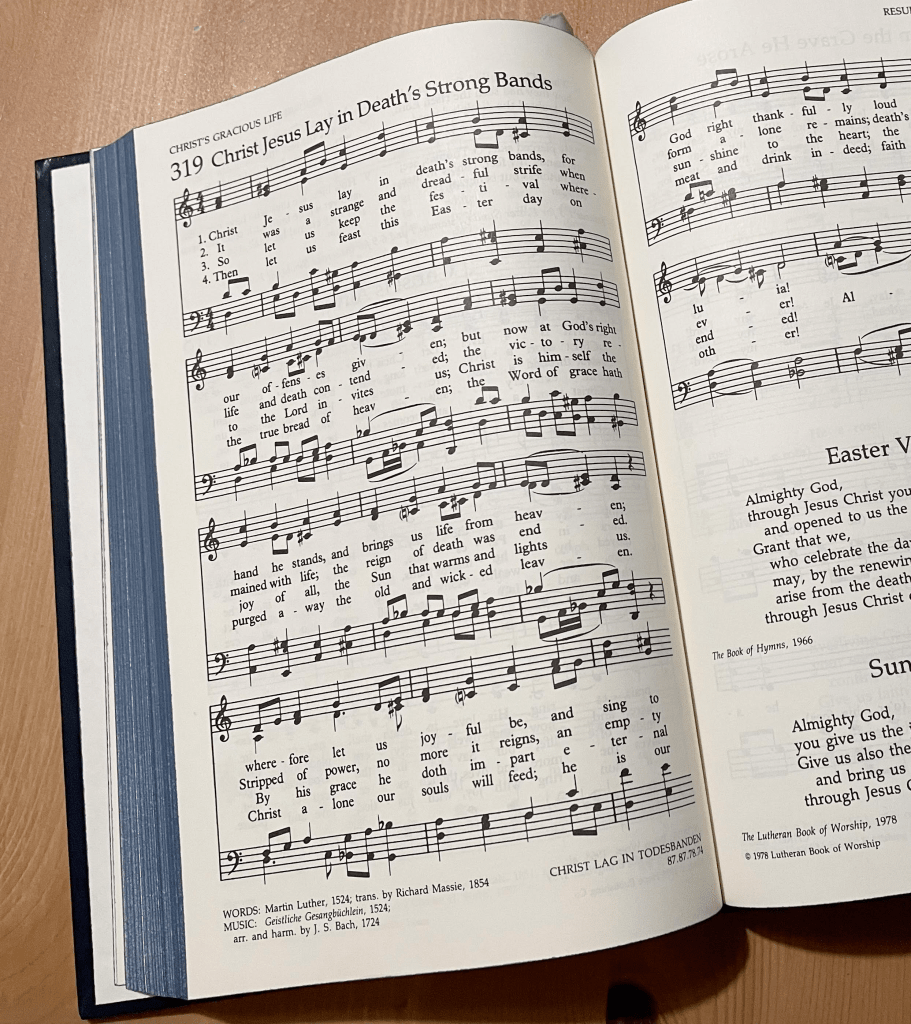
There’s one hymn that really stuck with me from that class: “Christ Jesus Lay in Death’s Strong Bands” by Martin Luther (sheet music and full copy of the lyrics here).  I have no idea how common this hymn is among Lutherans.  For all I know, they sing it every week.  Goodness knows Methodists know more than their fair share of Charles Wesley hymns.  However common it might be in other traditions, it was totally foreign to me, which means I could appreciate just how weird (and wonderful) it was. Here’s a great rendition by Concordia Publishing House:

First off, it’s an Easter song in A minor.  Who writes an Easter song in a minor key?  Easter is a celebration!  It’s glorious!  I don’t expect sad music!  But here’s Death’s Strong Bands, full of melancholy, proudly announcing Easter.  It’s a mix of joy and sorrow that I didn’t expect on Easter.

The lyrics have that same tension.  Just look at verse 1:

Christ Jesus lay in death’s strong bands
for our offenses given;
but now at God’s right hand he stands
and brings us life from heaven.
Therefore let us joyful be
and sing to God right thankfully
loud songs of alleluia! Alleluia!

The first two lines are intensely melancholy, so much so that I’m surprised by the heavenly triumph that follows! And before you say, “Hold on, Vincent!  What if Martin Luther was only saying something like ‘Christ died for us,’ in the first verse?  That could certainly be considered joyful,” hear me out.  The whole hymn vacillates between triumph and sorrow:

  • Verse two is about how all of humanity was enslaved to sin and death (mournful)

  • Verse three is about Jesus destroying death and taking its crown (triumphal)

  •  

    Verse four is about the “strange and dreadful strife” when good and evil fought and good won (triumphal, but with mournful undertones)

  • Verse five compares Jesus to the paschal lamb that died so his blood could save others (could be played either way; suffering love is a complex theme)

  •  

    Verse six and seven switch into high celebration, explicitly saying that it’s Easter and we should remember it with food, drink, and celebrations (highly triumphal)

When I talked to the class about this particular hymn, it turned out to be a lot less popular than I expected.  The most popular complaint was that it was just too gloomy to sing on Easter and too perky to sing on Good Friday. Maybe it could fit in on a Palm/Passion service? But even then you’d have to cut out the verse that explicitly says it’s Easter. It came off like a hymn with some problems that would need solved before it saw it’s day in Sunday worship.

Apparently the people who compiled the United Methodist Hymnal felt the same way.  They cut verses two, three, and five, removing the themes of death, sin, and atonement (the stuff we usually associate with Good Friday). What’s left is significantly more triumphal. Given that verse six and seven are the only two “very triumphal” verses, the percent of the hymn dedicated purely to celebration rockets up from 28% pre-edit to 50% post-edit. This is a common edit of the hymn shared by most mainline denominations and a few evangelical ones.

I can’t help but feel we’re losing something with edits like this. The tension between joy and sorrow and the battle between good and evil are what made the song interesting to begin with! If we ditch that, what are we left with? A weird, subpar Easter hymn that’s arbitrarily in a minor key. Gross. But I get what they were trying to do! They wanted to tip the balance between joy and sorrow in favor of joy! They wanted to resolve the tension and make it a little more Eastery! But resolving that tension made it boring and odd.

If were going to give it some tweaks to help it find a place in worship, a better solution (in my mind) is showcased by efforts like the band Koine. Rather than remove the tension between the celebratory stuff and the mournful stuff, they leaned into that tension. They removed verses 6 and 7 (the explicit references to Easter) and basically turned it into a Good Friday hymn:

Now that’s worth singing!  The minor key makes sense.  I get it.  The sweetness of salvation and the bitterness of Christ’s death are properly intermingled.  It feels a lot more loyal to Luther’s original intent as well. I can’t fathom someone asking him if they could ditch the stuff about Christ’s death and sin and him saying, “Oh, for sure!  Now that I think about it, it was a little gloomy.”  Not a chance.

I do have to admit that the original draft is definitely an odd hymn and a tough sell for Easter.  I almost wonder if you could split the verses and make two versions: the Good Friday edit would have verses 1 through 5, and the Easter Sunday edit would have verses 1, 6 and 7.  If you sang those different versions on their appropriate days during Holy Week, it might give a sense of continuing work that works really well. But maybe I’m working too hard to make an odd hymn work.  Or maybe I’m not properly appreciating what Martin did in the first place! Either way, this hymn’s mix of joy and sorrow hit me just right. I’ll keep pondering this hymn for weeks to come.

Easter Sermons, Augustine of Canterbury, and the Procession to the King of Kent

I preached my first Easter sermon this past Sunday, which was delightful. I hadn’t had the privilege of preaching on a holiday before (at least, not one of the big ones). Now that it’s over, I’m reflecting on the occasion. There are so many guests at churches on Easter. A lot of them have pretty minimal relationships with the Church. What do we show them to impress the importance of God on their hearts? How do we evangelize on big occasions like Easter?

Luckily for me, I stumbled across this reading from Bede’s Ecclesiastical History of England while auditing one of Matthew Hoskin’s classes at Davenant Institute (his blog is here and is brilliant, by the way).

Augustine of Canterbury (who is not the same person as Augustine of Hippo) was sent by Pope Gregory the Great to share the Gospel with the people in Kent (modern England). They set up a meeting with the king in the hopes of getting permission to evangelize throughout his territory. I can only imagine a meeting like that would be infinitely more stressful than giving an Easter sermon to a visitor-heavy crowd today. He needed translators! He needed to adhere to local sensibilities and codes of respect! If things went wrong, the King might not only decide to kick them out; he might decide to kill these obnoxious missionaries that were meddling where they ought not meddle. So what did he bring? What did he show the king of Kent to impress upon him the seriousness of this Christian faith?

They came… bearing a silver cross for their banner, and the image of our Lord and Savior painted on a board; and chanting litanies, they offered up their prayers to the Lord for the eternal salvation both of themselves and of those to whom and for whom they had come. When they had sat down, in obedience to the king’s commands, [they] preached to him, and his attendants there present the Word of life.

The Venerable Bede, Bede’s Ecclesiastical History of England, Ch. XXV

Can you imagine the spectacle of that procession? An envoy from Rome arrives complete with silver cross and marching chanters and all the (figurative) bells and whistles. It’d have been a breathtaking sight! More than that, Augustine is unapologetically offering up things that are otherworldly. He isn’t offering trade deals. There’s no promise of improved relationships with other kingdoms. He isn’t even explaining how fun the children’s ministry will be for the kingdom’s kids! All of the pageantry and splendor serve to create this little window into a world beyond our own. And it works! The king gives his approval for their activity in his realm.

I’m well aware that some of that procession is normative for the time and culture. I’m also sure that the average Easter visitor won’t have the same response to a crowd of monks chanting for their salvation that King Ethelbert did. As I continue to unpack my first Easter at the helm, I have to keep asking, how do we create a window into Heaven? How can we evangelize like Augustine of Canterbury and present the truth in a way that makes people stop and marvel?

What Did Jesus Write in the Dirt in John 8:1-11? Big Name Theologians Weigh In

While poking around some different articles on the treatment of women in Leviticus, I stumbled across some wacky interpretations of what Jesus wrote in the sand in John 8:1-11. Let me refresh your memory on that passage (with a verse from chapter 7 to make sure we don’t start in the middle of a sentence):

53 Then they all went home,

but Jesus went to the Mount of Olives.

At dawn he appeared again in the temple courts, where all the people gathered around him, and he sat down to teach them. The teachers of the law and the Pharisees brought in a woman caught in adultery. They made her stand before the group and said to Jesus, “Teacher, this woman was caught in the act of adultery. In the Law Moses commanded us to stone such women. Now what do you say?” They were using this question as a trap, in order to have a basis for accusing him.

But Jesus bent down and started to write on the ground with his finger. When they kept on questioning him, he straightened up and said to them, “Let any one of you who is without sin be the first to throw a stone at her.” Again he stooped down and wrote on the ground.

At this, those who heard began to go away one at a time, the older ones first, until only Jesus was left, with the woman still standing there. 10 Jesus straightened up and asked her, “Woman, where are they? Has no one condemned you?”

11 “No one, sir,” she said.

“Then neither do I condemn you,” Jesus declared. “Go now and leave your life of sin.”

What did Jesus write? It’s important enough that it’s referenced twice at crucial story moments, but apparently not important enough to tell us anything about it. I’ve heard people say he was writing a passage from Leviticus 20 indicating that BOTH people were supposed to be stoned, revealing that they would be breaking the law if they stoned her because they failed to produce both parties. Others have said that he was writing the names of every accuser along with the sins that they had recently committed. I’ve even heard that he drew a line in the sand for people to cross if they felt they were worthy. There are a lot of takes out there, but most of them aren’t really founded on much apart from one person’s random guesswork. What have the major theologians of the Christian tradition said about the writing in the sand?

Naturally, I started with Augustine (because you can never go too far wrong with Augustine). Luckily for me, he preached a series of sermons about the book of John and his take was customarily good. He suggested the trap the Pharisees laid was in making Jesus choose between gentleness and justice. If Jesus approved of the women’s death, he’d be the guy that condemned peasant women and his popularity would suffer. If he didn’t approve of her death, he was speaking against God’s justice and was officially a transgressor of the law! Jesus navigates the dilemma with his typical craftiness by taking neither option. But what about the finger writing?

You have heard, O Jews, you have heard, O Pharisees, you have heard, O teachers of the law, the guardian of the law, but have not yet understood Him as the Lawgiver. What else does He signify to you when He writes with His finger on the ground? For the law was written with the finger of God; but written on stone because of the hard-hearted. The Lord now wrote on the ground, because He was seeking fruit. You have heard then, Let the law be fulfilled, let the adulteress be stoned. But is it by punishing her that the law is to be fulfilled by those that ought to be punished? Let each of you consider himself, let him enter into himself, ascend the judgment-seat of his own mind, place himself at the bar of his own conscience, oblige himself to confess… Each looking carefully into himself, finds himself a sinner. Yes, indeed. Hence, either let this woman go, or together with her receive ye the penalty of the law… [H]aving struck them through with that dart of justice, [Jesus] deigned not to heed their fall, but, turning away His look from them, “again He wrote with His finger on the ground.” 

Augustine, Sermon on John Chapter VII. 40–53; VIII. 1–11

Brilliant! Rather than focus on non-existent content, he’s looking at the symbolism of the act itself. Why would Jesus write on the ground? Because God wrote the law on stone the first time, and now he’s writing on the ground. This is the same dust that people were created from. Were they fertile enough to bear fruit after all these years? Or were their hearts still hard as the rocks that the commandments were once written on? He even returns to his idea of gentleness by indicating that Jesus didn’t stare them down after the incident, shaming them for their sin. He just keeps writing. Really nice work here.

Other patristic authors are less worthy of sharing. John Chrysostom has a sermon series on John that deliberately skips over this particular story and a lot of ancient theologians (especially in the East) follow suit, leading some to believe that they had copies of John that didn’t contain these verses. In Against the Pelagians, Book 2, Jerome suggests Jesus was writing out the names of the accusers to to fulfill Jeremiah 17:13 “Those who turn away from you will be written in the dust,” (a passage which seems to have been intended to be more poetic than literal). By and large, Augustine’s logic seems to have been attractive. Thomas Aquinas carries it forward to the Middle Ages in his mega-commentary Catena Aurea and includes support from Venerable Bede and Alcuin of York to back him up.

In the Reformation, John Calvin comes out swinging against Augustine and approaches the story without interest in allegory:

By this attitude he intended to show that he despised them. Those who conjecture that he wrote this or the other thing, in my opinion, do not understand his meaning. Nor do I approve of the ingenuity of Augustine, who thinks that in this manner the distinction between the Law and the Gospel is pointed out, because Christ did not write on tables of stone, (Exodus 31:18,) but on man, who is dust and earth. For Christ rather intended, by doing nothing, to show how unworthy they were of being heard; just as if any person, while another was speaking to him, were to draw lines on the wall, or to turn his back, or to show, by any other sign, that he was not attending to what was said. Thus in the present day, when Satan attempts, by various methods, to draw us aside from the right way of teaching, we ought disdainfully to pass by many things which he holds out to us.

John Calvin, Calvin’s Commentary on John 13:1-11

Gone is the speculative symbolism! Instead, we have a Jesus that’s just not listening. Pharisees are coming around, asking questions that they already know the answer to, and Jesus just starts doodling in the sand. That’s how little he cares what they have to say. When he says “Let he who is without sin throw the first stone,” Calvin reads that as a deliberate reference to their own sinfulness. They know they aren’t being sincere. They’re scheming, conniving, wretched men trying to kill someone to prove their own point. It’s not that the law isn’t legitimate; it’s that they aren’t being legitimate, and they know it. Again, Calvin is sticking to the Scripture pretty thoroughly and avoiding wild speculation about the writing. Well done.

The Reformation seems to be a bit of a hinge in historical interpretation. After the Reformation, commentaries that I can find seem to take a more practical approach to the matter. The symbolic dimension is swallowed up by the practical. Some lean more heavily on WHY he wrote (to avoid meddling in politics, to calm people down, etc.) while others focus on WHAT he wrote (names, sins, passages of the law, etc.). John Wesley is one of the better big-name interpreters to marry the practical and the symbolic, but his notes are still ruthlessly pragmatic:

God wrote once in the Old Testament; Christ once in the New: perhaps the words which he afterward spoke, when they continued asking him. By this silent action, he,

1. fixed their wandering, hurrying thoughts, in order to awaken their consciences: and,
2. signified that he was not then come to condemn but to save the world.

John Wesley, Wesley’s Explanatory Notes on the New Testament, John 8:1-11

Obviously there are oodles of others well worth reading, but these were the ones that I thought were worthy of lifting up. They’re all respected enough for their words to carry weight, and each seems to represent the general stream of mainstream interpretation within their era.

Ultimately, I’m really pleased with what I found. I expected to find some really wacky stuff, but a shocking majority of commentators avoided wild speculation about the specifics of the writing and interpreted in light of the information that they had, rather than what they didn’t have. Frankly, that was my bias from the outset. If the Bible doesn’t say what Jesus wrote, it couldn’t have been all that important to the story (sorry Jerome). But really, it was phenomenal to see all the directions people went with it. I have a soft spot for that symbolic dimension. It emphasized the weight of each action within the passage in a way that was far beyond the mundane. So what did he write? Beats me. As much as I like Augustine, I’ll side with Calvin for the sheer delightful possibility of Jesus rolling his eyes and playing tic tac toe against himself in the dirt while they were trying to talk to him.

Christian Resentment and the Good News of Martyrdom

I’ve been reading a fair few cultural critiques lately (C.S. Lewis, Philip Rieff, Charles Taylor, Andrew Root, and Rod Dreher). Each of these authors is trying to articulate what makes faith in the modern world challenging and the cultural forces that make conversion so unlikely for the average Westerner. And honestly? It’s been kind of a bummer. To be clear, I think there’s immense value for Christians in each of these writers. To share the gospel effectively, we have to understand the people around us. What do they long for? What do they expect? What do they think is reasonable? What parts of the faith will they find to be a challenge? Given the massive cultural shift over the past 50 years, churches need to realize that the mission field has changed and they have to adapt to be effective ministers of the gospel. At the same time, reading these books repeatedly can breed a sense of desperation. It’s clear the Church no longer has the privileged status it once had.

Certain eras just had a tremendous energy around faith. For example, if you’ve ever read the diaries of old Methodist preachers from the earliest days of America, you know that their experiences are totally incomprehensible for a modern Christian. “I preached the gospel in a field today. Five-hundred were converted through the grace of God. Huzzah!” Seriously? How on Earth did you pull that off? To be fair, the diary entries tend to end in mass conversions or the preacher having tomatoes hucked at them, but still! There’s that sense that things are MOVING! Today, there’s not that same movement. Cultural critiques can help us put our finger on some of the factors that have made things harder, but they can’t make them go away. A truth that once seemed so obvious that people might convert on the spot is now so challenging for people to accept that there are active, identifiable cultural barriers preventing people from hearing that good news. It can all start to feel a little hopeless. When you put all those thinkers together, you end up with one massive decline narrative about Christianity in the West.

It’s not just reading philosophy that can lead you to feel hopeless. A lot of churches have pretty strong decline narratives themselves. Mind you, not all. There are some big churches that are doing very well for themselves! But converts to those churches are often drawn from smaller churches, rather than from the ranks of non-Christians. The shrunken churches that are left behind end up with a distinct decline narrative. “There used to be so many more people here.” “Those are the classrooms we don’t use anymore.” “What gets young people to go to church? Why aren’t they coming?” Again, some of this is good. Congregations need to look at the tough realities of their situation! But a lot of it feels hopeless. Looking at the bad is only helpful insofar as it can direct us to the good.

So where’s the hope for Christians in a post-Christian era? How can we stay excited when it feels like things are going downhill?

It can help to remember that the challenges we face aren’t anything near the persecutions that other believers have experienced. There are countries where you can get killed for being Christian. There are places where evangelizing is illegal. What we’re facing? It’s nothing compared to that. And so many of them didn’t face their harsh realities with hopelessness. They were joyful to suffer for the one they loved.

The Martyrdom of Polycarp is a beautiful second-century story of someone was joyful in the face of wild adversity. The culture that second-century Roman Christians were living in was openly hostile. If you couldn’t tell from the title, they killed Christians. In this particular account, they’re going to kill Polycarp (a Christian bishop) if he doesn’t deny his faith make a sacrifice to the emperor (spoiler: he doesn’t). Here’s a community that has EVERY REASON to be frustrated by the philosophy of their day and is facing challenges to ministry that we can’t even fathom— but they don’t express any hopelessness in the story. Just look at this excerpt:

All the martyrdoms, then, were blessed and noble which took place according to the will of God. For it becomes us who profess greater piety than others, to ascribe the authority over all things to God. And truly, who can fail to admire their nobleness of mind, and their patience, with that love towards their Lord which they displayed?— who, when they were so torn with scourges, that the frame of their bodies, even to the very inward veins and arteries, was laid open, still patiently endured, while even those that stood by pitied and bewailed them. But they reached such a pitch of magnanimity, that not one of them let a sigh or a groan escape them; thus proving to us all that those holy martyrs of Christ, at the very time when they suffered such torments, were absent from the body, or rather, that the Lord then stood by them, and communed with them.

Martyrdom of Polycarp, Ch. 2

They saw their bishop get stabbed to death by the authorities, and they’re praising God! Because God is in control. Even if circumstances are horrendous, they trust him. If he wants them to endure, they’ll do it with a smile. There’s not even a hint of fear. All of this is coming to pass because of God, and it will all turn out right because of God.

I’ll skip the bulk of the middle, but feel free to read it over at New Advent here if you’re curious.

After the story of Polycarp’s death, the final chapter ends with this:

We wish you, brethren, all happiness, while you walk according to the doctrine of the Gospel of Jesus Christ; with whom be glory to God the Father and the Holy Spirit, for the salvation of His holy elect, after whose example the blessed Polycarp suffered, following in whose steps may we too be found in the kingdom of Jesus Christ!

Martyrdom of Polycarp, Ch. 22

They wish their readers happiness. Not worldly happiness, but the kind of happiness that Polycarp had. The kind of happiness is the kind Paul felt when he wrote, “Christ will be exalted in my body, whether by life or by death. For to me, to live is Christ and to die is gain,” (Phil 1:20-21). Real happiness isn’t rooted in culture or circumstance; it’s rooted in God.

The world is different. Converting to Christianity isn’t the obvious choice. Going to church isn’t as common. We won’t likely won’t enjoy the cultural clout and full buildings that we used to, but the happiness that we’re aiming for was never in full buildings or philosophical ease. It’s in loving Jesus and trusting him no matter what.

C.S. Lewis’s Nerdy Poetry: The Country of the Blind

Most of my experience with C.S. Lewis comes from those approachable classics that sit on many a Christian’s bookshelf: The Screwtape Letters, Mere Christianity, A Grief Observed, The Great Divorce and a few others. Only recently have I started to see the more academic, professorial side of him. Books like The Discarded Image: An Introduction to Medieval Literature are way more intense than Narnia, and frankly, they’re a bit of a slog. And now, I found out the man wrote poetry! Not just any poetry either. He wrote the nerdiest poetry you’ll ever find. These poems were not intended for general audiences. They’re just a smart guy playing with ideas in verse. If you enjoy them, great! If you don’t get ’em or don’t like ’em, I don’t think he would particularly care. My current success rate of “getting” his poetry is about 70%. Some of them are loaded with mythology and theory that I’m not familiar with (especially the Greek mythology, which he clearly loves), but the ones that I do get are brilliant. I thought I’d share a couple of them on here along with my thoughts as I work through them.

The Country of the Blind
Hard light bathed them-a whole nation of eyeless men,
Dark bipeds not aware how they were maimed. A long
Process, clearly, a slow curse,
Drained through centuries, left them thus.

At some transitional stage, then, a luckless few,
No doubt, must have had eyes after the up-to-date,
Normal type had achieved snug
Darkness, safe from the guns of heavn;

Whose blind mouths would abuse words that belonged to their
Great-grandsires, unabashed, talking of light in some
Eunuch’d, etiolated,
Fungoid sense, as a symbol of

Abstract thoughts. If a man, one that had eyes, a poor
Misfit, spoke of the grey dawn or the stars or green-
Sloped sea waves, or admired how
Warm tints change in a lady’s cheek,

None complained he had used words from an alien tongue,
None question’d. It was worse. All would agree ‘Of course,’
Came their answer. “We’ve all felt
Just like that.” They were wrong. And he

Knew too much to be clear, could not explain. The words —
Sold, raped flung to the dogs — now could avail no more;
Hence silence. But the mouldwarps,
With glib confidence, easily

Showed how tricks of the phrase, sheer metaphors could set
Fools concocting a myth, taking the worlds for things.
Do you think this a far-fetched
Picture? Go then about among

Men now famous; attempt speech on the truths that once,
Opaque, carved in divine forms, irremovable,
Dear but dear as a mountain-
Mass, stood plain to the inward eye.

This one especially has consumed me as of late. I can’t help but read it and think about Jesus’s response to the disciple’s question: why do you speak in parables?

13 This is why I speak to them in parables:

“Though seeing, they do not see;
    though hearing, they do not hear or understand.

14 In them is fulfilled the prophecy of Isaiah:

“‘You will be ever hearing but never understanding;
    you will be ever seeing but never perceiving.
15 For this people’s heart has become calloused;
    they hardly hear with their ears,
    and they have closed their eyes.
Otherwise they might see with their eyes,
    hear with their ears,
    understand with their hearts
and turn, and I would heal them.’ (Matt 13:13-15)

I generally assume that Jesus wants everyone to understand what he’s saying. Sure, I might rail against visions of him that are altogether too polite and soft, but by no means do I assume he would intentionally make his points opaque to keep people from understanding them. And we could go back and forth trying to soften the impact of the verse by applying different theological methodology to it (after all, it does say that they closed their eyes first), but it seems like it would be almost impossible to erase the sense that not everyone will understand what Jesus is saying and that that is intentional (John Calvin is smiling down on this paragraph, I’m sure).

Lewis’s poem is right in this same vein. We still have people that do not see, but it’s not their own willfulness or crafty parables that are keeping them from seeing. They’ve shut their eyes for so long that their biology has shifted to accommodate their decision. Even if they wanted to see, they lack the capacity. Worse than that, they refuse to confront the reality of their own blindness. They’re happy to discuss the world with the small amount of people that can still see, but only insofar as they’re treated as complete equals. Whatever is being discussed is primarily understood as a matter of internal experience, rather than external truth. “Of course, we’ve all felt like that,” they croon, completely missing the simple fact that they haven’t. Every piece of information being shared is radically different from anything they’ve ever conceptualized, but rather than admit it, they just insist that they already know and continue on.

What a tremendous way to look at the modern shift in metaphysics. I can’t help but think of it in terms of pastoral expectations as they were laid out in Andrew Root’s, The Pastor in a Secular Age. In each era, Christians have expected different things from pastors. In the medieval era, the priest had power. Even if the whole service was in Latin and you didn’t quite understand how communion worked, the popular imagination had such a strong sense of God’s action and a dynamic range of entities beyond human senses that you knew he carried power. He was the bridge between this world and the next. In a magical world, the priest stood as an obvious and clear figure worthy of your attention. With the shift to Protestantism, there was a fundamentally new way of imagining metaphysics. Suddenly, it wasn’t just the priest that was responsible for navigating the path between this world and the next; it was the individual believer. You were responsible for what you believed! You had to devote yourself to the highest ideals of Christian life and take responsibility for your own faith if you wanted to please God. Here, we see this tremendous shift towards the pastoral ideal as a professor. People like Luther and Calvin are the obvious legendary figures in this tradition, but the example Root provides is Johnathan Edwards. According to legend, Johnathan Edwards studied and prayed for thirteen hours every day. And his congregation was happy! They wanted to understand the intricacies of the world around them and the claims that were being made in the Bible, so if the pastor preached an hour long sermon that relied on multiple commentaries and theological bigwigs? Awesome! Bring it on. These were people that strove to see. They wanted to know the nature of the universe, and no watery spirituality would be an acceptable substitute.

Root details a long history of philosophical shifts that slowly lead to modernity, but as we approach our own era, the assumptions about what a pastor does have totally shifted. A pastor does not tell objective truths. That’s what math and science are for! No, a pastor works in the realm of values. They tell you how to live a good life. They help you understand who you are. They belong in the humanities section of a university, not the sciences side. Their value comes from their ability to befriend people, reflect an identity for others to consider, and build a massive church with multiple satellites to reflect the vitality of the community. The ideal pastor is a mix between an entrepreneur and an instagram influencer, encouraging us to try on a way of living that will make us happy. We moved from a world in which the Church was expected to teach objective truths about the world around us to a world in which the church was expected to help us feel subjective somethings within ourselves.

Unfortunately for moderns, Scripture is devilishly difficult to cast as something that’s primarily concerned with subjective feelings. The whole of the book bursts with objective claims about creation! And yet, religious dialogue is often dominated by what feels right and how we can live moral, decent lives. Not that either of these are inherently bad things, of course, but when they’re uprooted from the metaphysical grounding of the objective claims that surround them, they wither and shift whatever way the wind blows. Our cultural hesitance to let the audacious claims of Scripture be what they are muddies them considerably and betrays a certain unwillingness to claim them as true knowledge. Christians and non-Christians alike are put into a position where truth is what we make of it. We fail to see the reality around us because we’re so busy constructing our own narrative that suits us.

We do not see.

Even the claims in Scripture start to look less and less like truth claims and more and more like “sheer metaphors” and “myths.” What if Jesus was not actually Jesus? What if he’s only intended to be a metaphor for humanity’s capacity for good? What if Jesus’s resurrection is no longer an actual resurrection, but a symbol intended to reflect the eternal resurrection of hope and goodness in the world? That slow erosion of the claim slowly eats away at it, giving more and more authority to us and less and less to the claim itself. Symbolic meaning can always be uncovered in an objective event, but once the event or story is stripped of objectivity, not only does it lose the core of its meaning, but the possibility for symbolism becomes infinite. Without any semblance of authority, the claim exists only to allow others an opportunity to create their own meaning. The “divine forms, irremovable” that were once so obvious and clear to every eye have become “symbols of abstract thought;” ideas to toy with and little more.

The ultimate consequence is a sort of de-evolution. Lewis never was shy about suggesting that things in the premodern world were better, and here he’s said it in an incredibly direct way. The people he’s considering aren’t portrayed as the same bipartite beings that were created in Genesis: “God formed a man from the dust of the ground and breathed into his nostrils the breath of life,” (Gen 2:7). Their descriptors lack that sense of divine spark. The language surrounding the blind creatures is primitive and earthy. They are “mouldwarps” with “fungoid” ways of describing things. They lack that spirit that separates them from the plants that preceded them.

And yet, the poem isn’t just a gripe about the good ‘ol days. At least, I don’t think it is. It’s profoundly melancholy. Some of these creatures still see. They see the grandeur of the stars, the waves, the human form, and the misty dawn. But even as they see the wonders around them, they have so few to to share it with. By the eyes they were given, they are able to see tremendous beauty, but they also become the bearers of an incredible sense of loneliness. What Christian in the postmodern era has not felt like that? Who has not lamented the inability of others to see the throngs of angels singing, the cloud of witnesses watching, the divine spark that lingers in every eye, and the glory of God in every rock? But attempts to uncover the transcendent turn shallow all too quickly. Even semi-regular churchgoers are all too often concerned with mere morality and tradition than the vibrant eternity around them, frustrating the Christian all the more. To see is to be lonely and burdened. How do you awaken others to the world?

Part of me wants to cut the intensity of the poem by suggesting that the claim isn’t quite what it is. It sounds hopelessly arrogant to claim to see when everyone else is blind. To say that you understand a reality that the rest of the world can only hopelessly grasp at until they are somehow granted sight is brash! But didn’t Jesus make those claims? Isn’t that the whole of the history of Christianity? Lewis has claimed to see, and while it would be more comfortable to mask the arrogance of claiming to know truth, it’s critically important for us to let his statement stand and consider it not as arrogance, but as humility in the face of a truth beyond himself.

No Story Left Untold: The Miracula of Engelhard of Langheim

In the long and decorated history of Christianity, there are a few figures that are especially well remembered: Augustine, Calvin, Wesley, Luther, Cranmer, Chrysostom, etc.  These are the names on the “A-tier” of history.   After all, they’re founding figures of whole denominations.  Calvin’s systematic theology holds up Reformed thinking.  Luther’s boldness brought about the advent of Protestantism.  Chrysostom’s liturgy is performed every Sunday in Eastern Orthodox churches.  If you’re from the tradition that these men helped create, there’s no doubt that you’re familiar with their works.

If you dip into the B-tier, the names still hold power, but they certainly haven’t achieved that pop recognition that the A-tier people have.  You have people like Cyril of Alexandria, Antony of Egypt, Origen of Alexandria, Julian of Norwich, and others like them.  Were they major figures in founding a denomination?  No, but they’re influential enough that someone in your congregation has heard of at least one of them.  They may even get their name dropped in a sermon or two.  One more tier down, we have names like Melancthon, Zwingli, and Bucer.  They tend to be viewed as supporting characters in other people’s stories, but specialists and scholars will be generally familiar with their work.  After all, how could they properly tell the full story of Luther without Melancthon or Calvin without Zwingli?  

We could keep going for ages, dipping into increasingly obscure people in the grand tier-system of historical clout, but I have to wonder: how many tiers down is someone like Engelhard of Langheim?

There are no English copies of his works.  He has no Wikipedia page.  He’s from that period of history after Augustine and before Luther that most Protestants treat as a no man’s land (1200 AD).  There’s a single book about him in English, and it’s pretty academic (Cistercian Stories for Nuns and Monks: The Sacramental Imagination of Engelhard of Langheim by Martha Newman).   Nevertheless, I rejoice in this little taste of Engelhard and I hope others will too, because he cared as little about the tier system of history as it seems to have cared about him, and he reminds us Christians to leave no story untold.

Engelhard was a Cistercian monk in what we now know as Germany.  His resume isn’t all that impressive.  He didn’t travel to Rome or do a lecture circuit.  His education was mediocre and based on a model that was quickly losing its legitimacy (his education was in terms of morality and grammar, rather the dialectical and philosophical focus that defined the emerging scholastic movement).  He did what most monks do and lived almost his entire life on the patch of land that was his monastery.  He was almost an abbot (head monk) of a monastery at one point, but the process that saw him get elected seems to have been deemed illegitimate by the Cistercian authorities, so he was deposed after a relatively short time at the helm.  Engelhard wasn’t the sort of person that makes the A-tier of Christian history books, but he was a storyteller.  In an era where churches were plunging into theory and beefing up their theological articulations, Engelhard kept telling stories about people that reflected God’s grace in the world.  People today tend to call his stories and those like them exempla (examples), but Engelhard called them historia (histories) or miracula (miracles).  Personally, I like miracula.  Why shouldn’t a story about God at work be something more than just an example?  Why can’t it be a miracle?

Engelhard’s miracula are incredibly rustic.  He uses the first person to frame them, and when he’s picked up a story from someone else, he’s sure to say so.  It’s almost as though you’re in the room with him, listening as he tells you the latest tales that have trickled down to him through letters and monastic conferences.  He clearly grew up in an oral culture and is dragging it with him into the written world.  He also doesn’t waste time telling stories that have already been told by others.  When someone asked him about his take on a particularly well-covered story, he replied:

I do not write it lest I put my hand into another’s field.  I recount stories that are untouched by others, for there are many; may they be useful!

EB  c. 8, fol. 53r. as cited in Newman, Cistercian Stories, 56. 

When asked to write the story of a particularly famous Cistercian (Bernard of Clairvaux), he showed no interest and protested that Bernard’s story was “already known in writing throughout the world.” (EB c. 28, fol. 70v. as cited in Newman, Cistercian Stories, 56). Old tales would not do for Engelhard.  He wanted to tell stories that had yet to be told, rather than dip into the A-tier of history to rehash what had already been done. God doesn’t just work through big shots; he’s working today in people that many of us have yet to hear of.

Here’s one of Engelhard’s miracula:

A necromancer from Spain tried to speak to a fellow necromancer that had died.  He used an elaborate ritual that he read directly from a book, careful not to speak a word that wasn’t printed on the page.  Sure enough, his friend rose, wearing a cloak that was covered in inky words.  Each of those words were the sins that he committed in life, and underneath the cloak was a fire, continually burning his flesh, and there’s nothing anyone can do to save him from his fate.  A little bit of the fire leaps out of the cloak and hits the hand of the living necromancer.  Terrified, the man asks his friend how he can avoid this fate.  The dead man responds that people from every walk of life were down in Hell, but there seemed to be less Cistercian monks than any other group.  The specter disappeared and the lone necromancer ran to a monastery to became a Cistercian.  

paraphrased from Newman, Cistercian Stories for Nuns and Monks, 57.

Engelhard says he heard this story from an abbot who heard it from the necromancer himself.  You might wonder why on Earth I chose to share a story that’s so dark in tone.  Why not share something chipper?  Who wants to hear weird stuff about necromancers and Hell?  Fair point, but I love how he weaves a critique of written culture into the story. Note how the the written word is inherently tied to death.  To summon a dead friend, you look in a book.  When the dead man arises, he’s bound by the words that defined him in life. It’s explicitly noted that nothing can change his fate. This is a man whose story has been told.  The living man is forced to flee the death of necromancy to find the living spirituality of the Cistercians, and in doing so, he abandons the static world of his books and becomes a storyteller himself.  If taken too simplistically, this merely suggests that writing is bad, which would make for a bizarre theme since Engelhard wrote the thing down himself.  No, I think Engelhard is critiquing the way we write more than the writing itself.  All too often, the written word is impersonal, cold, and concerned with endless retreads of what is considered acceptable. It is the stuff of necromancers, dredging up old specters and refusing to reflect life as we know it. It doesn’t have to be like this. When we write, we can lower our guards. We can drop our facade of impartiality to reveal that we’re just people reaching out to other people. Similarly, we aren’t obligated to dredge up the A-listers if we want credibility.  God works everywhere.  We can tell the stories that we’ve  heard in our own lives.  They’re just as good as those that have already been written down for ages.

I still remember coming across a history book written by one of the congregations I served that was very much in the spirit of Engelhard.  It had been written out on a typewriter and stapled together in days long passed, but it was just a treat to read.  The writers didn’t fall into that trap that so many do when they write out congregational history, focusing on names, dates, and numbers.  No, it was more of a series of miracula than anything else.  There was a tale about someone in the congregation whose prayers were so powerful, they ended a drought by praying for rain and thus saved the crops of the local farmers.  There was a tale about a preacher that gave sermons that were so short that he got a visit from a bishop.  “I tell them everything that I know!” the poor preacher protested.  The bishop responded, “Then we will have to give you more to say,” and gave him a ton of books and a plan to read them all.  By the time he was done with his readings, he became one of the best preachers they’d ever had.  Every story just oozed character.  Nobody could read that booklet without being reminded that God’s work is not far away, locked up in history’s A-tier.  It’s right here. People in the same communities that we occupy have done marvelous things, and we can too.  So why not take a moment today and jot down a miracula that deserves to be remembered?  Remind yourself and someone else of the God that is in our midst today.  As Engelhard would say, “there are many such stories; may they be useful.”