Letters from Luther: The Struggles (and Gifts) of Wartburg

The story of Martin Luther at the Diet of Worms is the stuff of legend.  Who could forget that grand moment in which he refused the emperor’s demands and cast his whole hope on the Gospel?   You can just imagine his voice resounding as he spoke those legendary words:

Unless I am convinced by testimonies of the Holy Scriptures or someone can reasonably prove to me that I have erred (for I believe neither in the pope nor councils alone, since it has been established that they have often erred and contradicted themselves), I am bound by the Scriptures which I have cited at length, and my conscience has been taken captive by the Word of God.  I am neither able nor willing to recant.  Here I stand.  I can do no other. God help me. Amen.

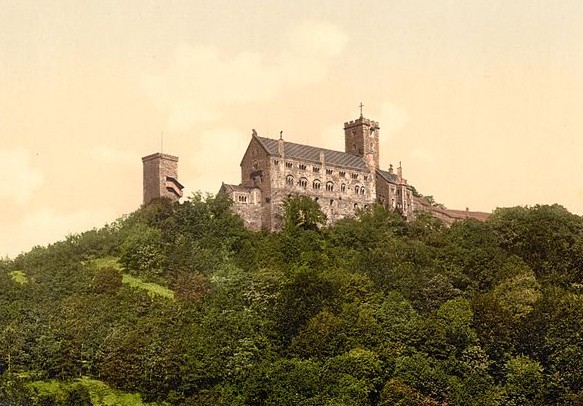
What happened after the drama died down—after the Pope declared him a heretic, the Emperor branded him an outlaw, and he was whisked away to Wartburg Castle by his protector, Frederick the Wise, for a year of hiding?  What happened in the heart of someone so bold when he was brought low and forced into solitude?  The letters he wrote during his time in exile give us the opportunity to see a side of him that we don’t often consider.  Of course, in some letters, we see the Luther we know.  We see the hero!  He gives orders to his supporters in the Protestant movement, he encourages them to push forward and risk martyrdom if necessary, and he continually redirects them towards the love of Christ.  It’s inspiring!  But alongside all of that wild courage, we see the man beneath the cape, so to speak.  We see Luther wrestling with frustration and depression.  We see him rethinking his identity as a monk, a son, and a Christian.  Best of all, we get to see him announce what he produced during his time in isolation, despite being burdened with all of that.  It’s that vulnerable side of Luther that I want to explore, because I think that’s something we can all relate to.  I don’t know that most of us have ever been the symbol of a Christian movement and responsible for rallying the troops, but we have had periods of loneliness, frustration, isolation and introspection.  How did Luther handle a moment like that?  And how can we be inspired to do the same?

The depths of Luther’s depression are especially clear in his communications with his friend and fellow Protestant leader, Philip Melancthon.  Even as he encourages Philip onward with complete assurance of the righteousness of their cause in the eyes of God, he shares just how difficult it is for him to be sidelined and forced into inaction.  He writes:

Instead of being ardent in spirit I am the prey of sinful appetites – laziness and love of sleep. For eight days I have neither prayed nor studied, through fleshly temptations. If I do not improve, I shall go to Erfurt and consult the physicians, for I can endure my malady no longer. (Letter to Philip Melancthon, May 12, 1521)

For a man that previously lived as a monk and spent hours every day praying the Liturgy of the Hours, that’s a vast departure from his norms.  Here is a famous professor, renowned for his writings and his hours spent in prayer, and he can’t get out of bed.  He refers to his pain elsewhere as “unbearable” and describes a prevailing numbness.  He should be weeping!  He should be worried about people that need the Gospel and are being opposed by the powers that be!  But instead, he finds himself quoting Psalm 89:47: “For what futility you have created all humanity!”  I can’t help but appreciate Luther’s use of the psalms here.  In some spaces in the modern Christian world, there’s this relentless push to smile and be happy that makes those darker psalms almost incomprehensible, but Luther draws on those words to faithfully express the very real pain that he’s experiencing at Wartburg.

That pain does prove helpful in giving him a fuller picture of himself.  It’s common to place the end of Luther’s time as a monk in 1524 or 1525 when he formally took off his monastic habit and married Katharina von Bora, but his writings very clearly show that what officially ended later was something that he had already come to terms with in a letter to his father during his stay at Wartburg.  Historically, his dad wasn’t a big fan of his decision to become a monk, but he came to terms with it because he loved his son.  He never apologized for his decision to become a monk, but the way he frames it isn’t the same anymore.  In his earlier writings, it’s his way of giving his life over to God.  And that’s still true… partially.  God did call him into monasticism earlier, but he did it so that Luther could see “the slavery it brings” firsthand and help others flee its clutches:

Dear father, do you ask me to renounce monkish orders? But – God has been before you, and has brought me out Himself… and has placed me, as thou seest, not in the miserable, blasphemous service of monachism, but in the true divine worship, for no one can doubt that I serve God’s Word…  Therefore I send you this book, from which you will see how miraculously Christ has redeemed me from my monkish vows, and endowed me with such freedom, that although I am the servant of all men, I am subject to Him alone. For He is my sole Bishop, Abbot, Prior, Lord, Father, Master! I know no other. I trust He has deprived you of your son, so that, through me, He may help the sons of many others and prevent you rejoicing alone.  (Letter to Hans Luther, November 21, 1521.)

He included a copy of On Monastic Vows with the letter, which explicitly talks about the dangers of monasticism, the ways in which it directly opposes God’s word, and encourages monks and nuns to leave the orders.  Until this point, Luther’s logic clearly points in this direction.  It’s not a wild deviation from his course of thought, but his time in Wartburg was more than just a bleak experience of pain.  It was an opportunity for him to ask, “How do I respond to this?  Who am I, and who do I need to be?” He synthesized some of what he had only hinted at previously into a full, cohesive idea that he’d later live out.

But the greatest gem is yet to come.  If you’re living out your own Wartburg moment, note that there were even greater treasures Luther forged in this season.  It was during his time at Wartburg that Luther gave the world one of his greatest contributions to the Reformation.  As he was emerging back into the public world in March of 1522, Luther wrote this to fellow reformer Georg Spalatin:

I have not only translated the Gospel of St. John in my Patmos, but the whole of the New Testament, and Philip and I are now busy correcting it, and, with God’s help, it will be a splendid work. Meantime we need your help, to find out proper words, therefore be ready to supply us with the common terms for some things we require, but not those used at Court, for this book is to be written in the simplest language that all may understand it[.] (Letter to Georg Spalatin, March 30, 1522)

In the middle of the depression, the frustration, and the self-examination, Luther had produced a full translation of the New Testament into German.  Until this point, most Bibles were in Latin, making them accessible only to scholars and nobles.  The Luther Bible in common German was one of the first accessible copies of the Bible to make its way into the everyman’s hands.

In the silence of isolation, the agony of self-examination, and the frustration of every circumstance, good things can happen.  Trust God in all circumstances, and in Luther’s words to Melancthon, “I am praying for you.  Pray for me, and let’s share this burden,” (Letter to Melancthon, May 12, 1521).
The Desert Fathers and Works Righteousness? Say it ain’t so!

In my last post, I mentioned that there were some theological tools I picked up from my mentor that I’m not sure I want to keep. For the most part, they’re Eastern Orthodox. Since I didn’t have classical Protestant thinkers at my fingertips when I connected with so many of these resources, they were great for that period of my life, but now that I’ve had some time to get a little more classical Protestant thinkers under my belt, I think it’s time to say goodbye to some of the things from my past that I have more disagreements with than I fully understood at the time.

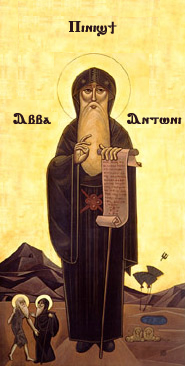
And this first one is a hard one: the Desert Fathers. SAY IT AIN’T SO! If you haven’t read The Sayings of the Desert Fathers before, let me just affirm that it is one of the most beautiful books I’ve ever read. Selections from this book were a part of my morning devotions for a long time. Here’s one of my favorites:

A brother came to see Abba Macarius the Egyptian, and said to him, ‘Abba, give me a word, that I may be saved.’ So the old man said, ‘Go to the cemetery and abuse the dead.’ The brother went there, abused them and threw stones at them; then he returned and told the old man about it. The latter said to him, ‘Didn’t they say anything to you?’ He replied, ‘No.’ The old man said, ‘Go back tomorrow and praise them.’ So the brother went away and praised them, calling them, ‘Apostles, saints and righteous men.’ He re- turned to the old man and said to him, ‘I have complimented them.’ And the old man said to him, ‘Did they not answer you?’ The brother said no. The old man said to him, ‘You know how you insulted them and they did not reply, and how you praised them and they did not speak; so you too if you wish to be saved must do the same and become a dead man. Like the dead, take no account of either the scorn of men or their praises, and you can be saved.’ (The Sayings of the Desert Fathers, trans. Benedict Ward, 132)

Isn’t that wonderful? Each of these sayings balance wittiness and wisdom, and they’re always focused on living Christianity, not just theorizing about it. I ran across this book for the first time while I was in seminary, studying abstract (and unorthodox) theories about how the Bible was written in my Bible class. I randomly plucked it off a shelf in the library, and when I opened it up? Boom. It felt like the Holy Spirit was right there next to me, encouraging me to live a Christian life, not just theorize about things that will never be edifying for real Christians.

As much as I love this collection of sayings, I’ve come to see its limitations. You can even see one of them in this piece. Did you catch what the man said when he asked for help? “Give me a word that I may be saved.” There’s only one word that can save you, dude, and that’s Jesus himself (Jn 1). And I know some would argue that I’m nitpicking here, since that little saying is just a standard part of the Desert Father’s story formula and there’s ways you can try to justify it, but on the whole, I think it’s pretty honest. A massive portion of the Desert Father’s stories are about how to develop a virtuous character, and they usually open with someone asking, “Father, give me a word that I might be saved.” A virtuous character is key to their understanding of salvation. And my logic here isn’t random or unfounded. The deadly edge of monasticism, as expressed by Luther so often and so clearly, is works righteousness. That’s incompatible with the Christian faith that you see in John 3:16 or Ephesians 2:8-9. There’s a big, glaring disagreement with most monastic literature and the Protestant battlecry of Sola Fide (by faith alone).

I may not have fully understood this when I picked up The Sayings, but it did rub off on me. I started reading more and more monastic literature, which pointed me towards Aristotle and his virtue-based ethics. His work is the philosophical underpinning of monastic thought. He argues that practicing good character traits consistently slowly molds you into a just person. I read up on that and thought it was pretty good! Just like the monks, really. So I decided to share my new leanings with my wife. I told her that Protestantism was probably a little wrong in parts. After all, it’s not just faith that makes you what you are! It’s what you do that molds you. It’s faith AND works that save you, when you think about it. Aristotle told me so.

While the monks would have approved of my thoughts, my wife certainly didn’t. She doesn’t often go all-out in arguments against me, but saying, “We might not be saved by faith alone,” was something she absolutely went all-out to defend. And I’m thankful that she did, because when your husband says, “I think Aristotle might be more right than the Bible,” you probably need to set him straight.

I’ve bounced back a lot since then. I’ve come to see that as much as I love the monks, they didn’t always focus on things in a way that reflects what the Bible clearly teaches. To use another Protestant phrase, I genuinely believe that Sola Scriptura (by Scripture alone) is true. Everything we need for salvation is in the Bible. Unfortunately, I can’t find anything that looks like what the Desert Fathers were doing. I think they have a logic to their actions that doesn’t reflect the heart of Scripture. Does that mean I think they’re all garbage? Absolutely not. But it does mean I think some of their emphases are a little off. If I want to read them, I have to be aware of the points where we diverge so I can get the best and leave out the worst.

So what to do with the Desert Fathers. Are they perfect? No, but here’s still a lot that I appreciate about them. I’ve just shifted my level of enthusiasm. Whereas historically, I would unapologetically have loved to do whole a sermon series that focuses on the Desert Fathers and their stories, now I’d rather keep Scripture at the center and maybe occasionally use them for a fun devotional or illustrative story. Am I throwing out these tools? Absolutely not. But they’ve gone from a core part of my toolbox that I used every day to some tools that stay up on their hooks until a special occasion comes out.

Theology Battle: Luther vs Erasmus

I get weirdly excited whenever I read about two theology legends having a showdown.  I probably shouldn’t.  It almost never ends well for one of them (see anyone who debated anything against Augustine), but seeing these legendary ideasmiths meet on the field of battle feels like a larger-than-life moment.  I guess it’s the theology geek’s equivalent of having an action movie with a showdown between Arnold Schwarzenegger and Dwayne Johnson; you know someone has to lose the exchange, but you’re gonna buy that ticket.

Recently, I’ve been poking around in Luther’s history and it turns out he had a showdown with the humananist scholar, Erasmus!  Today, Erasmus isn’t seen as in the same league as Luther, but in his time, he was a huge deal.  He was one of the most published authors in Europe, an international theological scholar, and a strong advocate for reform in the church.  Little did he know, Luther would experience a meteoric rise and end up eclipsing him in each of those categories.  Luther would be the author that legitimized the printing press, the scholar that would give a massive theological school it’s foundational logic, and the reformer that would kick off Protestantism.

Erasmus first heard about Luther when a mutual friend passed on a critique.  George Spelatin told him that an Augustinian monk friend of his was concerned about the way that he framed works and original sin in his translation of the New Testament.  At the time, Erasmus didn’t think much of it. And reasonably so! Imagine a young professor at the rinky-dinkiest community college sending a Harvard professor their critiques.  That’s the modern day equivalent.  But as time went on, Luther’s star rose and Erasmus’s waned.  Before too long, Erasmus wrote a book attacking Luther’s understanding of free will (De Libero Arbitrio) and Luther was the one to ignore the critique.  He said it was “an unlearned book from such a learned man,”(Brand Luther, p. 233) and didn’t bother to respond for five years.  When he finally did respond with his own book, Erasmus churned out another response as quickly as he could, but Luther just ignored him.  The once-mighty Erasmus was old news.

What happened? Why couldn’t these two fans of church reform get on the same page? And how did Luther crush him so easily?

Fans of both men paint their inability to cooperate as a matter of temperament.  Luther was a bombastic, larger-than-life fighter.  He was happy to verbally obliterate the church hierarchy when they were wrong, and he would fight until the end for what he thought was right.  He was also always finding ways to reach out to the everyman.  His bestselling pamphlets boiled down complicated theological ideas into little papers that anyone could read.  He was a parish priest as well as an academic.  To detractors, he was a populist demagogue, and to fans, he was a fiery prophet of the people. Either way, he was an unrelenting fighter, willing to give everything for what he loved.  To him, Erasmus was a naïve coward, hiding in an ivory tower:

[Erasmus is] not concerned for the cross but for peace thinks that everything should be discussed and handled in a civil manner and with a certain benevolent kindliness.
(Letter from Luther to Spalatin, Sept 9, 1921, as quoted in Brand Luther, 231)

Erasmus, on the other hand, was more moderate, patient, and renowned for his cleverness.  He wrote big books for people that were educated enough to read them.  His legendary wit was his best tool for reform.  He railed against the corrupt priesthood in veiled satire, and he wrote in Latin or Greek (the languages of the educated).  Even though he agreed with Luther on some points, he never entertained splitting from the Catholic Church.  This was his home.  He wouldn’t break from tradition and the path that the Fathers had passed down (even if things had gotten a bit muddled).  To him, Luther was a tradition-killer who was willing to warp all of Christianity to his will:

You stipulate that we should not ask for or accept anything but Holy Scripture, but you do it in such a way as to require that we permit you to be its sole interpreter, renouncing all others. Thus the victory will be yours if we allow you to be not the steward but the lord of Holy Scripture. (Hyperaspistes, Book I, Collected Works of Erasmus, Vol. 76, pp. 204–05.)

Naturally, two men as different as this would come to different conclusions about the right course of action in the face of religious corruption.

There are lots of other differences between these two that could be key as well.  One emphasized the power of God, the other focused on the capacity of men.  One signaled an emerging nationalist sentiment, the other was an international figure.  One divided the church over doctrine, while the other longed for internal reform. 

In modern conversation, I’ve noticed that this showdown is heavily politicized.  Liberal readers associate Erasmus with some kind of proto-secularism that emphasized behavior over religious doctrine, while they see Luther as a small-minded populist.  More conservative readers see Luther as a man of integrity, standing for religious liberty, and Erasmus as a sniveling puppet of the bureaucracy, happy to speak in safe, smart circles about how he’d like change, but too cowardly to do anything that put him at risk.  Frankly, both views reek of more interest in modern politics than the Christian past.  Like him or not, Erasmus legitimized Luther and paved the way for the Reformation with his cries about corruption and demands for reform.  Even if he never jumped ship, he was crucial. You lose a key player in the religious landscape of the time if you cut him out. And a 15th century medieval priest like Erasmus said and did things that would make a modern secular humanist cringe.  A lot of his complaints were also echoed and escalated by Luther. These people are from their own times, not ours.  Modern caricatures equating these two to modern political stances are almost always inaccurate and lazy.

But I suppose we all have to understand their story on terms that make sense to us.  I’m still wrestling with their little scuffle myself!  Strangely, I feel closer to Luther, but I imagine I’d probably get along better with Erasmus.  Part of that is probably Protestant pride.  Sola scriptura and all that, right?  Luther’s reputation certainly hasn’t hurt him either.  He’s a hero! There’s something admirable about risking your life for what you believe.  Luther putting his blood on the line makes Erasmus’s scathing quill look kinda wimpy in comparison.  On the other hand, it’s hard to not lament over the divisions in Christianity, and Luther decisively struck the blow that would shatter the establishment.  Was it worth it?  Was Rome so irredeemably corrupt that division was the only solution with any integrity? Or was Erasmus an unheard prophet for unity that the reformers desperately needed to hear?

I’m not sure where I fall in the end. I love so many of the gifts that Protestantism has brought, but I lament the divisions that came with it.  Both men are heroes in their own right, even if only one made it to popular history books. Luther definitively won the day and brought so many wonderful things, but maybe Erasmus’s cry for tradition and unity needs to be heard today by the thousands of denominations that represent the children of the Reformation.

If you want to know more about these two, check out Andrew Pettegree’s Brand Luther or Michael Massing’s Fatal Discord.