Christian Whimsy

This is a brief departure from my current series. I’ve been chipping away at the fundamentalist/modernist debates, but this came up and it was too fun not to write about.

I don’t know that Christianity is usually associated with whimsy.  Sure, you have your happy-clappy Christians that play guitar while they sing who are a good deal more relaxed than their high church counterparts, but even they’re pretty serious in the grand scheme of things.  They seriously implore people to love their neighbor.  They seriously talk about the need to emulate Jesus.  Though they may be chipper and informal, they’re still not exactly playful on average.  Whimsy seems not to come naturally when your centerpiece is a crucified God.  That’s the thing I love about the Christian apologist G.K. Chesterton. He taps into a level of whimsy that is so rare within Christian communities. 

For example, in his book Orthodoxy, he recalls an incident in which he was working in a publishing house and his boss had just turned someone’s manuscript down.  This boss muttered, “He’ll be ok.  He believes in himself.”  Chesterton promptly argued that point with him:

Shall I tell you where the men are who believe most in themselves? For I can tell you. I know of men who believe in themselves more colossally than Napoleon or Caesar. I know where flames the fixed star of certainty and success. I can guide you to the thrones of the Super-men. The men who really believe in themselves are all in lunatic asylums.

(Ch. 2, Orthodoxy, Chesterton)

Sure enough, when we’re logical about it, when recognize that believing in ourselves doesn’t actually make us any more likely to succeed than anyone else.  Every would-be pro-athlete and aspiring instagram influencer believes in themselves.  Some delusionally so!  We’ve all known someone who has no ability to sing and yet insists that they will be the next great pop-star.  We’ve all known someone who wrote “the next great American novel” without being able to handle simple sentence structure.  But telling them that they won’t hit it big won’t change their plans one iota.  Why?  Precisely because they believe so strongly in themselves.

Our individualist society says that if you believe in yourself, you’ll get somewhere, but Chesterton takes that secular dogma and flips it on its head.  Logically, we are the least trustworthy people when it comes to evaluating our own ability.  We’re incredibly biased, either for or against ourselves.  We need to believe in something more secure than our own ego.

He does the same flip with our faculty of reason.  We assume that if you use your reason, you’ll figure things out sooner or later.  But how flawed is that assumption?  Some of the most rational people in the world are the least reasonable:

If a man says (for instance) that men have a conspiracy against him, you cannot dispute it except by saying that all the men deny that they are conspirators; which is exactly what conspirators would do. His explanation covers the facts as much as yours. Or if a man says that he is the rightful King of England, it is no complete answer to say that the existing authorities call him mad; for if he were King of England that might be the wisest thing for the existing authorities to do. Or if a man says that he is Jesus Christ, it is no answer to tell him that the world denies his divinity; for the world denied Christ’s.

Ch. 2, Orthodoxy, Chesterton

Again, the tables are turned!  We assume that a keen sense of rationality can make sense of the world, but none of the people in this scenario are illogical!  They all make perfect sense!  And yet, we know they’ve reached the wrong conclusions.

The world we’ve constructed in our minds is far too narrow.  We assume that we need to set out with our brain and our ego to conquer a largely stagnant world.  But in the process, we miss all of the delightful joy that surrounds us.  For example, we fail to celebrate the greenness of a leaf.  We all assume that leaves ought to be green because they’re always green.  But what if that leaf were polka-dotted?  Or puce?  Or teal?  Why not?  Things could have been any way imaginable!  And yet, the leaf is green.  What a delight!  What a pure, unpredictable delight to see the greenness of a leaf and know that it could have been any other way, but it is green.  It’s only our own self-centeredness that stops us from seeing the joy in that leaf!  We assume that things are the way they are because “logically” that’s what they have to be.  Or we assume that the green leaves are just backdrops for our grand story that we’re responsible for making.  But these leaves are more than that!  Once we start to delight in the crazy random joy of green leaves, we can start to wonder, why are they like that?  Is it all just mechanistic detail to be relegated to the background?  Or is there a joyful logic to it?  Is there a god that happens to delight in green leaves?

The world we live in is so dreary.  There’s so rarely anything greater than ourselves.  We are expected to go out in all of our power and make something out of both ourselves and this mixed-up world.   But Chesterton tells us to stop.  There’s so much more at work in this world than what our little minds can perceive.  Rather than drawing the limits at our own horizons, he invites us to rediscover a world infinitely larger than our own perception.  A world in which a green leaf is a miracle and in which we are a tiny speck in the plans of an infinite God.

Chesterton’s works are all in the public domain, so if you’re intrigued, check out a free copy of his work on Amazon or google.  And if you don’t have the time for a new read right now, reawaken your sense of whimsy.  Don’t believe the narrow constraints that modern philosophy places on the world.  The good news of Christianity isn’t all somber.  A creative, world-creating God is real, and he’s in charge of every little thing you see.  That truth makes mundane existence more of a fairy tale than you might expect.

One Point Per Parable: Julicher is Overrated

I knew a pastor that used to preach that every parable had precisely one meaning. They never explained why that was the case. Of course, making declarations like that from the pulpit isn’t uncommon. Pastors have a terrible habit of just kind of declaring that their school of thought is self-evident and there’s no other possibilities out there. Or worse yet, they use the dreaded, credibility-grabbing phraise “scholars say…” Which scholars? Why do they say that? What are my other options? Don’t get me wrong, I get the instinct. Sermons aren’t intended to be a comprehensive history of religious thought. At the same time, I do wonder how often we cause problems by not fully explaining why we’re preaching what we are. In any case, I just assumed the “one point per parable” idea was a weird quirk of that pastor and ignored it. Until now. Lo and behold, I found the history of the idea. And it turns out the guy behind the theory was pretty influential! But not quite as influential as many claim.

Adolf Julicher was the guy who started telling people that there was “one point per parable.” He’s a 19th century German professor. I stumbled across the name while I was reading Kenneth Bailey’s Jesus through Middle Eastern Eyes (which is a phenomenal resource for anyone looking to learn about Middle Eastern culture and Christ, by the way). He cited Julicher’s work as the fundamental turn away from the allegorical approach which dominated thought in the medieval era. This would be a pretty major accomplishment. Allegorical interpretations are often pretty weird to modern eyes. For example, Bailey points to Augustine interpreting the parable of the Friend at Midnight (Luke 11:5-13). In that particular parable, Jesus tells everyone to imagine trying to knock on their neighbor’s door to borrow three loaves of bread at midnight. What would your neighbor say? Probably nothing nice. But if you keep pestering them, eventually they’ll get out of bed and give you some bread. He follows up with some of his classic thoughts on prayer: “Ask and it will be given to you; seek and you will find,” (Lk 11:9). Augustine reads this story and says that the person waking up in the story is actually intended to represent anyone who is seeking meaning in life. They’re up at midnight because they’re so world-weary and desperately seeking something more. The friend is Scripture, which we should always go to in times of need. And the bread? That’s the life-giving knowledge of the trinity. Needless to say, it’s a bit of a stretch. (If you want to know more about the best and the worst of the allegorical approach, see my posts on the best of it and the worst of it)

Adolf Julicher is presented as the anti-allegorist. He says Jesus told parables not to obscure the meaning of things, but to make them clear. Jesus wasn’t some kind of weirdo mystic; he was just a relatable storyteller trying to get simple points across. Consequently, there are no hidden meanings in parables. They have one meaning, and it should be obvious.

I’m sure some of you are thinking, “Hold up! But Jesus was specifically asked why he kept speaking in parables and he said:”

Because the knowledge of the secrets of the kingdom of heaven has been given to you, but not to them. Whoever has will be given more, and they will have an abundance. Whoever does not have, even what they have will be taken from them. This is why I speak to them in parables:

“Though seeing, they do not see;
though hearing, they do not hear or understand.”

Matt 13:11-13

Fair point. That passage definitely favors the allegorists more than Julicher. But that’s where Julicher’s modernist background comes across the strongest. The modernists were a group that thought the core of religion had been corrupted by centuries of mythology and tradition, and it had to be recovered by stripping away the weird parts of religious doctrine to get back to the pure ideas of Jesus. Julicher is right in those footsteps. He says that the apostles were all wrong about the parables. They quoted them out of context. They mythologized them way more than Jesus intended. They didn’t understandJesus at all. Rather than take him at face value and accept him as a sweet, simple rabbi that could help them grow, they mythologized him and made it incredibly complicated for the modern person to see the true simplicity that Jesus was getting at. What Julicher sees in Scripture is a sort of fanciful take on the true idea that was planted by the original Jesus:

The authenticity of the Gospel parables is not absolute. They did not emerge from the mouth of Jesus as we now read them. They are translated, displaced, and internally transformed. . . . Without careful examination, one can nowhere identify the voice of Jesus with voices of the Gospel authors.

Jülicher 1963: I.11. as cited at
https://parablesreception.blogspot.com/2015/08/adolf-julicher-1857-1938.html

As you can tell, Julicher’s comes with a lot of baggage. If we’re seriously claiming to rely on his work as a cornerstone of our own thought, we’ve got this whole, “Don’t trust the Bible, it’s full of misunderstandings,” overtone above everything else. We are forced to fumble through the mistakes of the authors when we pick up our Bibles, rather than to be informed about anything we didn’t come in with. We end up on this quest for a historical Jesus, which is ironically different from the story of Jesus that came down to us through history. Because that guy does miracles and was the son of God, and that’s just silly.

Is this really the cornerstone of modern parable interpretation? It seems like a lot of people out there think so. Not only did Bailey directly contrast him with the allegorical approach, citing him as the cure for the past’s goofiness, but a lot of professors in seminaries out there seem to hold up Julicher as the start of contemporary parable scholarship. And I think they’re wrong. If you’re a theological modernist, Julicher is absolutely core to that tradition, but there are a lot of Protestants out there who certainly aren’t intellectual descendants of Julicher and somehow avoid the highly allegorized approach. To know why, we need to look between these two eras to find a school of thought that was infinitely more influential and far less controversial.

What happened between the Middle Ages and the modern era? The Reformation! You know, that big period where people specifically started avoiding allegorical readings and focusing on what Jesus meant in his context when he said things. It was that era in which John Calvin and Martin Luther dominated. To be fair to Julicher, he seems to have suggested that these men were on the right track before their followers delved back into allegory, but I don’t think he’s right. To the contrary, I think that the fundamentals of the Protestant Reformation set out a path that’s normative for most Protestant preachers to this day. Let’s use Calvin as an example. Just glance through Calvin’s commentaries on any parable. He’s consistently logical (by modern Protestant standards). He pays attention to the cultural context and the implications of the words in Greek. He often gains several meanings from a parable, but they’re ideas that all seem theologically connected to the circumstances at hand and the major themes Jesus is speaking to. Calvin does all this without devolving into the fullness of allegorical wackiness. When he looks at the warning from Jesus that parables are deliberately unintelligible to some people, he doesn’t read that at a license to go wild speculating about the hidden meaning, nor does he dismiss it as a piece of obscurantism from some befuddled disciples. He goes in a different direction:

 These words were intended partly to show that all were not endued with true understanding to comprehend what he said, and partly to arouse his disciples to consider attentively that doctrine which is not readily and easily understood by all. Indeed, he makes a distinction among the hearers, by pronouncing some to have ears, and others to be deaf. If it is next inquired, how it comes to pass that the former have ears, Scripture testifies in other passages, that it is the Lord who pierces the ears, and that no man obtains or accomplishes this by his own industry.

Calvin’s Commentary on Matthew, ch. 13 v. 9

The challenge in understanding the parable is that no person is capable of understanding any part of God’s truth on their own. Only through God’s grace are we capable of understanding any of it. Anyone listening to the parables without the grace of God hears little more than nonsense. And just to make sure Arminians out there aren’t outraged by the choice of Calvin as normative, I gave Wesley a quick check and he says almost the same thing with the caveat that all people could listen to that grace, but some won’t because they’re so stuck in their worldly ways. Either way, the assumption that the parables are generally capable of being explored through logic and knowledge of Jesus’ cultural context and are ultimately legitimized through faith made possible by grace is pretty normative for most of the sermons on parables I’ve ever heard. And that methodology was around way before Julicher.

I hate to contribute to creating these big categorizations in history. It’s always unpleasant dividing thinkers between different eras. Whenever we categorize things, we inevitably simplify them to a degree that rarely does justice to the subject matter. Nevertheless, I was delighted to find Julicher and solve the mystery of where that pastor got the “one point per parable” theory, but I do think it’s necessary to keep a wider scope when considering his legacy. He’s not the first one to advocate intensely for less allegorized approaches to the parables, nor is he the most popular. He’s got his place in his tradition, for sure. But it’s not quite as massive as the average article seems to claim.

Apologies for the indirect citations for Julicher. Most of his key stuff remains in German, so it’s tough to get at. If you want to know more, check out this site, which has links to some great secondary sources in English and even one in German: https://virtualreligion.net/primer/julicher.html.

The Flight of Gregory Nazianzen and the Challenge of New Beginnings

It’s been ages since I last posted. Life has been crazy. I’ve gone from being the associate pastor at Bexley UMC to the pastor at The Plains UMC. I moved about an hour and a half south for the new position and, right now, all of my life is in boxes. Needless to say, I’ve not had a lot of spare time for reading.

Once I got a moment to myself, naturally, I wanted to find a saint who had been through the same sort of challenges and read up about how they handled their big transition. I landed on one of my favorites: Gregory of Nazianzus. This is the fourth post I’ve written about him. Previously, I’ve written about his poetry, his take on theosis, and his refreshing melancholy in the face of the modern obsession with happiness, but this is the first time I’ve ventured out of the poetry of his retirement years.

In his younger days (32), Gregory was chosen for ordination a priest. His dad (also named Gregory) was the local bishop in Nazianzus and he found his son’s help invaluable in his ministry. His son managed to help him navigate the political and doctrinal challenges of the Arian Creed of 359 (Gregory Senior signed on as a supporter of a heretical creed and made a bunch of enemies until his son convinced him to apologize and withdraw his support), and besides that, he was incredibly capable as a theologian and pastoral care provider. Unfortunately, Gregory Jr. had no interest in actually being a priest. He wanted to be a monk! His ordination moved forward anyway, which was kind of a thing at the time. Ancient theologians are always getting priest-ed without wanting it. It’s humility trope—the most suitable person to put in power was supposed to be the guy who is too humble to want it. It’s usually reasonable to assume it’s being exaggerated for the sake of a good story. In Gregory’s case, it’s safe to assume he REALLY didn’t want to be ordained. He ran away for a few months, leaving his church really peeved at him, and after he finally did return, he called his ordination a “noble tyranny” in his first sermon (Or. 1, par. 1). If he was just trying to come off as humble, he went a little too hard.

In any case, Gregory was someone who knew what it was like to have his life uprooted for the Church and learned to thrive in the midst of it. How did he do it? I picked through his first two orations. The first is the sermon he gave when he returned to Nazianzus on Easter after a few months of hiding. The second is something he wrote to explain himself when people weren’t so thrilled with him after he returned (nobody came to church for a while in protest—church politics never change). I found a few gems in each.

The first one was certainly the lesser of the two. He doesn’t dwell much on his flight and spends most of the time talking about Easter. Don’t get me wrong, I’m glad he didn’t make the Easter sermon all about him. That’s a great move. At the same time, I’m here for that juicy personal drama. The fact that it’s not here limited my interest. Nevertheless, I liked his biggest reference to his flight:

A Mystery anointed me; I withdrew a little while at a Mystery, as much as was needful to examine myself; now I come in with a Mystery, bringing with me the Day as a good defender of my cowardice and weakness; that He Who to-day rose again from the dead may renew me also by His Spirit; and, clothing me with the new Man, may give me to His New Creation, to those who are begotten after God, as a good modeller and teacher for Christ, willingly both dying with Him and rising again with Him.

Or. 1, par. 2

How eloquent! I appreciate his willingness to name his flaws. To call yourself a weak coward is pretty intense! But he didn’t shy away. It wasn’t that the task was too great; it’s that his courage failed him and he needed to step away and reevaluate himself. God’s grace is enough to cover it.

There are also several references to mysteries. As I read it, the first mystery appears to be his ordination. He withdrew because of the weight of the sacrament bestowed on him. Now, he returns proclaiming a second mystery, which is the mystery of the resurrection of Jesus and the new life bestowed on us all. By this promise, even one who was a coward can be born into the new man that God desires.

The second oration was a little juicier. This one wasn’t a sermon and was explicitly intended as an explanation of his absence, so I got pages upon pages of him giving personal details about his challenge in facing a big transition. This is what I came here for. It starts out:

I have been defeated, and own my defeat. I subjected myself to the Lord, and prayed unto Him.

Or. 2 par 1

What a bombastic opening. He immediately reasserts the best of what he said in his sermon for those who didn’t attend worship that day. Why was I gone? Because I was at war with God. I have laid down my weapons and been defeated. I am subjecting myself to him. I’m no longer running. I’m digging in.

In the ensuing paragraphs, he discusses his respect for God’s sacred order, his meager qualifications, and his emotions through it all. The big crescendo of his argument builds as he points to the duty of a priest:

[T]he scope of our art is to provide the soul with wings, to rescue it from the world and give it to God, and to watch over that which is in His image, if it abides, to take it by the hand, if it is in danger, or restore it, if ruined, to make Christ to dwell in the heart by the Spirit: and, in short, to deify, and bestow heavenly bliss upon, one who belongs to the heavenly host.

Or. 1, par. 22

He goes all out after this, going on for paragraphs about how this is, “the wish of the prophets and the law…why God was united to the flesh by means of the soul…why the new [covenant] was substituted for the old…” etc. (or 2, par 23-25). This is, in his eyes, the summation of it all. The whole of the job of a priest is to assist God in healing the core essence of a person. In light of this incredible duty, how could anyone be surprised that he balked for a moment? And yet, he ultimately accepts his new priestly responsibilities, saying, “I fell down and humbled myself under the mighty hand of God… now I am commissioned to exalt Him in the congregation of the people and praise Him in the seat of the elders,” (or 2, par. 115). What once seemed like a terrifying possibility is now a duty. The weight of the task may be heavy, and the responsibility unexpected, but he now recognizes that it has fallen to him to glorify God in this way. God put him in this place. Who is he to argue? And who is any detractor to deny him this place that God gave to him?

I don’t know that a lot of modern people can relate deeply to being stolen away from the monastery and ordained against their will, but Gregory still lays out a lot of great principles that are worth embodying. First, he’s honest! He owns his initial shortcoming and doesn’t try to cover it up. The whole thing could have been a total disaster, but he acknowledges his mistakes (something especially difficult when you’re under immense pressure) and ends up making the whole thing a moment that reflects the weightiness of God’s calling and the heights of God’s mercy. More importantly, he learns to trust God all the more after being called to something new. Big transitions are hard. It’s easy to get nervous, upset, frustrated, weirded-out, etc. But God isn’t just randomly switching things up. He’s placed us exactly where we are for the sake of our own holiness and the deification of those around us. Sometimes we might get negative. It’s certainly not ideal, but even some of the greats had their moments of despair. We need to bounce back and recognize the importance of the duties he’s given us. The heights of what God calls us to are greater than anything we could possibly imagine for ourselves.

I hope I can keep the spirit of post-flight Gregory as I adjust to my new setting down here in The Plains. I know God put me here for a reason, and I hope I can do work that brings him glory.

God is Red: Zhang Yinxian and True Discipleship

Back when I was first trying to find good books about Christianity, I went to my local library and grabbed whatever was on the shelves. One of those books happened to be Liao Yiwu’s God is Red, a series of interviews with people who endured persecution in communist China around the time of the Cultural Revolution. It made quite the impression on me. Specifically, the story of Zhang Yinxian was one that I never forgot.

Zhang was an orphan that became a nun at the cathedral of Dali in the Yunnan province. That church was MASSIVE. There were over 400 that lived in the church complex and thousands who came from throughout the province to worship. All of that changed when the communists took over. Church property was confiscated. Worshipers renounced their faith to avoid punishment from the government. Out of thousands who worshiped, only three remained faithful: Zhang, her Aunt Li, and Bishop Liu.

They were beaten. They were imprisoned. They were released as pariahs at the bottom of the social ladder with few opportunities to avoid poverty. On top of all that, they had to endure mass denunciations. They would be trotted out in front of crowds that would spit at them and scream about how narrow-minded and backwards they were and how they were leeches on society. They endured all of that for thirty-one years.

In 1983, the Communist Party changed policies. Certain religions were now acceptable. People could worship freely. Church property would gradually be returned. Zhang, Li, and Liu were given modest apartments… but that wasn’t enough for them. They went to the local statehouse and started a hunger strike until they got their church back. The people that passed by them weren’t sympathetic: “You oughta be grateful for what you got! Be more patriotic!” But they stayed and they prayed and waited. A government official spoke with them and told them that they’d get their church back but these sorts of things took time. They said, “Thank goodness, because we’re hungry and we can’t eat until we have our church back. Here’s to hoping its soon!” The official got furious and called them greedy for demanding a massive building for just three people. They just said that it wasn’t for them; it was for God. They wanted to go to his house and worship him.

After 31 years of persecution, they got their church back. Thousands once worshiped there, but after thirty-one years of persecution, only three remained. There may have been a big crowd at that sanctuary, but there were only three real disciples.

Would I have been one of those three? I hope so, but I also know that I can’t fathom how hard it would have been to endure. Only an unshakable faith can endure trials like that, and an unshakable faith doesn’t just spring up by accident. It takes deliberate training and constant nurture. How can we help make disciples like Zhong, Li, and Liu? And how can we become disciples like that? I don’t know. But that mental image of little old Aunt Li getting spat on and screamed at while she loved Jesus has certainly stuck with me. Here’s to hoping I can be as faithful as she was.

An Odd Mix of Joy and Sorrow: Christ Jesus Lay in Death’s Strong Bands

A few weeks back, I wrapped up a class about hymns at the church.  We looked back at how music was used in worship throughout the ages and looked at some particularly famous hymns along the way.  If you’re interested in that kind of thing, we used the book Then Sings My Soul: Book 3 by Thomas Nelson, which is not only approachable and concise, but does a nice job of blending history and music. 

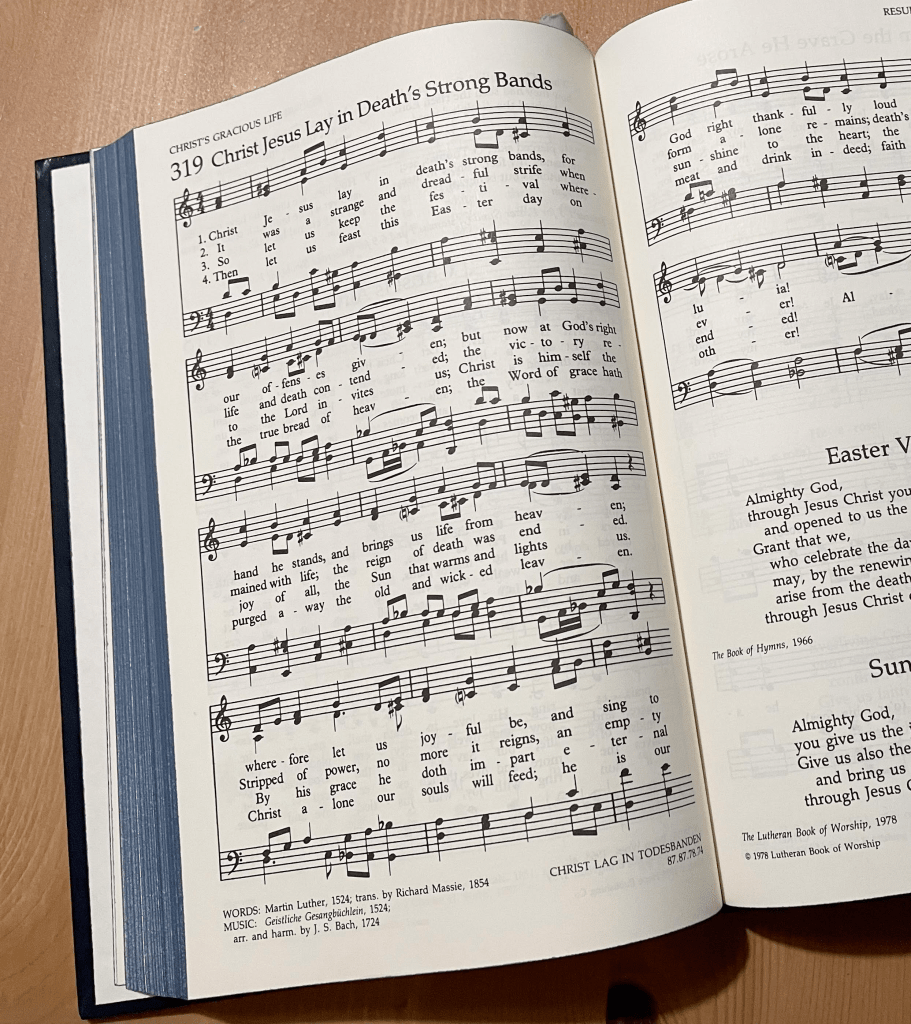
There’s one hymn that really stuck with me from that class: “Christ Jesus Lay in Death’s Strong Bands” by Martin Luther (sheet music and full copy of the lyrics here).  I have no idea how common this hymn is among Lutherans.  For all I know, they sing it every week.  Goodness knows Methodists know more than their fair share of Charles Wesley hymns.  However common it might be in other traditions, it was totally foreign to me, which means I could appreciate just how weird (and wonderful) it was. Here’s a great rendition by Concordia Publishing House:

First off, it’s an Easter song in A minor.  Who writes an Easter song in a minor key?  Easter is a celebration!  It’s glorious!  I don’t expect sad music!  But here’s Death’s Strong Bands, full of melancholy, proudly announcing Easter.  It’s a mix of joy and sorrow that I didn’t expect on Easter.

The lyrics have that same tension.  Just look at verse 1:

Christ Jesus lay in death’s strong bands
for our offenses given;
but now at God’s right hand he stands
and brings us life from heaven.
Therefore let us joyful be
and sing to God right thankfully
loud songs of alleluia! Alleluia!

The first two lines are intensely melancholy, so much so that I’m surprised by the heavenly triumph that follows! And before you say, “Hold on, Vincent!  What if Martin Luther was only saying something like ‘Christ died for us,’ in the first verse?  That could certainly be considered joyful,” hear me out.  The whole hymn vacillates between triumph and sorrow:

  • Verse two is about how all of humanity was enslaved to sin and death (mournful)

  • Verse three is about Jesus destroying death and taking its crown (triumphal)

  •  

    Verse four is about the “strange and dreadful strife” when good and evil fought and good won (triumphal, but with mournful undertones)

  • Verse five compares Jesus to the paschal lamb that died so his blood could save others (could be played either way; suffering love is a complex theme)

  •  

    Verse six and seven switch into high celebration, explicitly saying that it’s Easter and we should remember it with food, drink, and celebrations (highly triumphal)

When I talked to the class about this particular hymn, it turned out to be a lot less popular than I expected.  The most popular complaint was that it was just too gloomy to sing on Easter and too perky to sing on Good Friday. Maybe it could fit in on a Palm/Passion service? But even then you’d have to cut out the verse that explicitly says it’s Easter. It came off like a hymn with some problems that would need solved before it saw it’s day in Sunday worship.

Apparently the people who compiled the United Methodist Hymnal felt the same way.  They cut verses two, three, and five, removing the themes of death, sin, and atonement (the stuff we usually associate with Good Friday). What’s left is significantly more triumphal. Given that verse six and seven are the only two “very triumphal” verses, the percent of the hymn dedicated purely to celebration rockets up from 28% pre-edit to 50% post-edit. This is a common edit of the hymn shared by most mainline denominations and a few evangelical ones.

I can’t help but feel we’re losing something with edits like this. The tension between joy and sorrow and the battle between good and evil are what made the song interesting to begin with! If we ditch that, what are we left with? A weird, subpar Easter hymn that’s arbitrarily in a minor key. Gross. But I get what they were trying to do! They wanted to tip the balance between joy and sorrow in favor of joy! They wanted to resolve the tension and make it a little more Eastery! But resolving that tension made it boring and odd.

If were going to give it some tweaks to help it find a place in worship, a better solution (in my mind) is showcased by efforts like the band Koine. Rather than remove the tension between the celebratory stuff and the mournful stuff, they leaned into that tension. They removed verses 6 and 7 (the explicit references to Easter) and basically turned it into a Good Friday hymn:

Now that’s worth singing!  The minor key makes sense.  I get it.  The sweetness of salvation and the bitterness of Christ’s death are properly intermingled.  It feels a lot more loyal to Luther’s original intent as well. I can’t fathom someone asking him if they could ditch the stuff about Christ’s death and sin and him saying, “Oh, for sure!  Now that I think about it, it was a little gloomy.”  Not a chance.

I do have to admit that the original draft is definitely an odd hymn and a tough sell for Easter.  I almost wonder if you could split the verses and make two versions: the Good Friday edit would have verses 1 through 5, and the Easter Sunday edit would have verses 1, 6 and 7.  If you sang those different versions on their appropriate days during Holy Week, it might give a sense of continuing work that works really well. But maybe I’m working too hard to make an odd hymn work.  Or maybe I’m not properly appreciating what Martin did in the first place! Either way, this hymn’s mix of joy and sorrow hit me just right. I’ll keep pondering this hymn for weeks to come.

Easter Sermons, Augustine of Canterbury, and the Procession to the King of Kent

I preached my first Easter sermon this past Sunday, which was delightful. I hadn’t had the privilege of preaching on a holiday before (at least, not one of the big ones). Now that it’s over, I’m reflecting on the occasion. There are so many guests at churches on Easter. A lot of them have pretty minimal relationships with the Church. What do we show them to impress the importance of God on their hearts? How do we evangelize on big occasions like Easter?

Luckily for me, I stumbled across this reading from Bede’s Ecclesiastical History of England while auditing one of Matthew Hoskin’s classes at Davenant Institute (his blog is here and is brilliant, by the way).

Augustine of Canterbury (who is not the same person as Augustine of Hippo) was sent by Pope Gregory the Great to share the Gospel with the people in Kent (modern England). They set up a meeting with the king in the hopes of getting permission to evangelize throughout his territory. I can only imagine a meeting like that would be infinitely more stressful than giving an Easter sermon to a visitor-heavy crowd today. He needed translators! He needed to adhere to local sensibilities and codes of respect! If things went wrong, the King might not only decide to kick them out; he might decide to kill these obnoxious missionaries that were meddling where they ought not meddle. So what did he bring? What did he show the king of Kent to impress upon him the seriousness of this Christian faith?

They came… bearing a silver cross for their banner, and the image of our Lord and Savior painted on a board; and chanting litanies, they offered up their prayers to the Lord for the eternal salvation both of themselves and of those to whom and for whom they had come. When they had sat down, in obedience to the king’s commands, [they] preached to him, and his attendants there present the Word of life.

The Venerable Bede, Bede’s Ecclesiastical History of England, Ch. XXV

Can you imagine the spectacle of that procession? An envoy from Rome arrives complete with silver cross and marching chanters and all the (figurative) bells and whistles. It’d have been a breathtaking sight! More than that, Augustine is unapologetically offering up things that are otherworldly. He isn’t offering trade deals. There’s no promise of improved relationships with other kingdoms. He isn’t even explaining how fun the children’s ministry will be for the kingdom’s kids! All of the pageantry and splendor serve to create this little window into a world beyond our own. And it works! The king gives his approval for their activity in his realm.

I’m well aware that some of that procession is normative for the time and culture. I’m also sure that the average Easter visitor won’t have the same response to a crowd of monks chanting for their salvation that King Ethelbert did. As I continue to unpack my first Easter at the helm, I have to keep asking, how do we create a window into Heaven? How can we evangelize like Augustine of Canterbury and present the truth in a way that makes people stop and marvel?

What Did Jesus Write in the Dirt in John 8:1-11? Big Name Theologians Weigh In

While poking around some different articles on the treatment of women in Leviticus, I stumbled across some wacky interpretations of what Jesus wrote in the sand in John 8:1-11. Let me refresh your memory on that passage (with a verse from chapter 7 to make sure we don’t start in the middle of a sentence):

53 Then they all went home,

but Jesus went to the Mount of Olives.

At dawn he appeared again in the temple courts, where all the people gathered around him, and he sat down to teach them. The teachers of the law and the Pharisees brought in a woman caught in adultery. They made her stand before the group and said to Jesus, “Teacher, this woman was caught in the act of adultery. In the Law Moses commanded us to stone such women. Now what do you say?” They were using this question as a trap, in order to have a basis for accusing him.

But Jesus bent down and started to write on the ground with his finger. When they kept on questioning him, he straightened up and said to them, “Let any one of you who is without sin be the first to throw a stone at her.” Again he stooped down and wrote on the ground.

At this, those who heard began to go away one at a time, the older ones first, until only Jesus was left, with the woman still standing there. 10 Jesus straightened up and asked her, “Woman, where are they? Has no one condemned you?”

11 “No one, sir,” she said.

“Then neither do I condemn you,” Jesus declared. “Go now and leave your life of sin.”

What did Jesus write? It’s important enough that it’s referenced twice at crucial story moments, but apparently not important enough to tell us anything about it. I’ve heard people say he was writing a passage from Leviticus 20 indicating that BOTH people were supposed to be stoned, revealing that they would be breaking the law if they stoned her because they failed to produce both parties. Others have said that he was writing the names of every accuser along with the sins that they had recently committed. I’ve even heard that he drew a line in the sand for people to cross if they felt they were worthy. There are a lot of takes out there, but most of them aren’t really founded on much apart from one person’s random guesswork. What have the major theologians of the Christian tradition said about the writing in the sand?

Naturally, I started with Augustine (because you can never go too far wrong with Augustine). Luckily for me, he preached a series of sermons about the book of John and his take was customarily good. He suggested the trap the Pharisees laid was in making Jesus choose between gentleness and justice. If Jesus approved of the women’s death, he’d be the guy that condemned peasant women and his popularity would suffer. If he didn’t approve of her death, he was speaking against God’s justice and was officially a transgressor of the law! Jesus navigates the dilemma with his typical craftiness by taking neither option. But what about the finger writing?

You have heard, O Jews, you have heard, O Pharisees, you have heard, O teachers of the law, the guardian of the law, but have not yet understood Him as the Lawgiver. What else does He signify to you when He writes with His finger on the ground? For the law was written with the finger of God; but written on stone because of the hard-hearted. The Lord now wrote on the ground, because He was seeking fruit. You have heard then, Let the law be fulfilled, let the adulteress be stoned. But is it by punishing her that the law is to be fulfilled by those that ought to be punished? Let each of you consider himself, let him enter into himself, ascend the judgment-seat of his own mind, place himself at the bar of his own conscience, oblige himself to confess… Each looking carefully into himself, finds himself a sinner. Yes, indeed. Hence, either let this woman go, or together with her receive ye the penalty of the law… [H]aving struck them through with that dart of justice, [Jesus] deigned not to heed their fall, but, turning away His look from them, “again He wrote with His finger on the ground.” 

Augustine, Sermon on John Chapter VII. 40–53; VIII. 1–11

Brilliant! Rather than focus on non-existent content, he’s looking at the symbolism of the act itself. Why would Jesus write on the ground? Because God wrote the law on stone the first time, and now he’s writing on the ground. This is the same dust that people were created from. Were they fertile enough to bear fruit after all these years? Or were their hearts still hard as the rocks that the commandments were once written on? He even returns to his idea of gentleness by indicating that Jesus didn’t stare them down after the incident, shaming them for their sin. He just keeps writing. Really nice work here.

Other patristic authors are less worthy of sharing. John Chrysostom has a sermon series on John that deliberately skips over this particular story and a lot of ancient theologians (especially in the East) follow suit, leading some to believe that they had copies of John that didn’t contain these verses. In Against the Pelagians, Book 2, Jerome suggests Jesus was writing out the names of the accusers to to fulfill Jeremiah 17:13 “Those who turn away from you will be written in the dust,” (a passage which seems to have been intended to be more poetic than literal). By and large, Augustine’s logic seems to have been attractive. Thomas Aquinas carries it forward to the Middle Ages in his mega-commentary Catena Aurea and includes support from Venerable Bede and Alcuin of York to back him up.

In the Reformation, John Calvin comes out swinging against Augustine and approaches the story without interest in allegory:

By this attitude he intended to show that he despised them. Those who conjecture that he wrote this or the other thing, in my opinion, do not understand his meaning. Nor do I approve of the ingenuity of Augustine, who thinks that in this manner the distinction between the Law and the Gospel is pointed out, because Christ did not write on tables of stone, (Exodus 31:18,) but on man, who is dust and earth. For Christ rather intended, by doing nothing, to show how unworthy they were of being heard; just as if any person, while another was speaking to him, were to draw lines on the wall, or to turn his back, or to show, by any other sign, that he was not attending to what was said. Thus in the present day, when Satan attempts, by various methods, to draw us aside from the right way of teaching, we ought disdainfully to pass by many things which he holds out to us.

John Calvin, Calvin’s Commentary on John 13:1-11

Gone is the speculative symbolism! Instead, we have a Jesus that’s just not listening. Pharisees are coming around, asking questions that they already know the answer to, and Jesus just starts doodling in the sand. That’s how little he cares what they have to say. When he says “Let he who is without sin throw the first stone,” Calvin reads that as a deliberate reference to their own sinfulness. They know they aren’t being sincere. They’re scheming, conniving, wretched men trying to kill someone to prove their own point. It’s not that the law isn’t legitimate; it’s that they aren’t being legitimate, and they know it. Again, Calvin is sticking to the Scripture pretty thoroughly and avoiding wild speculation about the writing. Well done.

The Reformation seems to be a bit of a hinge in historical interpretation. After the Reformation, commentaries that I can find seem to take a more practical approach to the matter. The symbolic dimension is swallowed up by the practical. Some lean more heavily on WHY he wrote (to avoid meddling in politics, to calm people down, etc.) while others focus on WHAT he wrote (names, sins, passages of the law, etc.). John Wesley is one of the better big-name interpreters to marry the practical and the symbolic, but his notes are still ruthlessly pragmatic:

God wrote once in the Old Testament; Christ once in the New: perhaps the words which he afterward spoke, when they continued asking him. By this silent action, he,

1. fixed their wandering, hurrying thoughts, in order to awaken their consciences: and,
2. signified that he was not then come to condemn but to save the world.

John Wesley, Wesley’s Explanatory Notes on the New Testament, John 8:1-11

Obviously there are oodles of others well worth reading, but these were the ones that I thought were worthy of lifting up. They’re all respected enough for their words to carry weight, and each seems to represent the general stream of mainstream interpretation within their era.

Ultimately, I’m really pleased with what I found. I expected to find some really wacky stuff, but a shocking majority of commentators avoided wild speculation about the specifics of the writing and interpreted in light of the information that they had, rather than what they didn’t have. Frankly, that was my bias from the outset. If the Bible doesn’t say what Jesus wrote, it couldn’t have been all that important to the story (sorry Jerome). But really, it was phenomenal to see all the directions people went with it. I have a soft spot for that symbolic dimension. It emphasized the weight of each action within the passage in a way that was far beyond the mundane. So what did he write? Beats me. As much as I like Augustine, I’ll side with Calvin for the sheer delightful possibility of Jesus rolling his eyes and playing tic tac toe against himself in the dirt while they were trying to talk to him.

Heroes of Old… and Me! Jerome’s De Viris Illustribus

While I was doing a little more digging on Polycarp, I ran across an account of him in Jerome’s De Viris Illustribus (aka On Illustrious Men). According to Jerome, Polycarp was a student of the Apostle John, which delighted me to no end. What a neat little detail! The Biblical era is so often made it’s own little self-contained thing, so when you see those moments where apostles interacted with the generations that followed, it just makes their work seem infinitely more real. They weren’t just storybook characters; they actually lived, met people, taught them, and made leaders in the early Church. Of course, it’s not undisputed. As with all ancient history, some people think it’s true, and some people think it’s false. This particular claim has some heavy hitters weighing in behind it (Tertullian, Irenaeus, Eusebius, and Jerome) and the timelines totally line up, but ancient history is always a little sketchy. There just aren’t those ironclad sources that you have today. This meme sums it up nicely:

The sources we have in this case are a little stronger than a cousin’s friend’s dream, but you get the picture. Modernity favors exactitude, whereas ancient history is full of legends. Me? I think it’s reasonable to say that Polycarp and John met. Polycarp was a notable bishop in modern Turkey that lived through the first and second centuries. John the Apostle would have been alive and in modern Greece. It makes sense that they would have interacted. Between the timeline, the geography, and the sources, it works.

But that wasn’t the only treat in De Viris Illustribus. It had a few other treasures that are worth sharing, one which is Jerome trying to determine the authorship of various Biblical books. De Viris Illustribus is basically a who’s who of people who wrote noteworthy books for the Church. Naturally, Jerome starts with the New Testament writers, which quickly leads to conversations about who wrote what. After all, how can you bring up Paul and his writings without saying what he wrote? So did Paul actually write Hebrews? Did Peter write 2 Peter? Jerome doesn’t seem to buy either. Which is kind of nice, actually. Even though Jerome isn’t 100% sure about the authorship, he still considers the books canonical and crucial for Christians. In the modern era, questions about authorship often feels like a litmus test to see if you’re really a real Christian. It’s nice to see that things aren’t always as black and white as we think. Great saints have asked questions that we might reject offhand today. Maybe we can afford to be a little gentler when such matters come up.

I also just appreciated the nature of the book itself. Like I said, it’s a list from a big-shot theologian saying who wrote things worth your attention in the Church world. That’s something that’s shockingly rare in the modern era! If you don’t go to seminary, you may not know who is worth reading and who isn’t. I remember being a new Christian and just kind of buying Christian books at random, hoping that they were legit. A lot of what I got wasn’t worth reading. People need to know who is worth engaging with! And Jerome doesn’t pull any punches either. This isn’t a little list of authors who are comfortable and safe. There are heretics on this list! There are non-Christians! Mind you, he tells his readers why each source is worth reading and warns them about what they are, but the point stands that he’s not just filling people up with his own ideas. He’s preparing them for a greater conversation in the world at large.

Finally, I think it’s just nice to have a list of heroes. Some of the details in here are a blast! For example, he says that James the Just prayed so often that his knees “had the hardness of camel’s knees,” (Ch. 2). He says that Ignatius of Antioch’s last words before he was martyred in the arena were “I am the grain of Christ. I am ground by the teeth of the wild beasts that I may be found the bread of the world,” (Ch. 16). Polycarp is said to have met one of the first big heretics of the Church (Marcion) while they were both trying to prosthelytize in Rome and their meeting sounds like something straight out of a movie. Marcion walks up to him and asks, “Do you know us?” Polycarp responds “I know the firstborn of the devil,” (Ch. 17). Not only are these great Christians and great thinkers, but they ooze personality. Jerome even adds himself to the list as the final person of note, which is hilarious. I’d call him out for being cocky, but since his writings have survived since the fourth century, I have to admit that he wasn’t wrong.

In any case, it was a joy finding this old list of heroes worth reading. Feel free to check it out here if you demand more, or make your own list. Share it with your fellow Christians at church! Who knows how it might help someone? But a word to the wise: probably don’t add yourself as the last person on the list.

Christian Resentment and the Good News of Martyrdom

I’ve been reading a fair few cultural critiques lately (C.S. Lewis, Philip Rieff, Charles Taylor, Andrew Root, and Rod Dreher). Each of these authors is trying to articulate what makes faith in the modern world challenging and the cultural forces that make conversion so unlikely for the average Westerner. And honestly? It’s been kind of a bummer. To be clear, I think there’s immense value for Christians in each of these writers. To share the gospel effectively, we have to understand the people around us. What do they long for? What do they expect? What do they think is reasonable? What parts of the faith will they find to be a challenge? Given the massive cultural shift over the past 50 years, churches need to realize that the mission field has changed and they have to adapt to be effective ministers of the gospel. At the same time, reading these books repeatedly can breed a sense of desperation. It’s clear the Church no longer has the privileged status it once had.

Certain eras just had a tremendous energy around faith. For example, if you’ve ever read the diaries of old Methodist preachers from the earliest days of America, you know that their experiences are totally incomprehensible for a modern Christian. “I preached the gospel in a field today. Five-hundred were converted through the grace of God. Huzzah!” Seriously? How on Earth did you pull that off? To be fair, the diary entries tend to end in mass conversions or the preacher having tomatoes hucked at them, but still! There’s that sense that things are MOVING! Today, there’s not that same movement. Cultural critiques can help us put our finger on some of the factors that have made things harder, but they can’t make them go away. A truth that once seemed so obvious that people might convert on the spot is now so challenging for people to accept that there are active, identifiable cultural barriers preventing people from hearing that good news. It can all start to feel a little hopeless. When you put all those thinkers together, you end up with one massive decline narrative about Christianity in the West.

It’s not just reading philosophy that can lead you to feel hopeless. A lot of churches have pretty strong decline narratives themselves. Mind you, not all. There are some big churches that are doing very well for themselves! But converts to those churches are often drawn from smaller churches, rather than from the ranks of non-Christians. The shrunken churches that are left behind end up with a distinct decline narrative. “There used to be so many more people here.” “Those are the classrooms we don’t use anymore.” “What gets young people to go to church? Why aren’t they coming?” Again, some of this is good. Congregations need to look at the tough realities of their situation! But a lot of it feels hopeless. Looking at the bad is only helpful insofar as it can direct us to the good.

So where’s the hope for Christians in a post-Christian era? How can we stay excited when it feels like things are going downhill?

It can help to remember that the challenges we face aren’t anything near the persecutions that other believers have experienced. There are countries where you can get killed for being Christian. There are places where evangelizing is illegal. What we’re facing? It’s nothing compared to that. And so many of them didn’t face their harsh realities with hopelessness. They were joyful to suffer for the one they loved.

The Martyrdom of Polycarp is a beautiful second-century story of someone was joyful in the face of wild adversity. The culture that second-century Roman Christians were living in was openly hostile. If you couldn’t tell from the title, they killed Christians. In this particular account, they’re going to kill Polycarp (a Christian bishop) if he doesn’t deny his faith make a sacrifice to the emperor (spoiler: he doesn’t). Here’s a community that has EVERY REASON to be frustrated by the philosophy of their day and is facing challenges to ministry that we can’t even fathom— but they don’t express any hopelessness in the story. Just look at this excerpt:

All the martyrdoms, then, were blessed and noble which took place according to the will of God. For it becomes us who profess greater piety than others, to ascribe the authority over all things to God. And truly, who can fail to admire their nobleness of mind, and their patience, with that love towards their Lord which they displayed?— who, when they were so torn with scourges, that the frame of their bodies, even to the very inward veins and arteries, was laid open, still patiently endured, while even those that stood by pitied and bewailed them. But they reached such a pitch of magnanimity, that not one of them let a sigh or a groan escape them; thus proving to us all that those holy martyrs of Christ, at the very time when they suffered such torments, were absent from the body, or rather, that the Lord then stood by them, and communed with them.

Martyrdom of Polycarp, Ch. 2

They saw their bishop get stabbed to death by the authorities, and they’re praising God! Because God is in control. Even if circumstances are horrendous, they trust him. If he wants them to endure, they’ll do it with a smile. There’s not even a hint of fear. All of this is coming to pass because of God, and it will all turn out right because of God.

I’ll skip the bulk of the middle, but feel free to read it over at New Advent here if you’re curious.

After the story of Polycarp’s death, the final chapter ends with this:

We wish you, brethren, all happiness, while you walk according to the doctrine of the Gospel of Jesus Christ; with whom be glory to God the Father and the Holy Spirit, for the salvation of His holy elect, after whose example the blessed Polycarp suffered, following in whose steps may we too be found in the kingdom of Jesus Christ!

Martyrdom of Polycarp, Ch. 22

They wish their readers happiness. Not worldly happiness, but the kind of happiness that Polycarp had. The kind of happiness is the kind Paul felt when he wrote, “Christ will be exalted in my body, whether by life or by death. For to me, to live is Christ and to die is gain,” (Phil 1:20-21). Real happiness isn’t rooted in culture or circumstance; it’s rooted in God.

The world is different. Converting to Christianity isn’t the obvious choice. Going to church isn’t as common. We won’t likely won’t enjoy the cultural clout and full buildings that we used to, but the happiness that we’re aiming for was never in full buildings or philosophical ease. It’s in loving Jesus and trusting him no matter what.

Recovering the Sacred: C.S. Lewis, Philip Rieff, and the Cleveland Museum of Art

A while back I wrote about my visit to the Cleveland Museum of Art and my reaction to all of their Mary-oriented medieval art. Today, I want to think about the bigger journey that gallery was a part of. As I walked through the museum, it was wildly apparent that the artistic ideal of society was deteriorating as each age passed. For example, let’s look at something from the medieval exhibit:

Crucified Christ, late 1300s

The point of the piece is immediately apparent: this is what the world is all about. Not only does it clearly present an ideal in the person of Jesus and the event of his crucifiction, but you can tell it’s a piece that the public was intended to interact with. It belongs in a church with people worshipping nearby. This is a sign intended to draw people’s minds to the highest understanding of perfection. It’s not a particularly unique piece for the era. The medieval galleries were stuffed with reliquaries, altars, and religious paintings. I can’t help but be staggered by the sheer level of devotion towards the sacred that people were expressing.

Now let’s look at something from the modern gallery:

Metal Fence, Cady Noland

What’s being conveyed? Certainly nothing positive. It’s a critique. Perhaps something like “Why build fences when you could build bridges,” “America is built on keeping others out,” “we need to knock down exclusionary structures,” etc. There’s no positive statement being made. There’s no indication that there’s a sacred ideal. If anything, it’s just the opposite. The plaque that accompanies this particular piece indicates that the author intended it as a critique of the history of the United States. This is a piece specifically intended to tear down images of the sacred. It’s definitely not beautiful. There’s also no possible way that a piece like this could be identified as an artistic endeavor outside of a museum. If you popped this in a community center, people wouldn’t stop to admire it. They would assume you were doing construction and avoid that part of the building! This is a piece intended for appreciation by cultural elites, not everyday people. Again, this example is anything but unique for the modern gallery. You have your fences, you have your baby carriages full of spray-painted phalluses, conglomerations of nude body parts, etc.

All of this is what came to mind as I read through C.S. Lewis’s A Confession:

A Confession
I am so coarse, the things the poets see

Are obstinately invisible to me.
For twenty years I’ve stared my level best
To see if evening–any evening–would suggest
A patient etherized upon a table;
In vain. I simply wasn’t able.
To me each evening looked far more
Like the departure from a silent, yet a crowded, shore
Of a ship whose freight was everything, leaving behind
Gracefully, finally, without farewells, marooned mankind.

Red dawn behind a hedgerow in the east
Never, for me, resembled in the least
A chilblain on a cocktail-shaker’s nose;
Waterfalls don’t remind me of torn underclothes,
Nor glaciers of tin-cans. I’ve never known
The moon look like a hump-backed crone–
Rather, a prodigy, even now
Not naturalized, a riddle glaring from the Cyclops’ brow
Of the cold world, reminding me on what a place
I crawl and cling, a planet with no bulwarks, out in space.

Never the white sun of the wintriest day
Struck me as un crachat d’estaminet.
I’m like that odd man Wordsworth knew, to whom
A primrose was a yellow primrose, one whose doom
Keeps him forever in the list of dunces,
Compelled to live on stock responses,
Making the poor best that I can
Of dull things . . . peacocks, honey, the Great Wall, Aldebaran,
Silver weirs, new-cut grass, wave on the beach, hard gem,
The shapes of horse and woman, Athens, Troy, Jerusalem. (Poems, p. 3-4)

Right out of the gate, Lewis is striking out at the people who are deconstructing classic visions of beauty. T.S. Eliot’s The Love Song of J. Alfred Prufrock is put on blast because there’s nothing sterile or dead about the evening sky. The evening is beautiful, melancholy, and momentous, but certainly not sterile. All these other popular poetic metaphors are equally unfitting. People keep taking these visions that should be massive, beautiful, even transcendent, and warping them into things that are mundane and ugly. The leading poets seem intent to warp the things that once inspired us into things that should disgust us.

As someone particularly fond of William Blake, I couldn’t help but think of him. He was one of the great masters of subverting the sacred. Take, for example, his poem Infant Sorrow:

My mother groand! my father wept. 
Into the dangerous world I leapt: 
Helpless, naked, piping loud; 
Like a fiend hid in a cloud. 

Struggling in my fathers hands: 
Striving against my swaddling bands: 
Bound and weary I thought best 
To sulk upon my mothers breast.

This was part of a collection called Songs of Innocence and of Experience. It was a two part collection. In Songs of Innocence, he presented the beautiful ideal of something, and in his later Songs of Experience, he warped it to show how a world-weary mind mind might experience the same circumstance. In this case, we have birth. Is there a miracle of life? In one sense, sure. But in another, there is the horrible burden of life.

The longer he writes, the clearer that basic motif becomes. The Marriage of Heaven and Hell blurs the lines between the sacred and the profane to suggest that both good and evil, in their own way, are sacred. Devils and angels both have wisdom that we need to learn from. He even creates his own mythology and writes grand creation stories about the history of the world. He portrays God the Father (especially as seen in the Old Testament) as hideously oppressive and in constant war against the great spirit of artistic inspiration and human freedom. What was once sacred is now profane as Blake’s spirit of freedom descends upon the world.

That’s exactly what we have in the contemporary art gallery. We have people eager to call what was once sacred profane. Any sense that something is beautiful or worthy of particular praise is dangerous. Who is one person to tell another what is beautiful? To restrict in any way is wrong. That is the great truth in our era.

It pairs perfectly with the famed sociologist Philip Rieff’s critique of modern culture. Historically, a massive part of culture has been that series of restrictions placed on us (via both taboo and law) in the hopes of helping us live a good life. Do you want to be like Jesus? Then don’t sin. Do you want to honor the gods? Then don’t forget your sacrifices. By coming together around one great vision of purpose and orienting ourselves towards that vision, meaningful community is possible and visions of the sacred are kept. Modern culture, however, no longer has a meaningful vision of the sacred apart from autonomy from all external obligations. People do not long to be a grand embodiment of the good so much as they long to be free to do what they please. Under these circumstances, discussions of good or evil becomes almost laughable because so few people aspire to become more than what they already are:

Evil and immorality are disappearing… mainly because our culture is changing its definition of human perfection. No longer the Saint, but the instinctual Everyman, twisting his neck uncomfortably inside the starched collar of culture, is the communal ideal , to whom men offer tacit prayers for deliverance from their inherited renunciations.

The Triumph of the Therapeutic, 6.

What we end up with is what Rieff calls an anti-culture. It can’t bind together or orient people towards a vision of the good life. The only thing really binding us together is mutual disgust at the thought of people telling us how to live, be the source older visions of natural law, religious obligations, or something else entirely. To paraphrase another great thinker, Stanley Hauerwas, the modern story is that we have no story except the story we choose for ourselves (Community of Character, 84). We end up rudderless in a life without meaning, desperately trying to create meaning for ourselves while knowing we just made it all up.

And what of the great thinkers and artists? Historically, their efforts were part of what bound us together. Buonarroti’s Creation of Adam, the icon Christ Pantocrator, the stained glass of Sainte-Chapelle and other great works served the public by bringing them together to aspire to be like God. Today’s intellectual class does not feel the same burden:

I suspect the children of Israel did not spend much time elaborating a doctrine of the golden calf; they naively danced around it, until Moses, their first intellectual, put a stop to the plain fun and insisted on civilizing them, by submerging their individualities within a communal purpose. Now, although there is some dancing again, the intellectuals mainly sit around and think in awe about the power and perversity of their instincts, disguising their rancorous worship of self in the religion of art.

The Triumph of the Therapeutic, 7.

While Rieff’s Moses seems a little elitist for my taste, I think there’s truth to what he’s trying to get at. We live in a world without a sense of the sacred with intellectuals and artists that would rather root out any remaining bits of transcendence than attempt to build anything that points to more than our own disenchantment and appetite.

That’s what I see Lewis lamenting here. The threads that have bound our culture together are unraveling. The waterfall is no longer a sign to point our eyes to God, so much as a mundane thing that might remind us of sex. The glaciers are no longer a sign that we are tiny, limited things in the world, so much as they are reminders of garbage. We have lost the sense that the world is pointing to something greater, and so historic memory of the sacred becomes bizarre. All we can do is ironically poke fun at the old world and trudge through our flattened-out world in frustration and disappointment.

But Lewis points to a solution: don’t give in. Don’t be someone who loses your sense of wonder. Be fascinated by the things that others think dull. Look at fresh cut crass and delight. Observe the miracle of honey. Taste it and be satisfied. Be astounded by the great cities of Jerusalem and Athens and the ideals they represent. Don’t lose hope, and don’t start defining yourself by opposition. Yes, he is absolutely being critical of his rivals in this poem, but the great hope he points to is not in opposition. That was Blake’s hope. “Opposition is true friendship,” he wrote (MHH20; E42) and eternal opposition seems to be the best that the modern anti-culture of self-gratification can offer. Don’t be like that. Be amazed. Rejoice in old stories about satyrs, magic, miracles, and devils. Recover the sacred, which never abandoned us even as we attempted to abandon it. Live a life defined by hope and beauty. Be the dunce in the eyes of the elites, “for the foolishness of God is wiser than human wisdom,” (1 Cor. 1:25).