What Do We Mean By ”Apocrypha?”

It’s so important to know what a word means before you start disagreeing with someone about it.  I remember a whole debate that I had with an old roommate about the ethics of punching someone that was “imminently” about to attack one of your friends or you.  I insisted that you should always try to de-escalate things first while he insisted that it was unethical to let someone get punched because you weren’t willing to step in.  We went back and forth and back and forth for about an hour, much to the annoyance of his girlfriend.  It wasn’t until we started roleplaying different scenarios (yes, it went that far) that we realized that the way that we were defining “imminent” was very different.  I assumed that the hostile party had just started to become erratic and hostile, showing their fast escalation towards an attack, while he assumed that they were already deeply hostile and were literally about to throw a punch.  When we recognized the difference, we realized we didn’t disagree at all on any point, much to the continued annoyance of his girlfriend, who took the opportunity to say, “You two are so stupid.  I’ve been saying this all along.”  We weren’t arguing about ethics; we were arguing about a definition.  Unclear terms are the real culprit behind a lot of disagreements.

One theological term that is infamously unclear is “apocrypha.”  The word is varyingly defined as…

•Those extra books the Catholics have (Tobit, Judith, Maccabees 1 and 2, etc.)

•Any ancient Christian-y book that didn’t make it into the Bible (Book of Jasher, Book of Adam and Eve, Book of Enoch, etc.)

•Helpful ancient books that wise Christians know about (The Epistles of Clement, Shepherd of Hermas, etc.)

•Harmful ancient books that are mostly heretical (Gospel of Thomas, Gospel of Judas, Acts of Paul and Thecla, etc.)

That boils down to two key factors that our word is trying to get at: canonicity and doctrine.  First, it might be an attempt to discuss the canonical status of a book.  Maybe someone is trying to say it’s only canonical for Roman Catholics (or “deuterocanonical” to Protestants).  That’s one option.  But it might also be saying that a book is flat out non-canonical.  Or maybe the key concern isn’t about canonicity, but about the doctrine presented in a particular book.  That doctrine could be sound without being a piece of Scripture, or it might be horrendously heretical.  Again, the term can mean either of these things.  It’s saying something about canonicity and/or doctrine… but what exactly?  The vagueness in the term isn’t a modern invention;  it’s baked into the term from the earliest days of the Church.

Factor One: Deuterocanonical vs. Purely Non-Canonical

A fair understanding of the first factor (canonicity) can be uncovered by just looking at the meaning of the word “apocrypha”.  It comes from the Greek word ἀπόκρυφα (apokryphos), which means “hidden” or “secret.”  The word was originally used by ancient Christians (or heretics) to refer to books that were wise, but had somehow been obscured because they represented a threat to authority.  It should be obvious how often this term was used by heretics to introduce “sacred” literature that violated church doctrine.  It’s not hard to find early Church Fathers railing against apocryphal books, meaning those things that were obviously non-canonical and harmful.  A good example can be found in that famous hunter of heresy , Irenaeus, when he’s against the Gnostics:

“[T]hey adduce an unspeakable number of apocryphal and spurious writings, which they themselves have forged, to bewilder the minds of foolish men, and of such as are ignorant of the Scriptures of truth.”

Irenaeus, Against Heresies, (1, 20, 1)

Cleary, he uses the word to warn Christians about harmful, non-Canonical books.  Another good example comes from that rhetorician of Carthage, Tertullian, in his Treatise on the Soul.  He notes that some philosophers arrived at partial truths about the world by using non-Christian sources such as Greek myths, but it doesn’t concern him because they don’t actually seem to hold those myths in particularly high esteem:

“[T]hese philosophers have also made their attacks upon those writings which are condemned by us under the title of apocryphal, certain as we are that nothing ought to be received which does not agree with the true system of prophecy, which has arisen in this present age; because we do not forget that there have been false prophets, and long previous to them fallen spirits, which have instructed the entire tone and aspect of the world with cunning knowledge”

Tertullian, A Treatise on the Soul, 2

Again, apocryphal here means any book that’s not a canonical part of Christian scripture.  Clearly that is indeed a valid, historic, Christian use of the term. 

At the same time, we can find Church Fathers that use the term to refer to just the opposite on this particular axis!  Some use it to refer to consent that would go on to be accepted in the Catholic canon and not the Jewish or Protestant canon.  For those that might be unfamiliar with this kind of so-called “apocryphal” content, the Catholic Bible contains a number of additions in the Old Testament that don’t appear in the Jewish or Protestant Bibles.  Why?  Early Christians often spoke Greek and consequently read Scripture from a Greek copy of the Old Testament called the Septuagint.  The Septuagint contained seven extra books (Tobit, Judith, 1 and 2 Maccabees, Wisdom, Sirach/Ecclesiasticus, and Baruch) and a few additional chapters in the books of Daniel and Esther.  Even though a broad segment of Greek speaking Jews that used the Septuagint for Scripture readings also considered this content legitimate, ultimately the authorities in Israel neither used it nor considered it canonical.  As time went on, Jews used the content less and less, returning to the Hebrew Scriptures, and Christians used it more and more.  Eventually, there was debate in the Church about it.  Why were Christians using versions of the Jewish Scriptures that the Jews didn’t actually think was canonical?  Why use the septuagint at all instead of something that would have circulated in the region that Jesus actually lived?  Should the church remove that extra content that had been used for generations?  Or did it still count as sacred Scripture?   In his Letter to Africanus, the ever-abstract and theological genius, Origen, argued for the legitimacy of the story of Susanna (a story from the additional chapters in Daniel):

But probably to this you will say, Why then is the History not in their Daniel, if, as you say, their wise men hand down by tradition such stories? The answer is, that they hid from the knowledge of the people as many of the passages which contained any scandal against the elders, rulers, and judges, as they could, some of which have been preserved in uncanonical writings (Apocrypha).

Origen, Letter to Africanus, 9

A word that was elsewhere used to condemn non-canonical writing is now used to point at the additional Septuagint literature as actually purer, uncorrupted, Scripture, hidden away from the tyranny of Israelite authorities.  You can see that from the earliest days of the faith and in the highest circles of authority, the word is used in multiple senses to talk about the canonicity of sacred writings.

Factor Two: Safe or Dangerous Doctrine

We’ve seen how the term historically was used in different circumstances to refer to different aspects of a document’s canonicity, but that’s not all it could do!  Apocryphal could also be a way to discuss expectations for the reliability of a document’s doctrine.  Obviously, Irenaeus and Tertullian used the term to refer to books that were actively heretical and not worth reading, and Origen used it to refer to books that should be considered canonical and are doctrinally pure, but we can also find people that use the term to refer to things that aren’t dangerous, per se, but don’t have any claim towards anything resembling canon.

The compiler of the Vulgate, Jerome, is a perfect illustration of this still further way of using the word “apocryphal.” In the fourth century, Jerome was debating the details of the emerging Christian canon, and he objected to the inclusion of both deuterocanonical content and certain other books that had arisen popularly in key Christian communities.  He listed the Old Testament books he thought ought to be canonical (identical to the modern Protestant and historic Jewish canon), and then makes this note:

Whatever falls outside these must be set apart among the Apocrypha.  Therefore, wisdom, which is commonly entitled Solomon’s, with the book of Jesus the son of Sirach, Judith, Tobias, and the Shepherd are not in the canon.

Jerome, Preface to the Books of Samuel and Kings

At first glance, this appears to be little more than a further exploration of canon.  Jerome is condemning the Catholic epistles to a non-canon status, just like Irenaeus and Tertullian did with dangerous books.  But Jerome doesn’t have that same attitude of suspicion and frustration when regarding these books.  To the contrary, he seems to like them.  He occasionally quotes them in his other writings.  Jerome has the utmost respect for some of these documents that he’s calling apocryphal; he just doesn’t think they’re canonical.  That’s a far cry from Tertullian and Irenaeus’s use of the term, which was essentially “horrible heresy carriers.”  He uses the term “apocryphal” to refer to books that have positive, doctrinally-sound additions to the Christian life.

To recap, we’ve established that even from the beginning of the church, the word “apocryphal” could refer to a writing that is either canonical or deuterocanonical/Catholic, or it could be a reference to the reliability of the doctrine within a non-canonical book. It’s a broad, flexible term! And it get’s thrown around pretty readily among church people that are exploring non-canonical writings enough that it causes issues from time to time.  When you’re talking with fellow Christians about apocrypha, just remember how much history this particular term has and be careful to define what you mean when you use it. It might just save you an argument.

THE NEPHILIM! A Word Study and History of Interpretation

Be there giants?

2 Timothy 3:16 famously says that all scripture is useful for teaching, rebuking, correcting, and training in righteousness.  Unfortunately, not all of it is easy to understand.  So let’s pick out a really weird verse and see what God has to say in it!  We’ll take a good look at the verse itself, explore the history of its interpretation, and see what we can make of it.

Genesis 6:1-8

6 When human beings began to increase in number on the earth and daughters were born to them, 2 the sons of God saw that the daughters of humans were beautiful, and they married any of them they chose. 3 Then the Lord said, “My Spirit will not contend with humans forever, for they are mortal; their days will be a hundred and twenty years.”

4 The Nephilim were on the earth in those days—and also afterward—when the sons of God went to the daughters of humans and had children by them. They were the heroes of old, men of renown.

5 The Lord saw how great the wickedness of the human race had become on the earth, and that every inclination of the thoughts of the human heart was only evil all the time. 6 The Lord regretted that he had made human beings on the earth, and his heart was deeply troubled. 7 So the Lord said, “I will wipe from the face of the earth the human race I have created—and with them the animals, the birds and the creatures that move along the ground—for I regret that I have made them.”8 But Noah found favor in the eyes of the Lord.

What on earth is happening in this passage?  For me, the pinnacle of weirdness is in verse 4: “The Nephilim were on the earth in those days—and also afterward—when the sons of God went to the daughters of humans and had children by them. They were the heroes of old, men of renown.” What the heck?

To make heads or tails of this passage, we have to be able to identify 3 different groups: the sons of God, the daughters of man, and the Nephilim.  Unfortunately, it’s incredibly hard to translate the Hebrew here with any level of certainty.  Not only are the words and phrases vague enough that they leave several interpretive possibilities on the table, but exact phrases like these are used so rarely in the Bible that we don’t have a lot of clues to help us out.

First, we have the sons of God or “bene haelohim”.  The phrase appears two other times in the Bible (Job 1:6 and Job 2:1) and in each instance it clearly means “angels.”  That being said, Genesis and Job weren’t written at the same time, and there are several other translations that would be well within the bounds of reason.  It could mean something like “men who follow God” or “men who are like God,” (aka godly men).  To add even more confusion to the matter, the word “elohim” can mean “God” or it can be used to refer to any being that’s particularly impressive.  It could mean “king.”  It could mean “angel.”  You get the picture.  Bene haelohim could easily mean “sons of kings” or “sons of warlords.”

Clearly the “daughters of humans” (a phrase uncommon in Scripture and more clearly rendered “daughters of man” in Hebrew) are intended to be the opposite of whatever the sons of God are.  If we say that the sons of God are angels, then thinking of them as human women makes the most sense.  If the sons of God are godly men, the daughters of man are intended to be worldly women.  If we say that the sons of God are the sons of kings or warlords, then they are intended to be peasant women.

Finally, we have the Nephilim.  You know a word is bad when Bible translators don’t even touch the thing.  There’s a few options here as well.  The literal translation from the Hebrew is “the fallen ones,”  It appears in two other places in the Bible: once in Numbers when the Hebrew spies look over at Canaan to see if it is safe to inhabit and they see nephilim (usually rendered “giants” in English) and again in Ezekiel 32 to describe warriors that have fallen on the battlefield.  In a battlefield context, the word could also be used to talk about strong attackers, or those who “fall upon” their opponents with attack after attack.  The giants idea might seem out of left field, given the English translation, but an ancient Greek manuscript grants us a little insight.  The Septuagint (a Greek translation of the Old Testament from the 3rd century BC) has Nephilim translated as “gigantes” or giants, so there’s some kind of cultural or linguistic link there, even if it’s not immediately apparent.

Where does that leave us?  Well, we have three story options starting to emerge.  This could be a story about angels coming to earth, having children with humans, and giants being born as a result of that union.  It could be a story about righteous men of God having children with worldly women, leading to a slow compromise of faith over the generations.  Then there’s the option that it could be about the sons of rich merchants mistreating peasant women and raising a generation of fierce warriors.  Each of these seems viable.

So what now?  Well, time to look at tradition.

The oldest interpretation I could find was from the Book of Enoch.  This little apocryphal book (book that didn’t make it into the Bible) was probably written between 200 and 300 BC.  And obviously Enoch didn’t write it.  Enoch is the guy who was famously “taken away” by God in Genesis 5:24 (and there’s much speculation about what THAT means, but that’s a story for another time), so someone else must have written it and popped his name on it.  The book is basically an attempt to retell the story of Genesis more thoroughly, filling in all the plot holes that the original has.  In the retelling of this story, the sons of God are DEFINITELY angels that come to Earth to have children with human women:

And it came to pass when the children of men had multiplied, in those days were born unto them beautiful and comely daughters. And the angels, the children of heaven, saw and lusted after them, and said to one another: ‘Come, let us choose wives from among the children of men and beget us children.’

1 Enoch 6:1-2

Not only do they have children with human women; they give humans science and technology!  Unfortunately for them, God is not best pleased with this development:

Bind Azazel hand and foot, and cast him into darkness: and make an opening in the desert, which is in Dudael, and cast him therein. And place upon him rough and jagged rocks, and cover him with darkness, and let him abide there for ever, and cover his face that he may not see light. And on the great day of judgment he shall be cast into the fire.

1 Enoch 10:4-6

Bad times for Azazel.

Does the story sound familiar to you?  It sounds suspiciously like the Greek myth of Prometheus to me!  A lesser divine being comes to Earth, hands out some tech, and gets banished to torment in a barren wasteland for their sin against the divine being/beings in charge.  I don’t think it’s any coincidence that this book starts showing up around 200-300 BC considering that Alexander the Great did his grand crusade of the world between 356 BC and 323 BC.  Would it be so crazy if an Israelite that heard the Greek myth was looking for greater clarity in their Scriptures and took a little inspiration from the Greeks?  I don’t think so.  Mind you, that’s a disputed point, but the dates and the narratives are too similar for me to dismiss.

In any case, we’ve got the angels and giants theory on the table.  How does mainstream Judaism react in the coming years?  They don’t seem to care for it much.  Not only is the Book of Enoch never canonized, but a majority of rabbinic writings that emerge tend to favor readings that cast the sons of God as tyrants and the Nephilim as powerful warriors.  These readings gain more and more momentum over time.  Nonetheless, the apocryphal books have their supporters.  There are certainly people, especially at the fringes, that strongly support a supernatural reading.

When Christians start popping up, they’re a little more interested in the whole angels and giants thing.  After all, a lot of early Christians were on the fringes of Judaism.  Apocalyptic Judaism was a fringe movement that focused heavily on the coming of the messiah, and the Book of Enoch was very popular with them.  If mainstream groups didn’t like the Book of Enoch, it was because they were scared of its prophecies concerning the messiah!  And so early Christians inherited the angels/giants theory from some of their earliest supporters.

Mind you, its momentum didn’t last long.  After about the year 300, the angel/giant theory seems to take a nosedive in popularity within the Christian community.  Not only did they slowly accept 1 Enoch as “not legit,” but they started asking questions.  What is an angel?  What can an angel do?  Are angels all male?  When did angels fall?  Why does the term say “angels” when clearly disobedient angels are devils?  Jesus said specifically in Mark 12 that Angels have no interest in procreation.  Why did the angels do that?  What happened to them? And what happened to the giants, because if you render that word “giants” to resolve their appearance in Numbers, you need them to survive a world-ending flood that the Bible deliberately says they would not have survived.  The whole interpretation is just incredibly bizarre and doesn’t make logical or narrative sense. So theologians started speaking out against it.  You have heavy hitters like Clement and Augustine weighing in against it.  Chrysostom goes so far as to call the theory “blasphemous.” 

To read the passage well, Christians looked back at what happened previously in Genesis and tried to think about how this puzzle piece fit.  Genesis 5 is highly interested in genealogies.  Seth is born to Adam “in his image and likeness.”  Genesis 1:26 previously established that Adam was made in God’s image and likeness.  To some interpreters, this was a symbolic passing of the torch.  Seth inherited his godliness from his father, and his people would continue to strive for godliness in the coming generations.  There became two types of people on the Earth: the children of Seth, and the children of Cain.  These two branches seem to be symbolic, more than biological.  The devout and the worldly both lived on the earth, though living in very different ways.  This, then, is a story in which people of faith decide to compromise their beliefs to intermingle with the attractive people of the Earth.  As Eve tempted Adam, so now the daughters of man tempt the children of God.  The resulting offspring are fallen; they do not know God, even though they know the ways of the world quite well.  The only truly devout man left is Noah.  You know how the story goes from there.

By the time the reformation rolls around, there seems to be broad consensus that this view is correct.  Martin Luther presents it as the obvious meaning.  John Calvin only brings up the angels and giants thing only to ponder why ancient thinkers would possibly have thought something so odd:

That ancient figment, concerning the intercourse of angels with women, is abundantly refuted by its own absurdity; and it is surprising that learned men should formerly have been fascinated by ravings so gross and prodigious.

Calvin’s Commentary on Genesis 6:2

The matter seems settled.  But lo and behold, the angels and giants make their way back into popular Christian thought around the 18th century.  At this point, modernists (a group that considered their Bibles to likely contain large amounts of mythology) started re-investigating the issue.  If the Bible is full of myths that aren’t literally true, why can’t this be a story about angels and giants?  Ironically, some fundamentalists reached the same conclusion, but through very different methodology.  If the Bible is always true and you don’t need tradition to understand it, then why shouldn’t you be willing to believe a fantastical story about angels and giants?  It’s one of those weird points in history where really conservative people go one way and really liberal people go another, and somehow they end up making a giant loop and meeting up at the same point.

But now we’ve looked at all the interpretive options and poked around all the major strands of tradition.  What do I believe?  Well, you ought to know that I’d rather be wrong with the likes of Augustine, Aquinas, Luther, and Calvin than right with anybody else.  Not only is their interpretation the most well-represented in Christian tradition, but it just makes sense.  It’s logical.  It fits the Biblical narrative leading from genealogy to flood, and it addresses a constant theme in the Bible: don’t compromise your faith to fit into this world more comfortably (Deut 7:3, 2 Corinth. 6:14, Deut 16:21, etc).  To be a true disciple of Christ, you can’t afford to compromise any part of the truth.  You have to live your whole life in constant worship and obedience.  Not only do I think this is a good interpretation, but I think it’s something that’s an important reminder as we try to live out our faith today.  We live in a world that’s increasingly secular.  Our culture is more than happy to accommodate Christians that are willing to compromise on the things that they believe.  If you’re willing to make a few concessions, you’ll fit in easier.  You’ll be the “right kind” of Christian. Your life will be significantly attractive on the outside.  If you don’t?  Well, things might get difficult. 

As people made in the image and likeness of God, we can’t afford to compromise truth for temporary gain.  After all, we know truth itself in the person of Jesus Christ. The only way for us to live well is to hold fast to truth and to continually honor God, rather than ourselves.

That’s my take!  But rather than end on a dramatic note, I’ll end with some humility.  It’s a tough passage!  If you think I missed something or want to dig around on your own, check out some of the resources below!  See what you think!   Either way, wrestle with those tough verses when you find them.  If all Scripture is useful for teaching, rebuking, correcting, and training in righteousness, sometimes we have to do a little bit of wrestling to see what God is saying.

Great articles if you want to know more:
https://www.biblicalcyclopedia.com/B/bene-elohim.html
https://biblehub.com/interlinear/genesis/6.htm
https://lutheranreformation.org/get-involved/bible-study-luther-genesis-61-8/

The Acts of Pilate: Jesus Conquers Hell

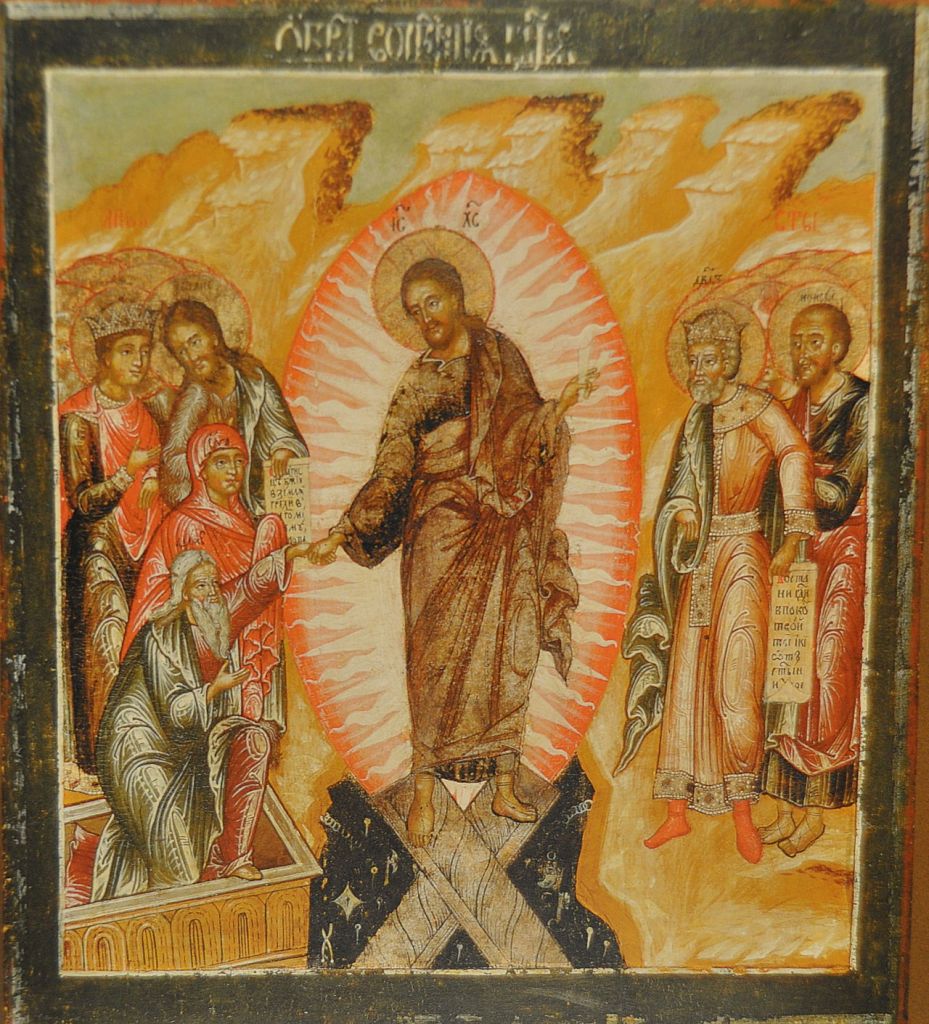
I’m doing a little class about the cross at my church, and this week we’re looking at the Christus Victor model of atonement.  It presents Christ’s death on the cross primarily as a victory over evil.  In ancient times, it was usually tied to the ransom theory of atonement (Jesus was given over to Satan/evil as a payment in exchange for humanity), so you can find these great old stories about Jesus going to Hell and wrecking everything to save the saints.

The book we are using for the study (The Sign and the Sacrifice by Rowan Williams) mentioned one such account from the fourth-century apocryphal book The Acts of Pilate (aka the Gospel of Nicodemus). Naturally, I wanted to read it firsthand!  Unfortunately, there’s no accessible copy online.  The best I could find was the version in The Apocryphal New Testament by Montague Rhodes James, published in 1924, which translates everything into Shakespearean English.  There’s thee’s and thou’s and all those other old words that make reading infinitely harder.  I went ahead and paraphrased the translation there so it was actually readable and I thought I’d share it.  This is not a translation!  It’s my attempt to make the James translation readable for a modern audience.  Feel free to check out the original here (at the bottom of p. 117).  I started paraphrasing at Christ’s descent into Hell (about halfway through The Acts of Pilate), and I stopped just shy of the real end of the text (I ended with Jesus leaving Hell, but all of the saints give praise and hallelujahs for a few more paragraphs).  This is based on the Latin A manuscript.

If you don’t know anything about apocryphal books or atonement theories, you might be asking, “Why on Earth would I want to read that” Well, it’s basically a fourth-century fanfiction about Jesus going to Hell after his death on the cross. He fights Hell (yes, Hell is a being in this one) and Satan, and he busts Adam and his friends out and takes them to Heaven. It may not be Scripture, but it’s really cool and well worth your time.

To make sure this isn’t the longest blog post ever, here’s a link:

https://classictheology.org/the-acts-of-pilate-christs-descent-into-hell/

Enjoy!