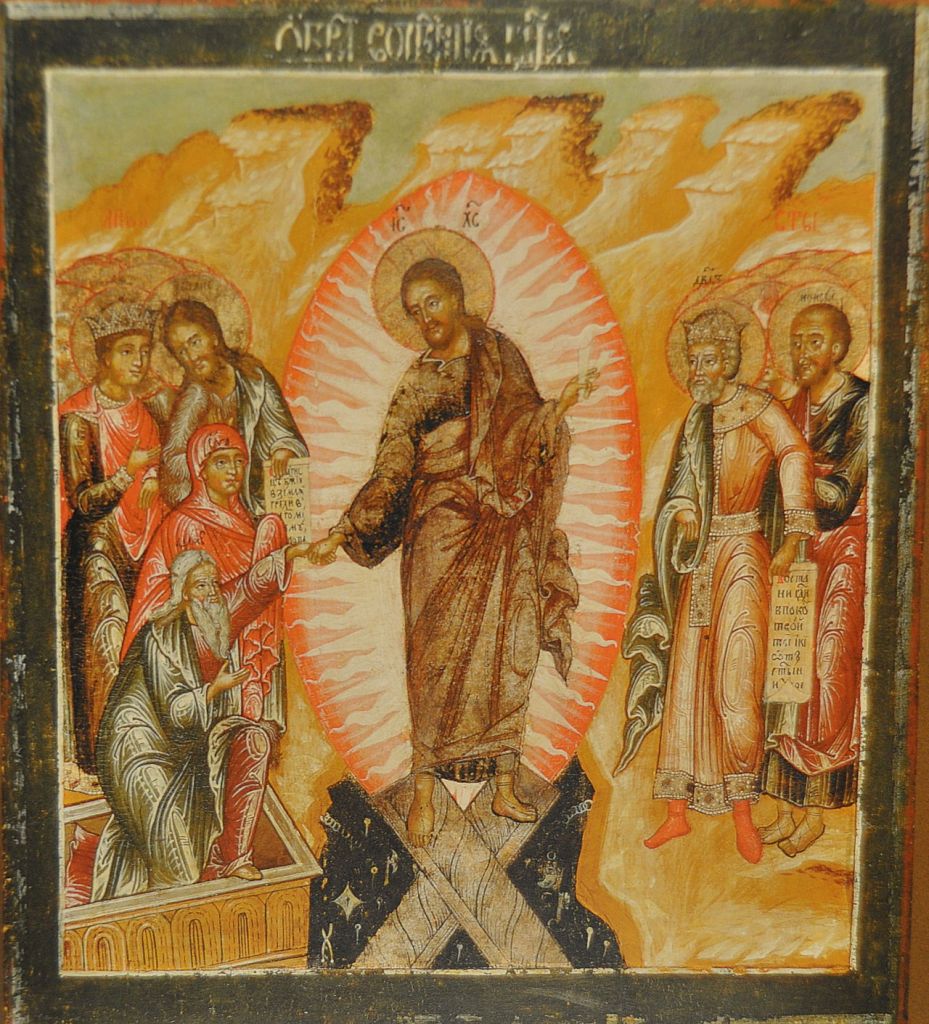
The Acts of Pilate: Jesus Conquers Hell

I’m doing a little class about the cross at my church, and this week we’re looking at the Christus Victor model of atonement.  It presents Christ’s death on the cross primarily as a victory over evil.  In ancient times, it was usually tied to the ransom theory of atonement (Jesus was given over to Satan/evil as a payment in exchange for humanity), so you can find these great old stories about Jesus going to Hell and wrecking everything to save the saints.

The book we are using for the study (The Sign and the Sacrifice by Rowan Williams) mentioned one such account from the fourth-century apocryphal book The Acts of Pilate (aka the Gospel of Nicodemus). Naturally, I wanted to read it firsthand!  Unfortunately, there’s no accessible copy online.  The best I could find was the version in The Apocryphal New Testament by Montague Rhodes James, published in 1924, which translates everything into Shakespearean English.  There’s thee’s and thou’s and all those other old words that make reading infinitely harder.  I went ahead and paraphrased the translation there so it was actually readable and I thought I’d share it.  This is not a translation!  It’s my attempt to make the James translation readable for a modern audience.  Feel free to check out the original here (at the bottom of p. 117).  I started paraphrasing at Christ’s descent into Hell (about halfway through The Acts of Pilate), and I stopped just shy of the real end of the text (I ended with Jesus leaving Hell, but all of the saints give praise and hallelujahs for a few more paragraphs).  This is based on the Latin A manuscript.

If you don’t know anything about apocryphal books or atonement theories, you might be asking, “Why on Earth would I want to read that” Well, it’s basically a fourth-century fanfiction about Jesus going to Hell after his death on the cross. He fights Hell (yes, Hell is a being in this one) and Satan, and he busts Adam and his friends out and takes them to Heaven. It may not be Scripture, but it’s really cool and well worth your time.

To make sure this isn’t the longest blog post ever, here’s a link:

https://classictheology.org/the-acts-of-pilate-christs-descent-into-hell/

Enjoy!
Sanctify this Work: George Herbert’s The Altar

I ran across the poet-priest George Herbert for the first time this week, much to my delight. I’d heard of John Donne (of Batter My Heart, Three-Person’d God fame), but I had no idea that there was a whole group of 17th century English poets that had an interest in religious writing! Apparently, they’re called the metaphysical poets. Not all of them cover religious topics like Donne and Herbert, but a hearty chunk of them did. The idea of the poet-priest was popular in that day!

George Herbert was kind of a hotshot in his younger years. He went to school to become a priest, but ended up becoming the public orator at Cambridge, serving in parliament, and personally knowing the king. After the king died, he quietly left the political scene and finally got ordained. He served 2 rural churches and wrote poetry until his death at age 39. His poetry career wasn’t some way he secretly tried to stay in the limelight; he sent his poems to a publisher when he was on his deathbed for them print if they thought it might “turn to the advantage of any dejected poor soul.”

I’m astounded at his humility. He mingled with some of the most elite Englishmen of his era! To turn around and take a job as a rural priest where the churches are so small that you’re expected to cover two of them? That’s a massive shift. But he seems to have enjoyed it. He wrote a manual to help country priests, A Priest to the Temple, which speaks of the job in the highest possible terms:

The countrey parson is exceeding exact in his life, being holy, just, prudent, temperate, bold, grave in all his wayes.

George Herbert, A Priest to the Temple, Ch. 3

That doesn’t sound like someone that’s inwardly miserable. It sounds like someone who genuinely believes they’re doing something of the utmost importance. He may have left the world’s seat of power, but to him, the rural pastorate seemed every bit as glorious as what happened in the king’s court.

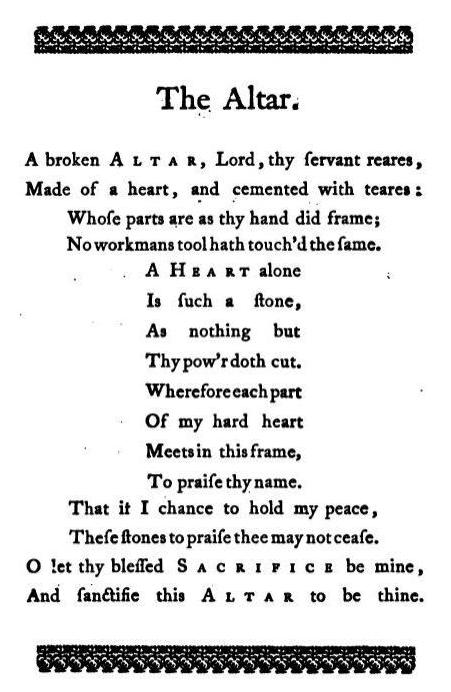
In any case, today I just wanted to look at his famous poem, The Altar. It’s been running through my head all week, and it’s really been inspiring me to think about work differently (this poem was printed in an era where the letter s often looks a lot like f, so read accordingly):

It’s a gorgeous poem. It’s rare to see linguistic and visual artistry paired so seamlessly. Different disciplines are all too often siloed, robbing us of possibilities like this. The particular line that I keep coming back to is, “sanctify this altar to be thine.” What a bold request. Obviously, it works in the context of the poem to refer to his heart, but since the poem is in the shame of an altar, it works on another level: Herbert is asking God to sanctify his work itself! He gave of himself and his time to create this poem, and now he asks God to bless it.

I don’t know how often I consider my work something to lay at the feet of God. I’m usually caught up in thinking about how many people will like it, or if it will make me look impressive or silly or whatever else. But if I sincerely give something my all and dedicate it to God, wouldn’t that be blessingworthy? Even if the world hates it, I have to imagine he’d enjoy it, and what matters more than that? No wonder George was so humble. He was serving the world, but working for the approval of an audience of one.