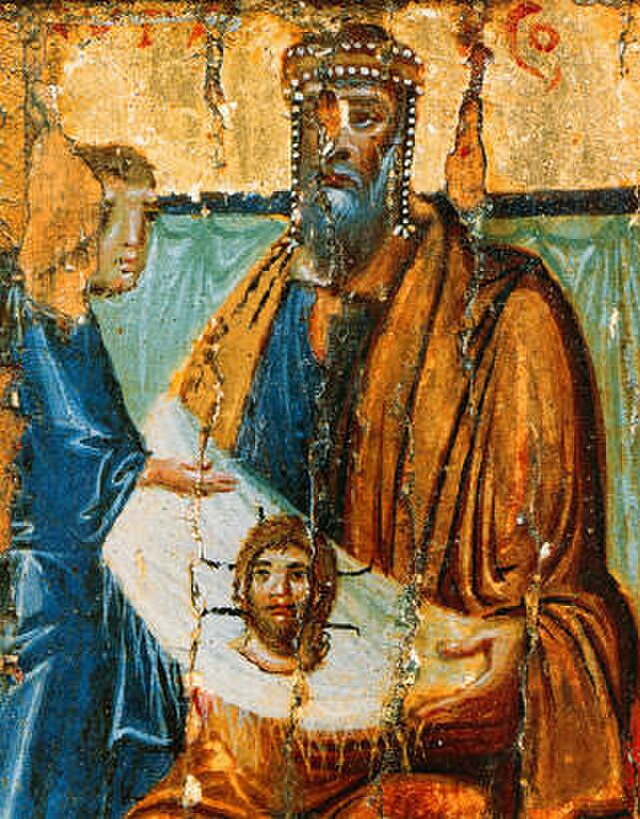
The ancient world was shaped by kings; men whose words were law and whose birthrights were governance. Their will, for good or ill, shaped the world. Stories of such kings converting to Christianity have a special place in Christian legend, as it often resulted in an overwhelming conversion of a nation afterwards. This post details just one such legend.
I used to think that Ethiopia was the first Christian kingdom, mostly because I knew it managed to beat Rome to the punch. Imagine my surprise when I picked up Eusibius’s Church History and came across the story of a king that converted before that: King Abgar V of Edessa (aka the Abgar V of the Kingdom of Osreone or Abgar the Black).
It’s worth mentioning that just because something appears in Eusebius’s history doesn’t mean it’s above suspicion. Eusebius may be the Father of Church History, but a little fact checking is merited. So much of history is collecting stories. Some stories are compelling and have a lot of evidence supporting them, while others are a little more speculative. In the case of King Abgar V, we’re definitely in speculative territory. It’s also worth noting that even double checking Eusibius’s work is a challenge in this instance. Sources about the Kingdom of Osreone and goings on in its capital, Edessa, are rare before the third century. Osreone was a small border kingdom that was gobbled up by Rome in the third century, and pre-Roman records weren’t well preserved. A lot of primary sources aren’t available in English, and the secondary sources are often less than thorough. It was a genuine struggle finding reliable ancient sources on Abgar and Edessa, but I think I managed to find enough to help clarify what is (and isn’t) likely to be true.
In any case, Eusebius reports that King Abgar the V of Edessa holds the unique honor of being the first Christian king. Not only was he the first, but he was so interested in Jesus that he actually wrote a letter to him before he died on the cross! To verify this claim, Eusebius travelled to the royal records in Edessa and found copies of the letter that Abgar wrote to Jesus and the response that Jesus sent back. He even translated them and copied them for his readers! It’s hard to imagine that Eusebius was lying about the existence of these documents. When he shares the content of other documents in his major work Church History, it’s incredibly accurate. For example, in chapter three, he cites letters between a magistrate named Pliny the Younger to the Roman Emperor Trajan regarding what to do with Christian citizens. When compared to Pliny’s records (Epistles 10.96-97), Eusebius’s work is almost verbatim. Again, in chapter four, he accurately reproduces the full account of the Martyrdom of Polycarp. Even his consistent citation of imperial edicts is spot on with independent accounts. Whether or not we find ourselves compelled by the contents of the letters, it’s hard to deny that Eusebius found them and copied them accurately. Here are the letters between Abgar and Jesus, as translated and by Eusebius in the early 4th century:
From Abgar to Jesus:
Abgar, son of Archam, prince of the land, to Jesus, Saviour and Benefactor of men, who has appeared in the country of Jerusalem, greeting:—
I have heard of You, and of the cures wrought by Your hands, without remedies, without herbs: for, as it is said, You make the blind to see, the lame to walk, the lepers to be healed; You drive out unclean spirits, You cure unhappy beings afflicted with prolonged and inveterate diseases; You even raise the dead. As I have heard of all these wonders wrought by You, I have concluded from them either that You are God, come down from heaven to do such great things, or that You are the Son of God, working as You do these miracles. Therefore have I written to You, praying You to condescend to come to me and cure me of the complaints with which I am afflicted. I have heard also that the Jews murmur against You and wish to deliver You up to torments: I have a city small but pleasant, it would be sufficient for us both.
From Jesus to Abgar:
Blessed is he who believes in me without having seen me! For it is written of me: ‘Those who see me will not believe in me, and those who do not see me will believe and live.’ As to what you have written asking me to come to you, I must accomplish here all that for which I have been sent; and, when I shall have accomplished it all, I shall ascend to Him who sent me; and when I shall go away I will send one of my disciples, who will cure your diseases, and give life to you and to all those who are with you.
Anan, Abgar’s courier, brought him this letter, as well as the portrait of the Saviour, a picture which is still to be found at this day in the city of Edessa.
Let’s begin by pointing out just a few of the obvious reasons why these letters aren’t trustworthy:
- Notice that Jesus referenced John 20:29 in the opening of this letter (“because you have seen Me, you have believed. Blessed are those who have not seen, and have yet believed”). He says this is what has been written about him. Unfortunately, this is something that couldn’t have been written about him at this point, given that Jesus said this to Thomas AFTER his resurrection, not before.
- A document that was hand-written by Jesus would have been a MASSIVE deal to the ancient church. The New Testament Scriptures were chosen partially based on their apostolic credentials. A connection to one of the twelve apostles ensured that the document represented the best of Jesus’s teachings and was not only inspired by the Holy Spirit, but fully legitimate. Something that people really thought was written by Jesus? They’d have put that in the Bible in a heartbeat.
- Finally, notice how strangely orthodox Abgar is. He describes Jesus as “God, come down from heaven to do great things, or… the Son of God.” Wow! He was so close! He almost recognized Jesus’s role in the Holy Trinity at a time when even the apostles were struggling with it. Funny how uncanny his instincts were given that he had never met Jesus and wasn’t Jewish.
There are other problems that I’ll leave you to catch on your own. The bottom line is that these aren’t particularly compelling documents.
On the other hand, it’s hard to deny that this legend is incredibly cool. You can’t get much better than a story about your king personally reaching out to Jesus and acknowledging his greatness and divinity. That’s top tier. Not only that, but he offers to let Jesus live with him in Edessa so he can get away from the coming violence in Israel? If that’s your king, he’s unbelievably rad.
While the document itself is more legend than reality, it’s hard to deny that, at minimum, it’s pointing towards some very true realities about the ancient world. Even the most critical historians admit that Abgar’s great, great grandson, King Abgar IX was definitely Christian and made the Kingdom of Osreone legally Christian in the early third century. That’s earlier than Ethiopia (330) and Rome (380), making it still the oldest Christian nation, even if we completely disregard the letters as a forgery. That alone ought to suggest that there may have been significant Christian history before that time. But is there any chance that any of this particular legend is true?
Eusebius records that the disciple who witnessed to Abgar V after Jesus ascended into Heaven was one of the 72 disciples mentioned in Luke 10: a disciple named “Thaddeus,” or Addai in the local Syriac. If we can show that Addai existed and has some form of historic record aside from just witnessing to Abgar V, that goes a long way towards indicating that there’s more to this than just a legend. Luckily for us, there is indeed a document that verifies the independent history of Bishop Addai: The Doctrine of Addai (Syriac, 4-5 c.). This brief document contains the history of the first three bishops in Edessa: Addai (the first bishop who was sent to the region by the apostle Thomas), Addai’s successor Aggai, and the third bishop in the region, Palut. Sure enough, Addai does things apart from witness to Abgar V in this document! Unfortunately, the things he does aren’t at all possible. For example, he converts Protonice, the wife of the Emperor Claudius, to Christianity by showing her incredible miracles. That would be really impressive… if Claudius ever had a wife named Protonice. Not only that, but Protonice goes to take a little tour of Jerusalem with Addai and finds the true cross in a story that sounds a lot like the story of Helena (Constantine’s mom), which was a story that would have existed by the time this document was written. A massive portion of Addai’s story in this document focuses on his relationship with the king and how he built up Christianity in the region until he died and basically everyone famous in Edessa went to his funeral and cried, regardless of their religion. This document makes the letters seem feasible in comparison.
The final straw is the details provided during the explanation of Palut’s (the third bishop’s) ordination. Apparently after the grand funeral of Addai, King Abgar V passed away and Aggai took over until he was martyred by increasing persecution in the region. Then we get to Palut! Since Aggai died before he could ordain Palut as a bishop, Palut was ordained by Serapion, Bishop of Antioch, who was ordained by Zephyrinus, Bishop of Rome. Here’s the problem… Serapion was the Bishop of Antioch between 191 and 211. Zephyrinus was the Bishop of Rome from 199-217. Zephyrinus wouldn’t have been able to ordain Serapion as a bishop, given that Serapion was ordained as a bishop first! Not only that, but both men are from around the 3rd century, when the king of Edessa would have been Abgar IX, who is the first recorded Christian king that a majority of historians consider the first Christian king of Edessa.
The difficulties to justify this particular legend are much too great to overlook, and this comes from someone who looked at as many other sources as I could to try to find a way to make the legend work. Regardless of which additional documents I included, these two documents are both foundational to the Abgar/Addai mythos, and anything that comes afterwards is a clumsy effort to try to massage the obvious errors in those documents.
I sadly have to admit that it seems almost certain that the claim that Abgar V of Edessa was the first Christian king isn’t true. The letters that it’s based on have clear historical errors and the legends that the disciple that converted to him have clear historical errors. That said, I do think there’s evidence that the legend points to a reality that we can count on. There was indeed a king named Abgar (IX, not V) that converted to Christianity due to the influence of a growing Christian community in Edessa, likely led by a very real bishop named Palut. Everything before that point is shrouded enough by legend that it’s not a reliable source to use. Was there someone named Addai? Maybe, but his resume would have been so radically different from the Addai of legend that it’s not even worth comparing the two.
All signs bring us back to somewhere in the early third century, where a king named Abgar (IX) saw a growing Christian population, probably led by a bishop named Palut, and was indeed converted through the influence of someone from the community. So, to be fair, the first Christian king WAS an Abgar of Edessa! The legends seem concerned with establishing an impressive lineage for the first Christian kingdom, which is a shame, because I’d say having the first Christian king is impressive enough without the exaggeration (though the exaggeration is still highly rad).

 Classic Theology