The story of Martin Luther at the Diet of Worms is the stuff of legend. Who could forget that grand moment in which he refused the emperor’s demands and cast his whole hope on the Gospel? You can just imagine his voice resounding as he spoke those legendary words:
Unless I am convinced by testimonies of the Holy Scriptures or someone can reasonably prove to me that I have erred (for I believe neither in the pope nor councils alone, since it has been established that they have often erred and contradicted themselves), I am bound by the Scriptures which I have cited at length, and my conscience has been taken captive by the Word of God. I am neither able nor willing to recant. Here I stand. I can do no other. God help me. Amen.
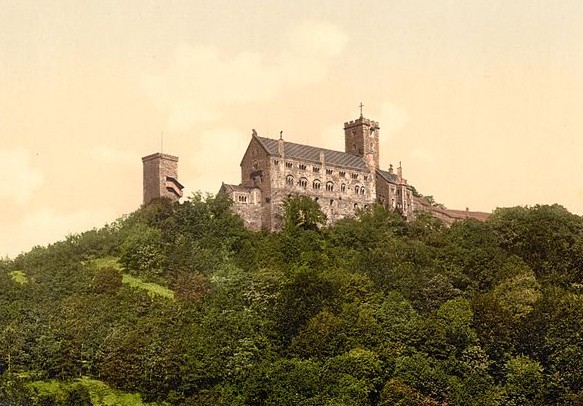
What happened after the drama died down—after the Pope declared him a heretic, the Emperor branded him an outlaw, and he was whisked away to Wartburg Castle by his protector, Frederick the Wise, for a year of hiding? What happened in the heart of someone so bold when he was brought low and forced into solitude? The letters he wrote during his time in exile give us the opportunity to see a side of him that we don’t often consider. Of course, in some letters, we see the Luther we know. We see the hero! He gives orders to his supporters in the Protestant movement, he encourages them to push forward and risk martyrdom if necessary, and he continually redirects them towards the love of Christ. It’s inspiring! But alongside all of that wild courage, we see the man beneath the cape, so to speak. We see Luther wrestling with frustration and depression. We see him rethinking his identity as a monk, a son, and a Christian. Best of all, we get to see him announce what he produced during his time in isolation, despite being burdened with all of that. It’s that vulnerable side of Luther that I want to explore, because I think that’s something we can all relate to. I don’t know that most of us have ever been the symbol of a Christian movement and responsible for rallying the troops, but we have had periods of loneliness, frustration, isolation and introspection. How did Luther handle a moment like that? And how can we be inspired to do the same?
The depths of Luther’s depression are especially clear in his communications with his friend and fellow Protestant leader, Philip Melancthon. Even as he encourages Philip onward with complete assurance of the righteousness of their cause in the eyes of God, he shares just how difficult it is for him to be sidelined and forced into inaction. He writes:
Instead of being ardent in spirit I am the prey of sinful appetites – laziness and love of sleep. For eight days I have neither prayed nor studied, through fleshly temptations. If I do not improve, I shall go to Erfurt and consult the physicians, for I can endure my malady no longer. (Letter to Philip Melancthon, May 12, 1521)
For a man that previously lived as a monk and spent hours every day praying the Liturgy of the Hours, that’s a vast departure from his norms. Here is a famous professor, renowned for his writings and his hours spent in prayer, and he can’t get out of bed. He refers to his pain elsewhere as “unbearable” and describes a prevailing numbness. He should be weeping! He should be worried about people that need the Gospel and are being opposed by the powers that be! But instead, he finds himself quoting Psalm 89:47: “For what futility you have created all humanity!” I can’t help but appreciate Luther’s use of the psalms here. In some spaces in the modern Christian world, there’s this relentless push to smile and be happy that makes those darker psalms almost incomprehensible, but Luther draws on those words to faithfully express the very real pain that he’s experiencing at Wartburg.
That pain does prove helpful in giving him a fuller picture of himself. It’s common to place the end of Luther’s time as a monk in 1524 or 1525 when he formally took off his monastic habit and married Katharina von Bora, but his writings very clearly show that what officially ended later was something that he had already come to terms with in a letter to his father during his stay at Wartburg. Historically, his dad wasn’t a big fan of his decision to become a monk, but he came to terms with it because he loved his son. He never apologized for his decision to become a monk, but the way he frames it isn’t the same anymore. In his earlier writings, it’s his way of giving his life over to God. And that’s still true… partially. God did call him into monasticism earlier, but he did it so that Luther could see “the slavery it brings” firsthand and help others flee its clutches:
Dear father, do you ask me to renounce monkish orders? But – God has been before you, and has brought me out Himself… and has placed me, as thou seest, not in the miserable, blasphemous service of monachism, but in the true divine worship, for no one can doubt that I serve God’s Word… Therefore I send you this book, from which you will see how miraculously Christ has redeemed me from my monkish vows, and endowed me with such freedom, that although I am the servant of all men, I am subject to Him alone. For He is my sole Bishop, Abbot, Prior, Lord, Father, Master! I know no other. I trust He has deprived you of your son, so that, through me, He may help the sons of many others and prevent you rejoicing alone. (Letter to Hans Luther, November 21, 1521.)
He included a copy of On Monastic Vows with the letter, which explicitly talks about the dangers of monasticism, the ways in which it directly opposes God’s word, and encourages monks and nuns to leave the orders. Until this point, Luther’s logic clearly points in this direction. It’s not a wild deviation from his course of thought, but his time in Wartburg was more than just a bleak experience of pain. It was an opportunity for him to ask, “How do I respond to this? Who am I, and who do I need to be?” He synthesized some of what he had only hinted at previously into a full, cohesive idea that he’d later live out.
But the greatest gem is yet to come. If you’re living out your own Wartburg moment, note that there were even greater treasures Luther forged in this season. It was during his time at Wartburg that Luther gave the world one of his greatest contributions to the Reformation. As he was emerging back into the public world in March of 1522, Luther wrote this to fellow reformer Georg Spalatin:
I have not only translated the Gospel of St. John in my Patmos, but the whole of the New Testament, and Philip and I are now busy correcting it, and, with God’s help, it will be a splendid work. Meantime we need your help, to find out proper words, therefore be ready to supply us with the common terms for some things we require, but not those used at Court, for this book is to be written in the simplest language that all may understand it[.] (Letter to Georg Spalatin, March 30, 1522)
In the middle of the depression, the frustration, and the self-examination, Luther had produced a full translation of the New Testament into German. Until this point, most Bibles were in Latin, making them accessible only to scholars and nobles. The Luther Bible in common German was one of the first accessible copies of the Bible to make its way into the everyman’s hands.
In the silence of isolation, the agony of self-examination, and the frustration of every circumstance, good things can happen. Trust God in all circumstances, and in Luther’s words to Melancthon, “I am praying for you. Pray for me, and let’s share this burden,” (Letter to Melancthon, May 12, 1521).
 Classic Theology