Aquinas and Abortion

Thomas Aquinas’s name gets dropped in quite a few pro-abortion arguments.  Roe v. Wade referenced Aquinas.  President Biden referenced Aquinas.  There’s even a popular undercurrent of pseudo-history you can find around the internet that appeals to Aquinas to portray the Middle Ages as this golden age of abortions where your local herbalist was always at the ready to sell the neighborhood abortion drugs at the drop of a hat.  But why is Aquinas referenced with such regularity?  

Aquinas didn’t believe that a fetus was genuinely human until one to three months after the pregnancy began.

And that’s true!  He didn’t.  We’ll get to why in just a minute.  But the strange thing about all of the Aquinas citations is that the people who reference Aquinas (on both sides of the aisle) don’t seem to know much about him.  They know he’s a famous Christian and philosopher and if they can convince people he’s on their side, boy, that would be a knockout punch in their favor.  But that’s the thing; they’re not curious about what he actually has to say for himself.  They want to explain their own position and drop his name in there when it’s convenient.  When they bother to give any citations, they tend to be from secondary sources (which is so lazy when when the person in question wrote as much as Aquinas did) and even when there are direct citations, his most famous works are usually referenced, rather than the most relevant to the actual topic at hand.  So, I wanted to give Aquinas a fair opportunity to speak on the matter.  What did Aquinas actually believe about abortion? 

It’s a big question, so I’m going to tackle it in three different pieces: Aquinas on the Beginning of Human Life, Aquinas on Sex, and Canon Law in the Day of Aquinas.

And if you’re looking for spoilers, here’s the big picture: working within the bounds of popular science in his day, Thomas did believe that human life starts to be genuinely human between one and three months into a pregnancy (depending on the child’s gender). This qualified early-term abortion as a crime other than murder. That said he still lists it as a crime against nature regardless of when it happens, and he worked within a system where it was legally punishable by law at any stage during the pregnancy. Aquinas’s question wasn’t “Is abortion a crime,” so much as it was, “How serious a crime is abortion at each stage?”

Let’s dig in.

Aquinas on the Origins of Life

If we want to talk about Aquinas and abortion, the first place to go is his commentary on Peter Lombard’s Sentences.  It’s not as well known as his famous Summa Theologica, but it’s the only place where he goes from speaking in abstract terms about human development to a description that’ so concrete that it lists specific timeframes for that development.  The context here is a debate about Jesus’s development during Mary’s pregnancy. When was that little fetus Jesus? Was he the Son of God right from the moment of conception?  Or did he become the Son of God at a certain moment in the pregnancy?  Classic Aristotialian thought held that sperm grew into a person in the incubating space of the womb (indicated in the word’s derivation from the Greek σπέρμα sperma meaning “seed”). That process took 40 days for a male child and 90 days for females.  If you hold to that Aristotlian science (and Aquinas certainly did), you end up with a question: did Jesus have a proto-human phase in which he successively became a human from a sperm?  Or was he just instantaneously there in the womb as a person through the power of the Holy Spirit?  He answers as follows:

[A]ccording to the faith, Christ’s conception must be held to have happened instantaneously, for human nature was not assumed before it was perfected in its species, since its parts were not assumable except by reason of the whole, as is evident from what was said in Distinction 2. … For this reason we must consider that conception to have been instantaneous, so that these things existed in the same instant: the conversion of that material blood into flesh and the other parts of Christ’s body; the formation of the organic members and the soul being infused in the organ-bearing body; and the assumption of the ensouled body into the unity of the divine person.

Now, in others these things occur successively, such that a male child’s conception is not completed until the fortieth day, or a female’s until the ninetieth, as the Philosopher says in History of Animals, [book] 9. But in the completion of the male body Augustine seems to add six days, which are distinguished as follows, according to him in his Letter to Jerome. For the first six days the seed has a likeness resembling milk; in the next nine days it changes to blood; then in twelve days it solidifies; in eighteen days it is formed to the complete lines of the members; and from then on the rest of the time until the time of delivery it grows in size. Thus the verse: Six days as milk, three times three as blood, two times six forms the flesh, three times six the members. However, in Christ’s conception, the matter that the Virgin supplied immediately took the form and figure of the human body, as well as the soul, and was assumed into the unity of the divine person (Commentary on the Sentences, Book 3, Distinction 3, Question 5, Article 2).

You can see him reference some of his previous work (Book 3, Distinction 2, Article 3) in the quote there to try to establish that Jesus Christ was not just the soul, but the body.  In the incarnation, there was a perfect union of God and man, not a material body that developed separately and then a soul that came along after the fact. There had to be a legitimate, full union between the two natures. He admits that for normal humans, the Aristotelian norm of 40 and 90 days before you’re fully human is true, but Christ’s exceptional incarnation led to him just popping into being through the power of the Holy Spirit, rather than developing from a sperm.

All of this science is very strange to us and obviously wrong. He doesn’t even know that eggs exist; only sperm. Even so, you can see how this really clearly gives us the framework to determine when a fetus is a human child. In his words, it’s “ensouled” after the first few weeks. Before that, an organic creature is developing, but it’s not one that’s human just yet.

If we just look at this solitary piece, abortion feels like a pretty rational move for a Christian that’s following in his footsteps, right?  Ah, but we can’t just pluck out his pieces about human development (a proportionally small piece of his works) and ignore the lion’s share of what’s left and declare ourselves to be thinking in his tradition.  Let’s keep going to see why Aquinas actually did not support abortion.

Aquinas on Sex

Now that we know what Aquinas thinks about the development of a fetus, we need to understand what he thinks about the procreative act itself.  On this topic, Aquinas really is absolutely a man of the medieval Chrisitan world.  And what did medieval Christians think about sex?  Well, to them, it was absolutely intertwined with having babies.  You couldn’t rightly separate the sensual aspect from the procreative aspect without stumbling into sin.  Now, obviously I’m not saying that everyone in the middle ages acted according to that worldview and never cheated on their spouse or whatever other thing you can imagine.  Of course they did.  People don’t always live up to the ideals of their society, even if they claim to ascribe to them.  But when it comes to the ideals, doctrines, and philosophy of the time, there can’t be any doubt that any effort to enjoy sex without an openness to procreation was sinful.

And why?  Well, the medieval world, and especially Thomas Aquinas, thought in terms of natural law.They believed the world had a natural sort of logic to it that was built in by God.  As you went about living your life, you were expected to look at each object and each act to consider why it exists.  Why did God make this?  What was his purpose?  Are you acting in a way that’s consistent with the logic of God’s creation?  Or are you twisting things around to serve your own wants, rather than God’s intended purpose?

That’s really abstract, so let’s work through an example.  An obvious one is food.  What is the logic of food?  Food exists to give us nourishment.  The process of eating it might be pleasurable (and there’s nothing inherently wrong with that), but if we’re going to live by the logic of the thing, the process of eating should never be separated from its natural end: we eat to be nourished.  If we start to enjoy it without that end in sight, that’s when we start to sin.  Are you enjoying Doritos because you’re hungry?  That’s great!  Are you enjoying Doritos when you’re already full but you just want to keep munching because they’re delicious?  That’s sin.  You’re losing sight of why God gave us food and just enjoying it out of gluttony.

Now, take that logic and apply it to sex.  Why does sex exist?  To have kids.  That’s the natural, logical end of the process.  If you wanted to have sex righteously, you were expected to look towards the end (babies), rather than just indulging for the pleasure of the process itself.  That was lustful and a misuse of what God gave us.  Not only was this logic very popular throughout the medieval world, but it was very popular with Thomas Aquinas.  As a matter of fact, the argument and examples that I just gave (sans Doritos) are straight out of his magnum opus, Summa Theologica, when he’s rejecting the idea that all “venereal acts” are inherently sinful:

A sin, in human acts, is that which is against the order of reason. Now the order of reason consists in its ordering everything to its end in a fitting manner… Now just as the preservation of the bodily nature of one individual is a true good, so, too, is the preservation of the nature of the human species a very great good. And just as the use of food is directed to the preservation of life in the individual, so is the use of venereal acts directed to the preservation of the whole human race (Question 153, Article 2).

Also, notice that he felt the need to debate whether or not there can be non-sinful sex.  That should tell you something else about the medieval world verses our own!  While we debate, is there any sex that is morally wrong, they were debating whether there was any sex that is morally right!  A very different starting place

This alone helps us shift gears when we’re thinking about Aquinas and abortion.  Aquinas would not have wanted anyone to have sex if they weren’t open to having children.  That would be against the nature of the act and sinful sex, even for a married couple.  Aquinas says as much directly in his Commentary on the Sentences when he addresses one of Peter Lombard’s quotes about birth control:

As for those who procure poisons to induce sterility, they are not marriage partners, but fornicators. (Sent. IV, 31.3 (184). 1.

Although this sin is grave, and to be counted among wicked deeds, and against nature (for even beasts desire offspring), nevertheless it is less grave than murder, since a child conceived could be prevented in another way.  Nor is such a person to be judged irregular, unless he should now procure an abortion for the child about to be born  (Book 4, Distinction 31, Question 2, Article 3).

And in that quote, you can see how he starts to move from birth control to abortion in applying the same logic. We are given food to be nourished.  We are given sex to procreate.  Why is a person made pregnant?  Is it to end the pregnancy?  No.  That would qualify as going against the natural logic of pregnancy in the most direct way possible.  Natural law philosophy was one of Aquinas’s biggest emphases, so if we want to introduce him to conversations about abortion, we have to remember that background first and foremost before we can deal with any of the specifics.

Church Law in the Days of Aquinas

But now that we’ve set the stage on some of Aquinas’s basic convictions as an Aristotilian thinker and a natural law enthusiast, we need to acknowledge the actual law of the medieval church during the era that he was at work.  As famous as he was, he influenced the teachings, and the teachings most definitely influenced him, so what did the church actually hold during the eras in question?  And I do want to acknowledge that this is a really complicated thing to research.  A shocking amount is not readily accessible if you don’t speak Latin.  Luckily, Paul Harrington wrote an excellent summary of laws pertaining to abortion over time in church history in The Linacre Quarterly that makes the depths of medieval church law accessible to anyone. While we have a particular interest in church law during the lifetime of Aquinas (1225-1274), a broader picture of what was going on in the medieval and Roman Catholic church won’t hurt our understanding either.

Looking at church law over time, for a little over a thousand years, the church considered abortion to be legally identical to murder and the standard punishment was usually excommunication.  It’s hard for us to wrap our minds around something like excommunication, since there’s not really an equivalent today. If we get kicked out of our congregation, good riddance! We’ll just go to the church down the street! But if we want to really understand their mindset, it’s crucial to recognize just how serious a punishment like that was in that timeframe.  An excommunicated person was cut off from the church until they had fully repented, meaning they couldn’t go to worship with their family and community.  They couldn’t participate in the sacraments.  They couldn’t get married.  They couldn’t offer prayers for dead relatives.  They couldn’t get buried. And if they died while excommunicated, Hell was the destination.  Excommunication was the most severe punishment you could get from the church.  This was serious.

A little after the turn of the millennium, we do see that distinction between an animated and inanimate fetus make it’s way into law. It first appeared in 1116.  A bishop named Ivo of Chartres first introduced it, and that distinction was taken up by a legal scholar named Gratian and printed in the legal textbook that became the standard for decades moving forward, Decretum.  It continued in Roman Catholic law for 753 years until Pope Pius IX ended that distinction in 1869.  During this period, if you got an abortion outside of the 40 day limit for males or 90 day limit for females, you were a murderer.  If you got an abortion within the limit, you had committed quasi-murder or homicide (the language varied depending on specifics at the time).  As the name implies, the punishments were less severe for quasi-murder.  For example, in 1159, your punishment was 3 years of penance if you aborted an inanimate fetus, verses the 7 years of penance or more that you would receive for aborting an animated fetus (which was the punishment for murder). And that’s just one specific instance. Sometimes, the punishment was a lifetime of excommunication. Sometimes it was left up to regional leaders. You get the idea. The important thing to note is that there was a legal distinction that made one a greater sin and the other a lesser sin. Some of the other abortion-centric laws in this timeframe didn’t acknowledge the distinction. For example, a piece of legislation by Regino of Prum in 1211 introduced a law that anyone caught selling drugs to induce abortion (at any stage of development) was guilty of murder. On the whole though, the distinction stands (for those who are curious, the distinction never really seems to have made a meaningful appearance in the Protestant world).

Notice that Aquinas’s position was the dominant position of the church during this time.  Abortion was always sinful.  The distinction in church law was never used to imply otherwise.  The distinction came up because people wanted to know how severe the sin of abortion was. Was it murder? Was it quasi-murder? Was it grave sin? Is it a lifetime excommunication or a period of penance? What punishment fits the crime?

Conclusion

Whew!  That’s a lot to take in.  Honestly, every time I learned more about this topic, it genuinely pushed me to deeper levels of understanding.  It was wild to see how recent our modern understanding of biology is, how church law was enacted in different eras, and how philosophy and theology have influenced one another in so many different ways.  I didn’t come to this question knowing the answer.  I came because I wanted to see firsthand what the truth was, and after some sifting around, I found more of it than I started with.  And I got to rediscover that history is so weird!  People in different times had such different ideas that are hard to wrap our minds around.

Nevertheless, at the end of it all, I have to wonder whether pro-abortion appeals to Aquinas are a product of ignorance or if they’re knowingly made in bad faith.  The solitary point of agreement is that he did not think human life began instantaneously after sex.  After that point, it’s all downhill.  In spite of that agreement, he did agree to a relatively early date where the child was fully human.  He considered abortion a crime against nature at best and murder at worst (depending on the timing).  He upheld and helped to shape a system of philosophy and canon of law that literally included it as a punishable offense.  Is this really the best person to appeal to?

As humans, we have the unique privilege of looking at this world around us and trying to figure it all out.  That’s wild!  We get to learn and read and try our best to come to knowledge of the truth.  A basic part of wielding that privilege well is acknowledging when we disagree with others and why we do.  When we misrepresent the legacy of others to make our ideas more palatable to those who would otherwise disagree, we’re participating in a lie, and the truth is never uncovered by lying.

Other great recommendations for those who want more:
Summa Theologica Ch. 118
Summa Contra Gentiles, Book 2, Ch. 65 and up
Abortion: Part VIII, Paul V. Harrington
A Great Free Translation of All Things Aquinas by the Aquinas Institute
What Did Jesus Write in the Dirt in John 8:1-11? Big Name Theologians Weigh In

While poking around some different articles on the treatment of women in Leviticus, I stumbled across some wacky interpretations of what Jesus wrote in the sand in John 8:1-11. Let me refresh your memory on that passage (with a verse from chapter 7 to make sure we don’t start in the middle of a sentence):

53 Then they all went home,

but Jesus went to the Mount of Olives.

At dawn he appeared again in the temple courts, where all the people gathered around him, and he sat down to teach them. The teachers of the law and the Pharisees brought in a woman caught in adultery. They made her stand before the group and said to Jesus, “Teacher, this woman was caught in the act of adultery. In the Law Moses commanded us to stone such women. Now what do you say?” They were using this question as a trap, in order to have a basis for accusing him.

But Jesus bent down and started to write on the ground with his finger. When they kept on questioning him, he straightened up and said to them, “Let any one of you who is without sin be the first to throw a stone at her.” Again he stooped down and wrote on the ground.

At this, those who heard began to go away one at a time, the older ones first, until only Jesus was left, with the woman still standing there. 10 Jesus straightened up and asked her, “Woman, where are they? Has no one condemned you?”

11 “No one, sir,” she said.

“Then neither do I condemn you,” Jesus declared. “Go now and leave your life of sin.”

What did Jesus write? It’s important enough that it’s referenced twice at crucial story moments, but apparently not important enough to tell us anything about it. I’ve heard people say he was writing a passage from Leviticus 20 indicating that BOTH people were supposed to be stoned, revealing that they would be breaking the law if they stoned her because they failed to produce both parties. Others have said that he was writing the names of every accuser along with the sins that they had recently committed. I’ve even heard that he drew a line in the sand for people to cross if they felt they were worthy. There are a lot of takes out there, but most of them aren’t really founded on much apart from one person’s random guesswork. What have the major theologians of the Christian tradition said about the writing in the sand?

Naturally, I started with Augustine (because you can never go too far wrong with Augustine). Luckily for me, he preached a series of sermons about the book of John and his take was customarily good. He suggested the trap the Pharisees laid was in making Jesus choose between gentleness and justice. If Jesus approved of the women’s death, he’d be the guy that condemned peasant women and his popularity would suffer. If he didn’t approve of her death, he was speaking against God’s justice and was officially a transgressor of the law! Jesus navigates the dilemma with his typical craftiness by taking neither option. But what about the finger writing?

You have heard, O Jews, you have heard, O Pharisees, you have heard, O teachers of the law, the guardian of the law, but have not yet understood Him as the Lawgiver. What else does He signify to you when He writes with His finger on the ground? For the law was written with the finger of God; but written on stone because of the hard-hearted. The Lord now wrote on the ground, because He was seeking fruit. You have heard then, Let the law be fulfilled, let the adulteress be stoned. But is it by punishing her that the law is to be fulfilled by those that ought to be punished? Let each of you consider himself, let him enter into himself, ascend the judgment-seat of his own mind, place himself at the bar of his own conscience, oblige himself to confess… Each looking carefully into himself, finds himself a sinner. Yes, indeed. Hence, either let this woman go, or together with her receive ye the penalty of the law… [H]aving struck them through with that dart of justice, [Jesus] deigned not to heed their fall, but, turning away His look from them, “again He wrote with His finger on the ground.” 

Augustine, Sermon on John Chapter VII. 40–53; VIII. 1–11

Brilliant! Rather than focus on non-existent content, he’s looking at the symbolism of the act itself. Why would Jesus write on the ground? Because God wrote the law on stone the first time, and now he’s writing on the ground. This is the same dust that people were created from. Were they fertile enough to bear fruit after all these years? Or were their hearts still hard as the rocks that the commandments were once written on? He even returns to his idea of gentleness by indicating that Jesus didn’t stare them down after the incident, shaming them for their sin. He just keeps writing. Really nice work here.

Other patristic authors are less worthy of sharing. John Chrysostom has a sermon series on John that deliberately skips over this particular story and a lot of ancient theologians (especially in the East) follow suit, leading some to believe that they had copies of John that didn’t contain these verses. In Against the Pelagians, Book 2, Jerome suggests Jesus was writing out the names of the accusers to to fulfill Jeremiah 17:13 “Those who turn away from you will be written in the dust,” (a passage which seems to have been intended to be more poetic than literal). By and large, Augustine’s logic seems to have been attractive. Thomas Aquinas carries it forward to the Middle Ages in his mega-commentary Catena Aurea and includes support from Venerable Bede and Alcuin of York to back him up.

In the Reformation, John Calvin comes out swinging against Augustine and approaches the story without interest in allegory:

By this attitude he intended to show that he despised them. Those who conjecture that he wrote this or the other thing, in my opinion, do not understand his meaning. Nor do I approve of the ingenuity of Augustine, who thinks that in this manner the distinction between the Law and the Gospel is pointed out, because Christ did not write on tables of stone, (Exodus 31:18,) but on man, who is dust and earth. For Christ rather intended, by doing nothing, to show how unworthy they were of being heard; just as if any person, while another was speaking to him, were to draw lines on the wall, or to turn his back, or to show, by any other sign, that he was not attending to what was said. Thus in the present day, when Satan attempts, by various methods, to draw us aside from the right way of teaching, we ought disdainfully to pass by many things which he holds out to us.

John Calvin, Calvin’s Commentary on John 13:1-11

Gone is the speculative symbolism! Instead, we have a Jesus that’s just not listening. Pharisees are coming around, asking questions that they already know the answer to, and Jesus just starts doodling in the sand. That’s how little he cares what they have to say. When he says “Let he who is without sin throw the first stone,” Calvin reads that as a deliberate reference to their own sinfulness. They know they aren’t being sincere. They’re scheming, conniving, wretched men trying to kill someone to prove their own point. It’s not that the law isn’t legitimate; it’s that they aren’t being legitimate, and they know it. Again, Calvin is sticking to the Scripture pretty thoroughly and avoiding wild speculation about the writing. Well done.

The Reformation seems to be a bit of a hinge in historical interpretation. After the Reformation, commentaries that I can find seem to take a more practical approach to the matter. The symbolic dimension is swallowed up by the practical. Some lean more heavily on WHY he wrote (to avoid meddling in politics, to calm people down, etc.) while others focus on WHAT he wrote (names, sins, passages of the law, etc.). John Wesley is one of the better big-name interpreters to marry the practical and the symbolic, but his notes are still ruthlessly pragmatic:

God wrote once in the Old Testament; Christ once in the New: perhaps the words which he afterward spoke, when they continued asking him. By this silent action, he,

1. fixed their wandering, hurrying thoughts, in order to awaken their consciences: and,
2. signified that he was not then come to condemn but to save the world.

John Wesley, Wesley’s Explanatory Notes on the New Testament, John 8:1-11

Obviously there are oodles of others well worth reading, but these were the ones that I thought were worthy of lifting up. They’re all respected enough for their words to carry weight, and each seems to represent the general stream of mainstream interpretation within their era.

Ultimately, I’m really pleased with what I found. I expected to find some really wacky stuff, but a shocking majority of commentators avoided wild speculation about the specifics of the writing and interpreted in light of the information that they had, rather than what they didn’t have. Frankly, that was my bias from the outset. If the Bible doesn’t say what Jesus wrote, it couldn’t have been all that important to the story (sorry Jerome). But really, it was phenomenal to see all the directions people went with it. I have a soft spot for that symbolic dimension. It emphasized the weight of each action within the passage in a way that was far beyond the mundane. So what did he write? Beats me. As much as I like Augustine, I’ll side with Calvin for the sheer delightful possibility of Jesus rolling his eyes and playing tic tac toe against himself in the dirt while they were trying to talk to him.

Through the Eye of an ACTUAL Needle: The Fake Gate Theory

Matthew 19: 23-24 famously reads:

Then Jesus said to his disciples, “Truly I tell you, it is hard for someone who is rich to enter the kingdom of heaven. Again I tell you, it is easier for a camel to go through the eye of a needle than for someone who is rich to enter the kingdom of God.”

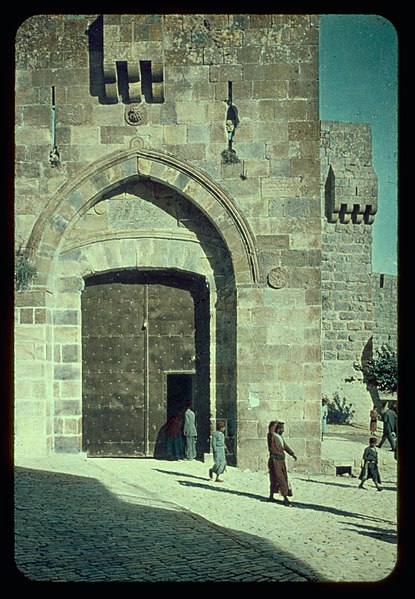
There are two popular interpretations for the phrase “eye of a needle.” The first theory is that it is a reference to the tiny hole at the top of a sewing needle. Simple enough. The second theory is that it is a reference to a gate with the name “the eye of the needle” that was in first century Jerusalem. The gate was so small that anyone that hoped to get a camel through would have to take all of their baggage off the camel, get it down to its knees, and kind of shimmy the camel through the tiny opening.

You can see why this is important for Bible readers. Either Jesus is saying that it is impossible for a rich man to get into Heaven, or he’s saying that it’s really challenging for a rich man to get into heaven. There’s a big difference between impossible and barely possible. So which is it? Is it hard or impossible? What is the eye of the needle?

After a little research, I wasn’t able to find a trustworthy modern commentary that genuinely advocated for the gate theory. In varying detail, they all disproved it with archaeology, translations from the Greek, interpretive history, and the plain sense of the story. That being said, I didn’t find a single place that really poured out all of the evidence for the reader’s consideration (especially when it came to the history of interpretation). So here we go! This is my attempt to round up all of that evidence and hand it over to you.

The archaeological evidence for the gate theory is pretty poor. There’s no legitimate evidence of a gate known as the “eye of the needle” gate existing in Jesus’ lifetime. I would cite something, but you can’t cite evidence proving a lack of evidence! A quick google search reveals that even modern claims about eye of the needle gates in Jerusalem are dubious at best. There’s one small Orthodox church that claims that they have the actual gate that Jesus was referring to (which looks suspiciously like a hole in an old wall). There’s also a handful of travel blogs from people that claim they went to the eye of the needle gate. None of these claims are citation-worthy. Church websites often make dubious claims (see my article about fake quotes from famous saints for more church website sins) and the travel blogs pictures feature people smiling by a variety of totally different “eye of the needle” gates. Were there gates in different times and locations referred to as eye of the needle gates? Yes. There’s gates like that in German castles from the Middle Ages and obviously a handful in Jerusalem today that claim to be eye of the needle gates. That being said, there’s no record of a gate being referred to by that title until after the year 1000. In first century Jerusalem, there is absolutely no evidence that such a gate existed. Strike one.

The Greek manuscript makes the gate theory even less viable. If the “eye of a needle” was the name of a specific gate or a reference to a type of gate, that would make the language a title. You’d have to use the same words, “eye of the needle,” every time you talked about it because you’re not actually talking about eyes and needles; you’re talking about a type of gate known as an eye of the needle gate. The story comes up three times in the Gospels (Matthew 19, Mark 10, Luke 18) and each author uses slightly different words for this phrase. Matthew calls the eye of a needle the “trypēmatos rhaphidos” (τρυπήματος ‘ῥαφίδος), while Mark calls it the “trymalias tēs rhaphidos” (τρυμαλιᾶς τῆς ‘ῥαφίδος). Both are using the same word for needle (referring specifically to a tailor’s needle), but they’re using different language to talk about the eye of that needle. Luke not only adds a third option for the eye, but uses the word for a surgeon’s needle rather than the word for a tailor’s needle: trēmatos belonēs (τρήματος βελόνης ). If they’re trying to use a title for a specific kind of gate, they’re all over the map! Two of the three of them are using the wrong words to refer to that gate. If, on the other hand, they’re talking about needles and the tiny holes in them, the differences in their accounts present no problem. Strike two.

Now to the history of interpretation. Most commentaries I looked at claimed that the gate theory was a legend from the Middle Ages, but there wasn’t much detail provided beyond that. I saw a lot of people throw around dates like the 9th century (maybe), the 15th century (definitely wrong), and the 19th century (right out), but few provided direct quotes from their sources, much less cited sources at all.

The oldest reference I could find that’s absolutely airtight comes from Thomas Aquinas’ megacommentary, Catena Aurea. It packed great quotes from multiple noteworthy church fathers into one convenient commentary. In the section on Matthew 19, he provides the following commentary from Anselm of Canturbury:

It is explained otherwise; That at Jerusalem there was a certain gate, called, The needle’s eye, through which a camel could not pass, but on its bended knees, and after its burden had been taken off; and so the rich should not be able to pass along the narrow way that leads to life, till he had put off the burden of sin, and of riches, that is, ceasing to love them.

Anselm of Canterbury as cited in Catena Aurea, Thomas Aquinas, CCEL Edition.

I can’t find a primary source from Anselm on this one, nor can I find anyone else who was able to track one down, so we’ll just have to take Thomas’s word for it. Anselm wrote in the early 12th century, so there’s definitely an uncomfortable gap here. Sources legitimately interested in uncovering the source of the theory often quote this as the its first official appearance, and I have to agree. I can’t find an earlier source than Thomas quoting Anselm. Did Anselm say it? Probably. Did he get it from someone else? I have to imagine he did. Someone that spent most of his life in England seems an unlikely candidate to start spouting off about gates in Jerusalem.

There are some people that point to an eastern bishop from the 11th century named Theophylact as the actual originator of the gate theory. If he did, it’s bizarre that he didn’t write it down anywhere and actively contradicted himself in writing. Here’s what he says on the matter in his commentary on Matthew:

As long as a man is rich and he has in excess while others do not have even the necessities, he can in no way enter the kingdom of heaven. But when all riches have been shed, then he is not rich and so he can enter. For it is just as impossible for a man with wealth to enter the kingdom of heaven as it is for a camel to go through the eye of a needle. See how Christ first said it was difficult to enter, but here that it is completely impossible. 

Theophylact’s Commentary on Matthew, Ch. 19, trans. Christopher Stade.

You can hear where he gets a little close: “when all riches has been shed, then he is not rich and so he can enter…” If there was a tiny gate where you had to get all of your gear off your camel and shimmy it through, the process might be something like that. But note that he still definitively says that it is impossible for a rich man to enter. Theophylact is describing the process of a rich person becoming poor, not talking about unpacking your camel for the sake of a narrow gate. Just to cover our bases, let’s see what he says about the same story in Mark 10:

Understand ‘hard’ here to mean ‘impossible’. For it is impossible for the rich man to be saved. This is clear from the example which the Lord gives, saying, ‘It is easier for a camel to go through the eye of a needle, than for a rich man to enter into the kingdom of God.’ For it is impossible for a camel to go through the eye of a needle.

Theophylact’s Commentary on Mark Ch. 10, trans. Christopher Stade.

Yeah, this guy is absolutely not the originator of the gate theory. Some people just misread his commentary on Matthew. This is why primary sources are so critical: because people don’t always say what others claim they did.

There are a number of proto-claims that come way closer to the gate theory than Theophylact did. For example, check out this commentary from Jerome (a Roman theologian from the 4th century):

By this saying it is shown to be not difficult but impossible. For if, in the same way that a camel cannot pass through the eye of a needle, so a rich man cannot enter into the kingdom of heaven, then no rich man will be saved. But if we read Isaiah, how camels of Midian and Ephah come to Jerusalem with gifts and offerings, and those that were previously bent and distorted by the depravity of vices entered the gates of Jerusalem, we will see how even these camels to which the rich are compared, when they have laid aside their heavy burden of sins and the crookedness of their whole body, they can enter through the narrow and strait road that leads to life.

Jerome’s Commentary on Matthew, trans. Scheck, 220-221.

Like Theolphylact, Jerome EXPLICITLY says that it is impossible. Buuuut there is that passage in Isaiah (60:6) where camels with loads of fancy gifts and people who were bent and distorted get into Jerusalem. Sooo maybe rich people can get in too if they lay aside their riches and vices? A bit of a comforting stretch for a passage saying that something is impossible. In his commentary, John Broadus goes so far as to suggest that Anselm got the idea from a misreading of Jerome’s fanciful explanation. A bit of a stretch, I think, but the connection between proto-claims like this and the gate theory are definitely real.

There’s a definite instinct in the history of this passage to try to soften the blow. Whether the eye of the needle is made a gate, the camel is made a rope (a suggested mistranslation that’s just not viable, as you can tell from the simple fact that no reputable Bible translates it that way), or the reading of the story is followed up with long statements about how being rich is actually fine if you manage to resist the allure of your riches (Clement of Alexandria among others), there are a lot of people that want this to be a little easier to swallow. Which is surprising, because all of this evidence pales in comparison with the words of Jesus in the following verses (Matt 19: 25-26):

When the disciples heard this, they were greatly astonished and asked, “Who then can be saved?”

Jesus looked at them and said, “With man this is impossible, but with God all things are possible.”

Jesus literally says that the point of bringing up the whole camel and needle thing in the first place was to say that it is impossible. He’s intentionally using an absurd image to talk about something that can’t happen! If his words aren’t enough to put the final nail in the coffin of the gate theory, I don’t know what would be.

Aquinas’s Prayer before Study

I’ll admit that sometimes my studying can feel detached from my devotional life (probably because I’m usually tempted to skip prayer to get to reading, which is never a good thing), but this week, I ran across a delightful resource to help with that. I started a new class (The Major Works of Augustine) and the professor read this prayer before we started:

Creator of all things,
true source of light and wisdom,
lofty origin of all being,
graciously let a ray of your brilliance
penetrate the darkness of my understanding
and take from me the double darkness
into which I was born:
an obscurity of both sin and ignorance.

Give me a sharp sense of understanding,
a retentive memory,
and the ability to grasp things correctly and fundamentally.
Grant me the talent of being exact in my explanations,
and the ability to express myself with thoroughness and charm.

Instruct my beginning
direct my progress,
and set your seal upon the finished work.

Through Christ our Lord,
Amen.

-Thomas Aquinas

There’s different versions of this prayer posted all over the internet, so if there’s bits in this one that you don’t like, feel free to shop around. I just thought it was a lovely way of weaving two strands together that are so often pulled apart: study and devotion.