Questioning Authority

This entry is part of a series called “The Gospel in a Postmodern World.” Learn more about the series here.
Preached on November 13, 2022
Scriptures: Psalm 119:161-168, Judges 17:1-13

Comedy of Errors at an Elegant Downtown Restaurant
The chair is really a table making fun of itself. 
The coat tree has just learned to tip waiters.
A shoe is served a plate of black caviar.
“My dear and most esteemed sir,” says a potted palm to a mirror, “it is absolutely useless to excite yourself.”

I remember my English teacher reading this poem by Charles Simic to the class back when I was a junior in highschool.  When he was done, he asked us what it meant.  One student said that maybe Simic was trying to talk about how objects take on their own personalities over time.  Not a bad guess, but the teacher just nodded his head and kept waiting for more answers, so we kept going.  Another raised their hand and suggested that the author was talking about how we treat objects better than we treat people.  Again, solid guess.  But still, the teacher just kept waiting with that stoic look on his face.  A few other people took a stab, but nothing seemed to satisfy him.  Finally, an uncomfortable silence settled over the room.  He said, “I noticed all of you were trying to tell me what the author meant.  What if he didn’t have anything in mind when he wrote this?  What if this is just a random thing he wrote down?  What if YOU’RE the one who has to decide for yourself what it means?”

He was introducing us to that classic dilemma within literature: where does the authority to declare the meaning of a piece lie?  Is it with the author, is it in the work, or is it with the audience?  If the author is the person who has the right to tell us what their piece really means, the best way to learn more about it is to read a biography about them.  The more we can learn about them, the more we can figure out what it was they were trying to get at.  But if you think the work itself has authority, you may not want to waste your time with a biography.  The author might have created something that they didn’t even fully understand!  Spending more time with the work itself will reveal things that they might not have dreamed of.  Pablo Picasso was famously in favor of this way of looking at things.  He would paint something and then critics would say, “Ah were you trying to get at this?” and he’d respond, “You know, when I painted it I didn’t think I was, but now that you pointed out it’s very clearly there.  You’re right.”   And then, of course, the meaning might rest with the audience.  Who cares what the creator wanted to say?  What do you experience when you’re engaging with the work?  How does it make you feel?  How does it help you to see things in a new way?  That’s what it’s all about.

Where does meaning lie?  Where is the authority: the author, the work, or the audience?  This question broadly correlates to three different eras that we’ve been talking about (premodern, modern, and post-modern).  In real life, we have those same three possible sources of authority available to us today.  We’ve got an author (God), we’ve got a work (creation), and we’ve got an audience (ourselves).  Where does authority lie?  Each era answered the question differently.

In the pre-modern world, especially from the Middle Ages until around 1700, it was broadly assumed not only that there was definitely an author of all of creation, but that author had the authority over everything.  If you look at the way their society was structured, it was deeply, deeply religious.  Political theory was steeped in faith.  The economy was highly religious.  Even their everyday language was constantly pointing to God.  Something as tiny as a basic greeting had a religious dimension to it.  Instead of “hello,” you might get something like, “God be with ye,” or “God save you.”  And why?  Because they assumed if you really want to understand things, you look to God.  God knows the meaning of everything.  Look to Him and you’ll know what’s going on.  You can see that attitude reflected so clearly in their writings.  I’m going to stick with poetry to explore the thought processes in each era because, you know, pick a motif and go with it.  John Dunn’s poem, Death, Be Not Proud, is a great example of thought in the Middle Ages:

Death, be not proud, though some have called thee
Mighty and dreadful, for thou art not so;
For those whom thou think’st thou dost overthrow
Die not, poor Death, nor yet canst thou kill me…

It goes on from there in that same general spirit.  What’s he drawing trying to draw attention to?  God.  We see this thing called death, and it might look scary, but it isn’t as bad as we think.  If you have faith in the author of creation, in God, you have to recognize that death isn’t anything to fear.  Look up to God and you’ll know how everything works out in the end. God makes sense of the world, even in the face of death.

Now let’s move forward to the Modern Era.  In the 17th through the 20th centuries, people started to think differently.  They said, if there is an author out there (and who can say whether there is or not), he doesn’t seem to do much.  Let’s not worry about authors.  Let’s worry about the work: creation.  Clearly creation has certain laws, regardless of where they come from.  If we understand those laws, we will understand existence.  So people set about uncovering those natural processes that governed creation.  

Some people think of this as a great scientific revolution.  A time of light, as opposed to the darkness that came before it.  I mean, the movement was called, “the Enlightenment,” so that’s certainly what they were trying to invoke, but I would push back on that.  Yes, there were some great advances in technology during this timeframe, that much is undeniable, but was it really as totally unprecedented as some make it out to be?  I don’t think so.  Science was advanced in startling ways in a lot of timeframes.  If it weren’t for the accomplishments of Medieval scientists that came before them, people like Alcuin of York, Roger Bacon, William of Ockham, Thomas Aquinas, Duns Scotus, and others, much less the thinkers of antiquity and before them.  No, the heart of the movement wasn’t nearly as scientific as it sometimes presented itself to be.  No, the biggest difference was that philosophical change in perspective: the world is its own authority.  We just have to understand it’s laws if we want to live well. To see that in action in a very unscientific way, let’s take a look at Walt Whitman’s Song of Myself:

I celebrate myself, and sing myself,
And what I assume you shall assume,
For every atom belonging to me as good belongs to you.

I loafe and invite my soul,
I lean and loafe at my ease observing a spear of summer grass.

My tongue, every atom of my blood, form’d from this soil, this air,
Born here of parents born here from parents the same, and their parents the same,
I, now thirty-seven years old in perfect health begin,
Hoping to cease not till death.

What’s Whitman excited about?  Nature!  This air!  This soil!  This blood!  Natural things are good.  There’s an earthiness that makes all of creation worth paying attention to.  It has value in and of itself.  Don’t look up!  Look out.  Look to creation.  It will tell you all of the meaning that needs to be known.

And then, of course, we have the Postmodern Era which we have discussed at length throughout this series.  That’s where you end up with poetry about shoes getting fed caviar.  What’s the point?  It’s up to you.  What does the work bring up in you?  What journey do you undertake internally when you encounter creation?  That’s what matters.

As you go through each era, you can see how people think about meaning and order.  The pre-modern mind saw a sacred order.  God at the top, everything goes around him.  The modern mind saw a natural order.  Keep the order in mind and you’ll figure things out as you go.  In the postmodern world, you make your own order, because there’s no natural logic to the things out here.  The world is what you make of it.

I know some of you may not be big fans of poetry, so thank you for suffering through those examples with me.  You can see these philosophical elements in any artistic medium, though.  I just chose poetry because I liked it and it’s short enough to get to quickly, but you can choose anything you like.  Think about literature.  Dante’s Divine Comedy is a perfect example of a pre-modern story.  A man goes through Hell, Purgatory, and then Heaven, detailing things along the way.  We’re literally observing the divine order at work.  You move into the Modern Era and you have Walden.  It’s just a guy living in the natural world.  The whole point is showing the beauty of living well within that natural order.  And then take something from today, for example, A Song of Ice and Fire a.k.a. Game of Thrones.  It may not be exactly a literary classic but it’s a story that got a lot of people’s attention.  Who’s the good guy in Game of Thrones?  No one.  There’s no divine order.  There’s barely any order at all.  Everyone is trying to seize power for themselves because where does power lie here? You.  You decide what the world is and you try to make what you can of it. 

You start in the medieval section and you will see art everywhere depicting divine beauty: Jesus, saints, and angels.  Then you move forward a little and what do you see?  Landscapes.  People want to capture the beauty of the natural world.  And the further on you move, the more you see the landscapes start to vary.  Artists like Monet and Van Gogh start to paint landscapes from perspectives that earlier artists would never have imagined.  And then, of course, you get to contemporary art and things just fall apart.  I saw one exhibit that was just a fence leaning against the wall.  If they didn’t have a plaque with the artist’s name next to it, I’d have assumed they were just doing construction!  I even googled it and found that exact fence on sale at Home Depot for $219.  You too can have an art installation in your home for the low, low cost of $219.

As we move through these different philosophies in each era, from seeing the authority in an author, to seeing authority in the work, to seeing it in ourselves, you would think it would be like a process of taking off shackles.  Theoretically, we should be the freest people of all time.  We should feel lighter than air!  We should be freer than ever since we’re only answerable to ourselves!  But if that’s the case, why is our Postmodern Era so typified by existential dread?  Why do so many people wake up in the morning and ask themselves, “What’s the point?  What am I even doing here?  What’s the point of any of this?”  It turns out, when we’re the only ones with authority and we invent our own meaning, it’s really easy to remember that it’s all nonsense.  We made it all up!  It’s pointless.  If we get frustrated or bored by what’s going on, the sheer arbitrariness of it all is right there, staring us in the face.  Is it any wonder that people can’t be bothered to enjoy a meaning that they know they’ve made up?  Why bother reading a book or a speech or short story when all of it is nothing more than an opportunity for me to expound upon myself.  Things feel pointless because in many ways, they are.  When the world is bound by the smallness of our own horizon, it seems so tiny.  We have nothing to live for!  We have nothing to die for!  It’s all tremendously shallow.  

This is not the first time that these sorts of ideas have taken hold.  There’s this temptation to assume that whenever something happens, it’s happening for the first time ever.  That’s rarely the case.  Here, we can see in the Scriptures a period not so very different from the one we inhabit; a period where people see no legitimate authority outside of themselves.  Let’s read through Judges chapter 17 carefully.

Now a man named Micah from the hill country of Ephraim said to his mother, “The eleven hundred shekels of silver that were taken from you and about which I heard you utter a curse—I have that silver with me; I took it.”

Then his mother said, “The Lord bless you, my son!”

Right from the beginning, this story should strike you as odd.  What a strange opening!  A man steals his mother’s fortune.  It’s 1,100 shekels of silver.  We don’t need to do any kind of ancient conversion rate to figure out that this is a lot.  Near the end of this story, someone is promised ten silver shekels of silver annually for a job and he takes it without complaint.  If ten shekels a year is a decent wage for one year, this is massive!  He’s set for life!  But he stole it from his mother, who curses whoever took the silver, so he brings it back.  And what’s her reaction?  To bless him.

Why?  Returning the money you stole because you’re worried about a curse is better than keeping it, of course, but it’s not exactly an example of sterling behavior.  Maybe it’s worth lifting the theoretical curse over, sure, but giving a blessing?  Why?  He hasn’t done anything good!  He barely managed to avoid the obvious evil that he was headed towards!  He hasn’t earned anything!  Even though he’s a sketchy guy, he gets a blessing.  I’m sure only good will come of this.

When he returned the eleven hundred shekels of silver to his mother, she said, “I solemnly consecrate my silver to the Lord for my son to make an image overlaid with silver. I will give it back to you.”

So after he returned the silver to his mother, she took two hundred shekels of silver and gave them to a silversmith, who used them to make the idol. And it was put in Micah’s house.

There has been some debate among commentators about what exactly was intended by the word “idol” in this particular story.  Is this idol intended to represent a being other than God, or is this idol a visual representation of the god of Israel?  I tend to assume the latter.  She essentially says, “Thank the Lord! I’ll have this idol made,” so to me that tips the scales towards an idol designed in service of God, rather than Baal or someone like that.  But here’s the thing, it doesn’t actually matter in the end. Either you’re making an idol for some other God, in which case you are guilty of breaking God’s law because you made you’re worshiping some other God, which is wrong, or you’re breaking the law by making an idol, which is against God’s law regardless of the intent you had when you made it.  

God explicitly forbids idols multiple times throughout the Scriptures.  It’s in the Ten Commandments!  Don’t make idols!  Why?  Because even if the idol is intended to serve God, idolatry fundamentally reverses the divine order.  God created us.  We are in his image.  When we turn around and create idols, in some sense we’re turning around and creating God.  We’re designing him in our image.  God is not subject to the smallness of our understanding.

The pattern of disordered behavior continues.  At first, a blessing went to a thief.  Now an idol goes to God because someone wants to thank him.

Now this man Micah had a shrine, and he made an ephod and some household gods and installed one of his sons as his priest. 

Even if I was right earlier and that first idol was intended to serve God, Micah has decided that one god wasn’t enough.  He’s filling out a little pantheon for himself, giving his main god some little friends.  Then he designs his own priestly garb and finds a priest to hire.  He’s got his own little religion going on!  And then we see the through line for the whole book of Judges:

In those days Israel had no king; everyone did as they saw fit.

This line appears throughout Judges, and it’s one of the last lines of the entire book: in those days, Israel had no king; everyone did as they saw fit.  It’s not necessarily a reference to a physical King.  Not long after Judges ends, Israel does get someone to be king and God warns them that they don’t need a king over Israel.  He warns them that he should be their king and that any king other than him is going to make all kinds of mistakes.  But they tell God, “That’s a little abstract for us.  We’re not really into the whole ‘king we can’t see’ thing. We’d rather just get a physical king just like every other nation.  Thanks!”  So they get a king, and he’s pretty rotten.  The point here is not just that there’s no physical king; it’s that there’s no authority.  There’s no god that anyone really acknowledges.  They are their own authority.  They do what they want.

A young Levite from Bethlehem in Judah, who had been living within the clan of Judah, left that town in search of some other place to stay. On his way he came to Micah’s house in the hill country of Ephraim.

We’re introduced to this Levite, a priestly figure, out traveling around.  He’s looking for somewhere to stay.  We don’t know why, but we know he has responsibilities back home.  For whatever reason, he’s out and about and he meets Micah…

Micah asked him, “Where are you from?”

“I’m a Levite from Bethlehem in Judah,” he said, “and I’m looking for a place to stay.”

Then Micah said to him, “Live with me and be my father and priest, and I’ll give you ten shekels of silver a year, your clothes and your food.” So the Levite agreed to live with him, and the young man became like one of his sons to him.

Micah hires this Levite away from his responsibilities in Bethlehem. And notice that at the end, it says that this Levite became like a son to him. In Roman Catholic churches today, people refer to priests as “Father,” partially to show reverence to a religious authority, but here this Levite is just the opposite! He’s “like a son.”  This priest isn’t someone he’s going to submit to.  He’s hired a false authority for show, but he retains authority over this Levite. 

Then Micah installed the Levite, and the young man became his priest and lived in his house. And Micah said, “Now I know that the Lord will be good to me, since this Levite has become my priest.”

What an absurd statement we get to end this story.  This man has done nothing but break the God’s law since the story began.  He stole money from his own mother, he made an idol, he invented new gods, he started his own religion, and then he hired a corrupt priest to serve as the head of this new religion.  And he sits back and thinks, “Yeah, God must be pretty happy right now.”  Why?  He’s never done anything that God wanted.  He’s only done what he wanted.  He imagined what he thought a good divine order might look like, he usurped traditional elements and ritual to make it look like it had some dignity to it, and now he’s bought in to what he himself invented.  He’s not interested in worshiping God!  He’s only interested in legitimizing his own self-worship.

All too often, that is the way Christians approach church today.  Is there an interest in God?  In church?  In his divine order?  No.  But there is an interest in legitimizing self-worship with traditional elements and ritual.  We come to church with our lives just the way we like them and tell God, “I’m happy with the way I’ve arranged things.  I just need you to sign off on it.  Please tell me it’s ok to break your law.  You want me to be happy, right?  So approve of what I’ve done!  Tell me you’re happy.  Tell me you’re happy!  Tell me you’re happy!”

The whole thing reminds me of a theory by the famous mystic Evelyn Underhill.  She once explained the goal of life by telling people to map their lives out on paper.  Write the central element of your life in the middle, and then everything that serves that center all around the page.  For most people, their name goes in the middle of the page, and most events in their lives are intended to serve them.  God ends up in a corner of the page, propping up their ego.  In this model, the assumption people carry is that God exists to serve them.  People assume that if everything serves them, they will be happy.  Ironically, it makes them miserable.  We long for something greater than ourselves to serve.  As long as we’re using all of the elements in our lives to serve ourselves, we’re eternally frustrated by just how shallow everything seems.  If we want to make a better map, we start with God in the center and design everything in our lives around him. How are we serving him?  How is our life a part of something greater than ourselves?  Serving God brings joy!

I think she’s right. I think she’s absolutely right.  In a world where there’s a sense that we ourselves are the ultimate authority and there’s no meaning outside of ourselves, we Christians have the meaning of life at our fingertips!  But there’s a temptation to slink back and say, “Maybe they’re right.  Maybe I am the authority.  Maybe all of these religious trappings are intended to serve me.  God is here to endorse my order.  He’ll like what I do.  He’ll sign off on it.”

But if we do that, we are denying the world something it desperately needs.  People are waking up every morning asking, “What’s the point?”  People desperately crave to know that there’s a point to all of existence.  For crying out loud, they’re reading poetry about feeding caviar to shoes and they’re staring at gates!  We can do better than that!  People are seeking legitimate beauty!  Legitimate truth!  Legitimate authority!

We have to accept God’s authority to understand any of that.  We have to seek to serve Him, rather than ourselves.  There is an authority outside ourselves.  There is an author, and he carries incredible authority over creation, revealed to us most completely in his word.  The great missionary, Leslie Newbiggin once said, “If we cannot speak with confidence about biblical authority, what ground have we for challenging the reigning plausibility structure.” In other words, we can’t present a genuine Gospel to the world if we can’t trust that God’s authority, as put forth in his word, is actually legitimate.  No, we need to look to Scripture and see how the God that we claim to serve is communicating with us!  Talking to us!  Telling us what the point is!

Of course, sometimes, it’s hard.  Sometimes, the things God asks of us in Scripture are incredibly difficult.  Some of his ways don’t seem to serve our wants at all.  The world might look on and say, “What are you doing?  Why don’t you just live an easy life?”  Nobody remembers people who live easy lives.  Nobody writes stories about people that did nice, easy, normal things.  Nobody writes a book about someone who went and got coffee one day.  People read stories about heroes that slay dragons and save kingdoms.  People crave stories about people who overcome the odds for something greater than themselves.  That’s something we have the opportunity to do: to serve something greater than ourselves. 

For the past three sessions (not counting our Reformation Day detour), we’ve talked about Postmodernism.  We’ve talked about the ways that the church is, in many aspects, on the back foot.  We’ve talked about truth; in the postmodern world claiming to know objective truth is seen as arrogant.  How do we communicate in a way that seems humble without giving up on truth?  We’ve talked about sin; in a world where the assumption is society is the sole corrupting force, how do we acknowledge the sin that rests in the human heart?  Both truth and sin are complicated to discuss honestly with people outside the Church.  It violates popular thought in ways that are often seen as offensive.  But when it comes to authority, I think we may have something intriguing on our hands.  It’s something that doesn’t violate the orthodoxy of secularism in a way that’s obviously offensive, but is still outside of the norm enough to make people hesitate and ask, “What?”

If we started to live into God’s authority, REALLY started to live into it, we would probably be perceived as pretty weird people.  We’d be those Christians; the ones who take it a little too seriously.  Too often, we try to distance themselves from those Christians.  We try to seem religious, but not too religious.  We try to be approachable and cool.  That’s proven pretty ineffective.  Looking at attendance rates in larger denominations, the more a church ignores the uncomfortable bits in Scripture to seem cool, the more their attendance rates plummet.  The more a church presents a Biblical counterculture to the world, the more likely they are to grow.  I don’t mean to oversimplify things by suggesting that attendance proves that something is right.  Obviously popularity is a poor substitute for truth.  But I do mean to suggest that people outside the church are seeking more than just an institution willing to rubber stamp the dominant cultural order.  They’re actually more interested in a weird place that they don’t fully understand than they are a safe place where that affirms their own authority.  Weird isn’t all bad.

When you’re weird, you show that you’re willing to break from a status quo that’s proving itself ineffective.  You also become the kind of group that earns a second glance from people.  Have you ever stopped to look twice at something normal?  No!  Of course not!  You see a million normal things every day.  Why on Earth would you stop to look at one more normal thing any longer than you have to?  But something weird?  You may well stop and look for a minute!  This thing, foreign though it may seem, is different.  It’s got something to say.  That’s a huge advantage to the Church, if we’re willing to take it.

Some churches do, and it proves surprisingly effective.  I remember one Pentecostal girl in seminary that spoke very well on this.  When I met her, I asked her about tongues because that’s what you do when you’re talking to someone who’s Pentecostal!  You talk about tongues!  It’s a rule somewhere I think.  We chatted about it a bit before I said, “You know, it must be really hard to evangelize because that’s really out of the norm.  I mean I think it’s weird and I’m a Christian!  I already agree with you on like a huge chunk of things that non-Christian people don’t, and I think your understanding is, forgive my saying it, strange.  It must be infinitely more challenging to talk to non-Christians about your faith, since this is a significant part of it.”

She responded, “Are you kidding me?  It’s so much easier for me to evangelize.  People want to talk to me.  They come up and say, ‘You’re Pentecostal, right?’ and I say, ‘Yeah.’  And they say, ‘But you obviously don’t believe in that tongues stuff, right?’ and I say, ‘I don’t just believe in it; I’ve seen it.  Come and see!’”

I may not agree with the way Pentecostals understand tongues, but wow, that’s a good sell.  I almost went to church with her there and then.  “Come and see!” 

In a world that isn’t used to accepting authority outside of themselves, there’s a shallowness that many feel.  Increasingly, people crave something bigger than their own thoughts and whims, and we have something they’re looking for.  Something weird.  Something that should be forcing us to live in a way that’s totally different from the people around us.  If we’re honestly accepting the authority of God as presented in the Scriptures, people should have to look twice!  If we’re living the way that we’re supposed to, there should be conversations a lot like the ones she experienced.

“You’re a Christian, right?”

“Yeah.”

“But you don’t believe in any of that weird stuff do you?”

“Yeah.”

“Wait, so you actually think there’s a God that you can talk to and outdated laws he wants you to keep and an objective point to all of this?”

“I don’t just believe it; I know it.  Come and see.”
Beyond the Mundane: William Carlos Williams and John Heath-Stubbs

A friend and I have a standing engagement to read poetry together and judge which poet is better (using the very precise metric of whatever we happen to enjoy in a given week). Each week, we each pick a new poet to do battle. Not that there’s any sense of competitiveness. We often pick poets we’ve never heard of before. Who cares? It’s just a silly excuse to hang out and read stuff. But this week, I’ve found one of the most imbalanced matchups so far: William Carlos Williams vs. John Heath-Stubbs. I can’t fathom giving William Carlos Williams a vote, but not for the reasons you might think.

I’m sure many of you are familiar with William Carlos Williams. He wrote the famous poem This is Just to Say:

I have eaten
the plums
that were in
the icebox

and which
you were probably
saving
for breakfast

Forgive me
they were delicious
so sweet
and so cold

This is Just to Say, William Carlos Williams

I hadn’t looked at this one since high school, but here it is again. Here’s another of his, Danse Russe:

If I when my wife is sleeping
and the baby and Kathleen
are sleeping
and the sun is a flame-white disc
in silken mists
above shining trees,—
if I in my north room
dance naked, grotesquely
before my mirror
waving my shirt round my head
and singing softly to myself:
“I am lonely, lonely.
I was born to be lonely,
I am best so!”
If I admire my arms, my face,
my shoulders, flanks, buttocks
against the yellow drawn shades,—

Who shall say I am not
the happy genius of my household?

WCW

Now, WCW’s opponent is someone I’m sure most of you haven’t heard of: John Heath-Stubbs. Who on earth is that? I didn’t even know who he was before I stumbled onto him. He’s much less famous and considerably more contemporary, but here’s a little selection:

In the middle of the world, in the centre
Of the polluted heart of man, a midden;
A stake stemmed in the rubbish

From lipless jaws, Adam’s skull
Gasped up through the garbage:
‘I lie in the discarded dross of history,
Ground down again to the red dust,
The obliterated image. Create me.’

From lips cracked with thirst, the voice
That sounded once over the billows of chaos
When the royal banners advanced,
replied through the smother of dark:
‘All is accomplished, all is made new, and look-
All things, once more, are good.’

Then, with a loud cry, exhaled His spirit.

Golgotha, John Heath-Stubbs

And, at the risk of posting altogether too much poetry, here’s another that’s indicative of his style:

The Old Swan has gone. They have widened the road.
A year ago they closed here, and she stood,
The neighborhood houses pulled down, suddenly revealed
In all of her touching pretentiousness
Of turret and Gothic pinnacle, like
A stupid and ugly woman
Unexpectedly struck to dignity by bereavement.

And now she has vanished. The gap elicits
A guarded sentiment. Enough bad poets
Have romanticized beer and pubs,
and for those whom the gimcrack enchantments
Of engraved glass, mahogany, plants in pots,
Were all laid out to please, are fugitives, doubtless,
Nightly self-immersed in a fake splendour.

Yet a Public House perhaps makes manifest also
The hidden City; implies its laws
of tolerance, hierarchy, exchange.
Friends I remember there, enemies, acquaintances,
Some drabs and drunks, some bores and boors, and many
Indifferent and decent people. They will drink elsewhere.
Anonymous, it harboured
The dreadful innocent martyrs
Of megalopolis- Christie or Heath.

Now that’s finished with. And all the wide
And sober roads of the world walk sensibly onwards
Into the featureless future. But the white swans
That dipped and swam in each great lucid mirror
Remain in the mind only, remain as a lost symbol.

The Old Swan, John Heath-Stubbs

I’ll be the first to admit that Heath-Stubbs isn’t my ideal cup of tea.  Golgotha, for instance, has some clumsy-sounding alliteration (“gasped up through the garbage” and “discarded dross” are a bit much for my taste).  The Old Swan seems to play to his writing strengths a little more, but I recognize that it’s a poem that may stick in my mind because I can relate to the circumstances. Not everyone can, and I’m sure some people would just find it dull. All of that to say, I’m not arguing that John Heath-Stubbs is some kind of perfect paragon of poetry (points off for alliteration; it’s a bit much for my taste). I do, however, think that his work is infinitely preferable to that of William Carlos Williams.

At first, I didn’t really get what WCW was doing at all. Why the jaunty plum poem? Why the weirdo dancing guy? So I read up a little on his goals. Williams wanted to uncover the poetic spirit of the everyday life and the beauty of American language as it was genuinely spoken. No traditional prose was needed. Nothing fancy. Nothing extraordinary. Instead, just look to the ordinary and see it for what it is. Cut away all the unnecessary ideas about what poetry is supposed to be and what fancy words should be used and you’re left with an honest statement of what is. While all of WCW’s work doesn’t conform to this methodology (American Imagism), most of his famous stuff seems to (This is Just to Say, Danse Russe, The Centenarian, Between Walls, etc.). To WCW, what is poetry? It’s a note that you left to your wife explaining where the plums have gone. It’s a broken bottle in a parking lot. Poetry is nothing pretentious. It’s just life! Simple, beautiful life.

Now when we look at the selections from Heath-Stubbs, what do we see? Not a glorification of the mundane, but a yearning for something just beyond the mundane. Why is an old pub worth remembering? Because that place was different somehow. It was a place where community was possible between radically different people. It was a place of ideas and chatter. It may have reeked of a tacky faux-elegance, but both it and everyone there aspired to something more than what was. Even his more straightforward poem of the two, Golgotha, looks at what humans are through deep metaphorical, religious language. We have this brilliant depiction of Adam, the heart of what humanity is, discarded each person’s heart, buried in a trash-heap. He’s crying out to be created properly. Something beyond has to rescue him. What is poetry to Heath-Stubbs? It’s capturing something more. There’s something juuuust beyond our eyes. Can we see it directly? No. Can we fully understand it? No. But if we use the right words and look in the right places just right, we might get a peek of this thing that’s better than all that we’ve made.

Ultimately, I see two styles: one content with what is, and one that looks beyond what is to see what really is. One is glorifies the mundane, while the other sees the mundane as something that beckons them onward. William Carlos Williams would see a pub and write a poem about a fun moment that occurred at that pub or a beer glass that gets a special sheen on it when seen in a particular light. Heath-Stubbs sees a pub and he sees the glories of Heaven.

To be clear, I don’t think William Carlos Williams is some kind of despicable hedonist. I just think he’s missing out. I think the simple, self-contained pleasures are just a shallow taste of what lies beyond them. To paraphrase Saint Augustine in On Christian Teaching, every thing exists either as something to be enjoyed or something to be used. “Toenjoy a thing is to rest with satisfaction in it for its own sake.” (I.4), whereas to use something is to find whatever you’re looking for through its proper use. To be clear, there’s nothing wrong with using things in Auggie’s model. After all, God is the only real end for our desire. Nothing else will fully satisfy us! Even people are meant to be used as means to the end of enjoying God. That’s why we ought to talk to people and care for them; we enjoy God through them. William Carlos Williams spends a lot of time on plums and tiny, self-contained ideas. He’s enjoying the thing. I wish he would move past enjoying the plum to enjoy the God that we can know through it.

Recovering the Sacred: C.S. Lewis, Philip Rieff, and the Cleveland Museum of Art

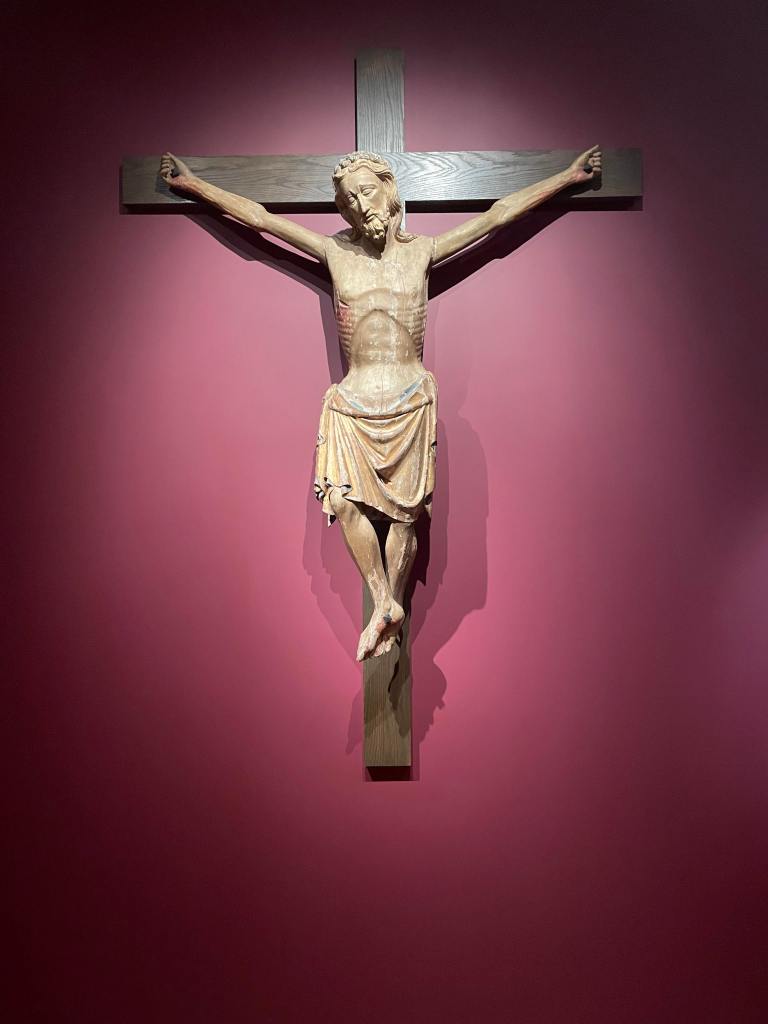
A while back I wrote about my visit to the Cleveland Museum of Art and my reaction to all of their Mary-oriented medieval art. Today, I want to think about the bigger journey that gallery was a part of. As I walked through the museum, it was wildly apparent that the artistic ideal of society was deteriorating as each age passed. For example, let’s look at something from the medieval exhibit:

Crucified Christ, late 1300s

The point of the piece is immediately apparent: this is what the world is all about. Not only does it clearly present an ideal in the person of Jesus and the event of his crucifiction, but you can tell it’s a piece that the public was intended to interact with. It belongs in a church with people worshipping nearby. This is a sign intended to draw people’s minds to the highest understanding of perfection. It’s not a particularly unique piece for the era. The medieval galleries were stuffed with reliquaries, altars, and religious paintings. I can’t help but be staggered by the sheer level of devotion towards the sacred that people were expressing.

Now let’s look at something from the modern gallery:

Metal Fence, Cady Noland

What’s being conveyed? Certainly nothing positive. It’s a critique. Perhaps something like “Why build fences when you could build bridges,” “America is built on keeping others out,” “we need to knock down exclusionary structures,” etc. There’s no positive statement being made. There’s no indication that there’s a sacred ideal. If anything, it’s just the opposite. The plaque that accompanies this particular piece indicates that the author intended it as a critique of the history of the United States. This is a piece specifically intended to tear down images of the sacred. It’s definitely not beautiful. There’s also no possible way that a piece like this could be identified as an artistic endeavor outside of a museum. If you popped this in a community center, people wouldn’t stop to admire it. They would assume you were doing construction and avoid that part of the building! This is a piece intended for appreciation by cultural elites, not everyday people. Again, this example is anything but unique for the modern gallery. You have your fences, you have your baby carriages full of spray-painted phalluses, conglomerations of nude body parts, etc.

All of this is what came to mind as I read through C.S. Lewis’s A Confession:

A Confession
I am so coarse, the things the poets see

Are obstinately invisible to me.
For twenty years I’ve stared my level best
To see if evening–any evening–would suggest
A patient etherized upon a table;
In vain. I simply wasn’t able.
To me each evening looked far more
Like the departure from a silent, yet a crowded, shore
Of a ship whose freight was everything, leaving behind
Gracefully, finally, without farewells, marooned mankind.

Red dawn behind a hedgerow in the east
Never, for me, resembled in the least
A chilblain on a cocktail-shaker’s nose;
Waterfalls don’t remind me of torn underclothes,
Nor glaciers of tin-cans. I’ve never known
The moon look like a hump-backed crone–
Rather, a prodigy, even now
Not naturalized, a riddle glaring from the Cyclops’ brow
Of the cold world, reminding me on what a place
I crawl and cling, a planet with no bulwarks, out in space.

Never the white sun of the wintriest day
Struck me as un crachat d’estaminet.
I’m like that odd man Wordsworth knew, to whom
A primrose was a yellow primrose, one whose doom
Keeps him forever in the list of dunces,
Compelled to live on stock responses,
Making the poor best that I can
Of dull things . . . peacocks, honey, the Great Wall, Aldebaran,
Silver weirs, new-cut grass, wave on the beach, hard gem,
The shapes of horse and woman, Athens, Troy, Jerusalem. (Poems, p. 3-4)

Right out of the gate, Lewis is striking out at the people who are deconstructing classic visions of beauty. T.S. Eliot’s The Love Song of J. Alfred Prufrock is put on blast because there’s nothing sterile or dead about the evening sky. The evening is beautiful, melancholy, and momentous, but certainly not sterile. All these other popular poetic metaphors are equally unfitting. People keep taking these visions that should be massive, beautiful, even transcendent, and warping them into things that are mundane and ugly. The leading poets seem intent to warp the things that once inspired us into things that should disgust us.

As someone particularly fond of William Blake, I couldn’t help but think of him. He was one of the great masters of subverting the sacred. Take, for example, his poem Infant Sorrow:

My mother groand! my father wept. 
Into the dangerous world I leapt: 
Helpless, naked, piping loud; 
Like a fiend hid in a cloud. 

Struggling in my fathers hands: 
Striving against my swaddling bands: 
Bound and weary I thought best 
To sulk upon my mothers breast.

This was part of a collection called Songs of Innocence and of Experience. It was a two part collection. In Songs of Innocence, he presented the beautiful ideal of something, and in his later Songs of Experience, he warped it to show how a world-weary mind mind might experience the same circumstance. In this case, we have birth. Is there a miracle of life? In one sense, sure. But in another, there is the horrible burden of life.

The longer he writes, the clearer that basic motif becomes. The Marriage of Heaven and Hell blurs the lines between the sacred and the profane to suggest that both good and evil, in their own way, are sacred. Devils and angels both have wisdom that we need to learn from. He even creates his own mythology and writes grand creation stories about the history of the world. He portrays God the Father (especially as seen in the Old Testament) as hideously oppressive and in constant war against the great spirit of artistic inspiration and human freedom. What was once sacred is now profane as Blake’s spirit of freedom descends upon the world.

That’s exactly what we have in the contemporary art gallery. We have people eager to call what was once sacred profane. Any sense that something is beautiful or worthy of particular praise is dangerous. Who is one person to tell another what is beautiful? To restrict in any way is wrong. That is the great truth in our era.

It pairs perfectly with the famed sociologist Philip Rieff’s critique of modern culture. Historically, a massive part of culture has been that series of restrictions placed on us (via both taboo and law) in the hopes of helping us live a good life. Do you want to be like Jesus? Then don’t sin. Do you want to honor the gods? Then don’t forget your sacrifices. By coming together around one great vision of purpose and orienting ourselves towards that vision, meaningful community is possible and visions of the sacred are kept. Modern culture, however, no longer has a meaningful vision of the sacred apart from autonomy from all external obligations. People do not long to be a grand embodiment of the good so much as they long to be free to do what they please. Under these circumstances, discussions of good or evil becomes almost laughable because so few people aspire to become more than what they already are:

Evil and immorality are disappearing… mainly because our culture is changing its definition of human perfection. No longer the Saint, but the instinctual Everyman, twisting his neck uncomfortably inside the starched collar of culture, is the communal ideal , to whom men offer tacit prayers for deliverance from their inherited renunciations.

The Triumph of the Therapeutic, 6.

What we end up with is what Rieff calls an anti-culture. It can’t bind together or orient people towards a vision of the good life. The only thing really binding us together is mutual disgust at the thought of people telling us how to live, be the source older visions of natural law, religious obligations, or something else entirely. To paraphrase another great thinker, Stanley Hauerwas, the modern story is that we have no story except the story we choose for ourselves (Community of Character, 84). We end up rudderless in a life without meaning, desperately trying to create meaning for ourselves while knowing we just made it all up.

And what of the great thinkers and artists? Historically, their efforts were part of what bound us together. Buonarroti’s Creation of Adam, the icon Christ Pantocrator, the stained glass of Sainte-Chapelle and other great works served the public by bringing them together to aspire to be like God. Today’s intellectual class does not feel the same burden:

I suspect the children of Israel did not spend much time elaborating a doctrine of the golden calf; they naively danced around it, until Moses, their first intellectual, put a stop to the plain fun and insisted on civilizing them, by submerging their individualities within a communal purpose. Now, although there is some dancing again, the intellectuals mainly sit around and think in awe about the power and perversity of their instincts, disguising their rancorous worship of self in the religion of art.

The Triumph of the Therapeutic, 7.

While Rieff’s Moses seems a little elitist for my taste, I think there’s truth to what he’s trying to get at. We live in a world without a sense of the sacred with intellectuals and artists that would rather root out any remaining bits of transcendence than attempt to build anything that points to more than our own disenchantment and appetite.

That’s what I see Lewis lamenting here. The threads that have bound our culture together are unraveling. The waterfall is no longer a sign to point our eyes to God, so much as a mundane thing that might remind us of sex. The glaciers are no longer a sign that we are tiny, limited things in the world, so much as they are reminders of garbage. We have lost the sense that the world is pointing to something greater, and so historic memory of the sacred becomes bizarre. All we can do is ironically poke fun at the old world and trudge through our flattened-out world in frustration and disappointment.

But Lewis points to a solution: don’t give in. Don’t be someone who loses your sense of wonder. Be fascinated by the things that others think dull. Look at fresh cut crass and delight. Observe the miracle of honey. Taste it and be satisfied. Be astounded by the great cities of Jerusalem and Athens and the ideals they represent. Don’t lose hope, and don’t start defining yourself by opposition. Yes, he is absolutely being critical of his rivals in this poem, but the great hope he points to is not in opposition. That was Blake’s hope. “Opposition is true friendship,” he wrote (MHH20; E42) and eternal opposition seems to be the best that the modern anti-culture of self-gratification can offer. Don’t be like that. Be amazed. Rejoice in old stories about satyrs, magic, miracles, and devils. Recover the sacred, which never abandoned us even as we attempted to abandon it. Live a life defined by hope and beauty. Be the dunce in the eyes of the elites, “for the foolishness of God is wiser than human wisdom,” (1 Cor. 1:25).

C.S. Lewis’s Nerdy Poetry: The Country of the Blind

Most of my experience with C.S. Lewis comes from those approachable classics that sit on many a Christian’s bookshelf: The Screwtape Letters, Mere Christianity, A Grief Observed, The Great Divorce and a few others. Only recently have I started to see the more academic, professorial side of him. Books like The Discarded Image: An Introduction to Medieval Literature are way more intense than Narnia, and frankly, they’re a bit of a slog. And now, I found out the man wrote poetry! Not just any poetry either. He wrote the nerdiest poetry you’ll ever find. These poems were not intended for general audiences. They’re just a smart guy playing with ideas in verse. If you enjoy them, great! If you don’t get ’em or don’t like ’em, I don’t think he would particularly care. My current success rate of “getting” his poetry is about 70%. Some of them are loaded with mythology and theory that I’m not familiar with (especially the Greek mythology, which he clearly loves), but the ones that I do get are brilliant. I thought I’d share a couple of them on here along with my thoughts as I work through them.

The Country of the Blind
Hard light bathed them-a whole nation of eyeless men,
Dark bipeds not aware how they were maimed. A long
Process, clearly, a slow curse,
Drained through centuries, left them thus.

At some transitional stage, then, a luckless few,
No doubt, must have had eyes after the up-to-date,
Normal type had achieved snug
Darkness, safe from the guns of heavn;

Whose blind mouths would abuse words that belonged to their
Great-grandsires, unabashed, talking of light in some
Eunuch’d, etiolated,
Fungoid sense, as a symbol of

Abstract thoughts. If a man, one that had eyes, a poor
Misfit, spoke of the grey dawn or the stars or green-
Sloped sea waves, or admired how
Warm tints change in a lady’s cheek,

None complained he had used words from an alien tongue,
None question’d. It was worse. All would agree ‘Of course,’
Came their answer. “We’ve all felt
Just like that.” They were wrong. And he

Knew too much to be clear, could not explain. The words —
Sold, raped flung to the dogs — now could avail no more;
Hence silence. But the mouldwarps,
With glib confidence, easily

Showed how tricks of the phrase, sheer metaphors could set
Fools concocting a myth, taking the worlds for things.
Do you think this a far-fetched
Picture? Go then about among

Men now famous; attempt speech on the truths that once,
Opaque, carved in divine forms, irremovable,
Dear but dear as a mountain-
Mass, stood plain to the inward eye.

This one especially has consumed me as of late. I can’t help but read it and think about Jesus’s response to the disciple’s question: why do you speak in parables?

13 This is why I speak to them in parables:

“Though seeing, they do not see;
    though hearing, they do not hear or understand.

14 In them is fulfilled the prophecy of Isaiah:

“‘You will be ever hearing but never understanding;
    you will be ever seeing but never perceiving.
15 For this people’s heart has become calloused;
    they hardly hear with their ears,
    and they have closed their eyes.
Otherwise they might see with their eyes,
    hear with their ears,
    understand with their hearts
and turn, and I would heal them.’ (Matt 13:13-15)

I generally assume that Jesus wants everyone to understand what he’s saying. Sure, I might rail against visions of him that are altogether too polite and soft, but by no means do I assume he would intentionally make his points opaque to keep people from understanding them. And we could go back and forth trying to soften the impact of the verse by applying different theological methodology to it (after all, it does say that they closed their eyes first), but it seems like it would be almost impossible to erase the sense that not everyone will understand what Jesus is saying and that that is intentional (John Calvin is smiling down on this paragraph, I’m sure).

Lewis’s poem is right in this same vein. We still have people that do not see, but it’s not their own willfulness or crafty parables that are keeping them from seeing. They’ve shut their eyes for so long that their biology has shifted to accommodate their decision. Even if they wanted to see, they lack the capacity. Worse than that, they refuse to confront the reality of their own blindness. They’re happy to discuss the world with the small amount of people that can still see, but only insofar as they’re treated as complete equals. Whatever is being discussed is primarily understood as a matter of internal experience, rather than external truth. “Of course, we’ve all felt like that,” they croon, completely missing the simple fact that they haven’t. Every piece of information being shared is radically different from anything they’ve ever conceptualized, but rather than admit it, they just insist that they already know and continue on.

What a tremendous way to look at the modern shift in metaphysics. I can’t help but think of it in terms of pastoral expectations as they were laid out in Andrew Root’s, The Pastor in a Secular Age. In each era, Christians have expected different things from pastors. In the medieval era, the priest had power. Even if the whole service was in Latin and you didn’t quite understand how communion worked, the popular imagination had such a strong sense of God’s action and a dynamic range of entities beyond human senses that you knew he carried power. He was the bridge between this world and the next. In a magical world, the priest stood as an obvious and clear figure worthy of your attention. With the shift to Protestantism, there was a fundamentally new way of imagining metaphysics. Suddenly, it wasn’t just the priest that was responsible for navigating the path between this world and the next; it was the individual believer. You were responsible for what you believed! You had to devote yourself to the highest ideals of Christian life and take responsibility for your own faith if you wanted to please God. Here, we see this tremendous shift towards the pastoral ideal as a professor. People like Luther and Calvin are the obvious legendary figures in this tradition, but the example Root provides is Johnathan Edwards. According to legend, Johnathan Edwards studied and prayed for thirteen hours every day. And his congregation was happy! They wanted to understand the intricacies of the world around them and the claims that were being made in the Bible, so if the pastor preached an hour long sermon that relied on multiple commentaries and theological bigwigs? Awesome! Bring it on. These were people that strove to see. They wanted to know the nature of the universe, and no watery spirituality would be an acceptable substitute.

Root details a long history of philosophical shifts that slowly lead to modernity, but as we approach our own era, the assumptions about what a pastor does have totally shifted. A pastor does not tell objective truths. That’s what math and science are for! No, a pastor works in the realm of values. They tell you how to live a good life. They help you understand who you are. They belong in the humanities section of a university, not the sciences side. Their value comes from their ability to befriend people, reflect an identity for others to consider, and build a massive church with multiple satellites to reflect the vitality of the community. The ideal pastor is a mix between an entrepreneur and an instagram influencer, encouraging us to try on a way of living that will make us happy. We moved from a world in which the Church was expected to teach objective truths about the world around us to a world in which the church was expected to help us feel subjective somethings within ourselves.

Unfortunately for moderns, Scripture is devilishly difficult to cast as something that’s primarily concerned with subjective feelings. The whole of the book bursts with objective claims about creation! And yet, religious dialogue is often dominated by what feels right and how we can live moral, decent lives. Not that either of these are inherently bad things, of course, but when they’re uprooted from the metaphysical grounding of the objective claims that surround them, they wither and shift whatever way the wind blows. Our cultural hesitance to let the audacious claims of Scripture be what they are muddies them considerably and betrays a certain unwillingness to claim them as true knowledge. Christians and non-Christians alike are put into a position where truth is what we make of it. We fail to see the reality around us because we’re so busy constructing our own narrative that suits us.

We do not see.

Even the claims in Scripture start to look less and less like truth claims and more and more like “sheer metaphors” and “myths.” What if Jesus was not actually Jesus? What if he’s only intended to be a metaphor for humanity’s capacity for good? What if Jesus’s resurrection is no longer an actual resurrection, but a symbol intended to reflect the eternal resurrection of hope and goodness in the world? That slow erosion of the claim slowly eats away at it, giving more and more authority to us and less and less to the claim itself. Symbolic meaning can always be uncovered in an objective event, but once the event or story is stripped of objectivity, not only does it lose the core of its meaning, but the possibility for symbolism becomes infinite. Without any semblance of authority, the claim exists only to allow others an opportunity to create their own meaning. The “divine forms, irremovable” that were once so obvious and clear to every eye have become “symbols of abstract thought;” ideas to toy with and little more.

The ultimate consequence is a sort of de-evolution. Lewis never was shy about suggesting that things in the premodern world were better, and here he’s said it in an incredibly direct way. The people he’s considering aren’t portrayed as the same bipartite beings that were created in Genesis: “God formed a man from the dust of the ground and breathed into his nostrils the breath of life,” (Gen 2:7). Their descriptors lack that sense of divine spark. The language surrounding the blind creatures is primitive and earthy. They are “mouldwarps” with “fungoid” ways of describing things. They lack that spirit that separates them from the plants that preceded them.

And yet, the poem isn’t just a gripe about the good ‘ol days. At least, I don’t think it is. It’s profoundly melancholy. Some of these creatures still see. They see the grandeur of the stars, the waves, the human form, and the misty dawn. But even as they see the wonders around them, they have so few to to share it with. By the eyes they were given, they are able to see tremendous beauty, but they also become the bearers of an incredible sense of loneliness. What Christian in the postmodern era has not felt like that? Who has not lamented the inability of others to see the throngs of angels singing, the cloud of witnesses watching, the divine spark that lingers in every eye, and the glory of God in every rock? But attempts to uncover the transcendent turn shallow all too quickly. Even semi-regular churchgoers are all too often concerned with mere morality and tradition than the vibrant eternity around them, frustrating the Christian all the more. To see is to be lonely and burdened. How do you awaken others to the world?

Part of me wants to cut the intensity of the poem by suggesting that the claim isn’t quite what it is. It sounds hopelessly arrogant to claim to see when everyone else is blind. To say that you understand a reality that the rest of the world can only hopelessly grasp at until they are somehow granted sight is brash! But didn’t Jesus make those claims? Isn’t that the whole of the history of Christianity? Lewis has claimed to see, and while it would be more comfortable to mask the arrogance of claiming to know truth, it’s critically important for us to let his statement stand and consider it not as arrogance, but as humility in the face of a truth beyond himself.

Fake Quotes from Famous Saints

The other day, I got an e-mail from a higher up in the Methodist church that ended with this quote:

Do all the good you can,
By all the means you can,
In all the ways you can,
In all the places you can,
At all the times you can,
To all the people you can,
As long as ever you can.

-John Wesley

I closed out of that message in a tizzy because John Wesley never said that!  Honestly, John Wesley never said most of his famous quotes.  Kevin Watson did a phenomenal series about quotes that Wesley never said here.  Just about every Wesley quote that makes its way onto a key chain, wall hanging, or church bulletin isn’t actually his.  The fact that a reputable higher up in the church was misquoting him was a bummer.  Did he not care about the integrity of the quote?

But as comfortable as it is to slip into self-justifying outrage, there are a TON of quotes that famous saints “said” that they didn’t actually say, and… they’re not bad!  They’re pithy.  They’re clever.   People love them!  They get referenced in reasonably educated circles and they’re popular in churches. So what do we do with all these fake quotes?

Francis of Assisi supposedly said “Preach the gospel at all times; use words when necessary.”  Not only is it not in his writings, but it’s not even a quote that suits him.  He’s known for his preaching, and preaching was one of the core tenants of the Franciscan monks that followed in his footsteps.  Why would someone that values preaching so much speak so flippantly about it?

Theresa of Avila supposedly wrote this famous poem:

Christ has no body but yours,
No hands, no feet on earth but yours.
Yours are the eyes with which he looks
Compassion on this world.
Yours are the feet with which he walks to do good.
Yours are the hands with which he blesses all the world.
Yours are the hands, yours are the feet,
Yours are the eyes, you are his body.
Christ has no body now but yours,
No hands, no feet on earth but yours.
Yours are the eyes with which he looks
Compassion on the world.
Christ has no body now on earth but yours.

But she didn’t.  Not only is it found nowhere in her works, but this blogger did a great deep dive on the origin of this poem and theorized that it was originally created by Methodist Minister Mark Guy Pearse, who said the second half in a sermon that he gave in 1888, and Quaker medical missionary Sarah Elizabeth Rowntree, who added the first half of the poem after acknowledging she took the second half from him. From there, other people started adapting the poem, and it gained a life of its own. I can’t personally guarantee that they’re right, but it seems like a really decent stab at locating the history of one of those mythical quotes. It still does leave a big question: how on Earth did it get attributed to Theresa?

None of these quotes have an oral history that dates back to the time of the figure in question.  Beyond a shadow of a doubt, they’re fake.  Are they malicious forgeries?  Who can say.  I’m going to guess no.  It’s hard to prove that sort of thing, so it mostly boils down to a guess.  I’m willing to give the parties involved the benefit of the doubt and say it was a mistake or some sort of misunderstanding.

That being said, it’d be silly to pretend that the quotes don’t benefit from their connection to famous historical figures.  It makes you sound way smarter if you say “As St. Francis of Assisi once said…” rather than, “I saw this on a keychain once…”  The quotes gain a certain amount of gravitas from their attachment to big-name historical figures.  Some very significant religious organizations have these quotes plastered on their websites, and they almost certainly wouldn’t if they were anonymous.  There’s no shortage of blog entries and news articles pointing out that these quotes are not legitimate, but there’s not enough church history nerds out there to keep them from getting through the cracks! 

So… what do we do?

I’ve seen some books take the position of claiming the quote is “attributed to” the saint in question, but probably wasn’t actually written by them.  I don’t know how much good that does, if only because it still creates a really fun backstory for the quote and then picks at it without adding a positive alternative.  We could always take the position of saying that they’re anonymous.  That would certainly detach the quote from it’s fake history, but nobody wants to engage with a quote by “anonymous,” so at that point, you may as well not use it anymore.

How much does the integrity of the quote matter?

It reminds me of a little story from The Decameron (basically the 14th c. Italian version of the Canterbury Tales).    There’s this guy named Ciappelletto, and he’s garbage.  He launders money, writes fake documents, lies, gambles, etc.  You get the picture.  One day, he gets really sick. His friends are afraid he’s going to die, but the Church won’t bury him unless he confesses his sins to a clergyman, and his sins are so horrible that no clergyman would absolve him. His friends will end up stuck with his corpse, and it’ll be a whole awkward thing. But Ciappelletto has an idea. They get this friar to come in and take his confession, and Ciappelletto just gets crazy with it.  He makes up lie after lie after lie about what a saintly life he’s led.  Sure enough, the friar absolves him and even buries Ciappelletto in his own convent later that day… but things don’t stop there. The friar is so moved by what he heard that he preaches about the virtuous life of Ciappelletto to everyone who will listen.  Before you know it, people are using items that Ciappelletto owned as relics and going on pilgrimages to his grave.   They claim that miracles are worked in his name!  Lots of people live holier, more Christlike lives because of the (fake) legend of Ciappelletto.  In the end, our narrator points to the whole affair as, “a manifest token of the superabundance of the goodness of God to us, inasmuch as He regards not our error but the sincerity of our faith,” (First Day, 090).

Does it matter that Ciappelletto was a rogue if his legend helped others grow in Christ?

Does it matter that Wesley, Francis, and Theresa never said those things if it helps people know God better?

…YES!  Faith is about truth!  The elements of our faith should be able to get by a simple Google search without being clearly and inarguably fake.  Better to build a house on the rock of truth than the sand of convenience. Fight the misquotes, dear friends. Say they’re anonymous! Say they’re misattributed! Ignore them if you want! Just don’t say they’re true.

The Decameron can be read here.

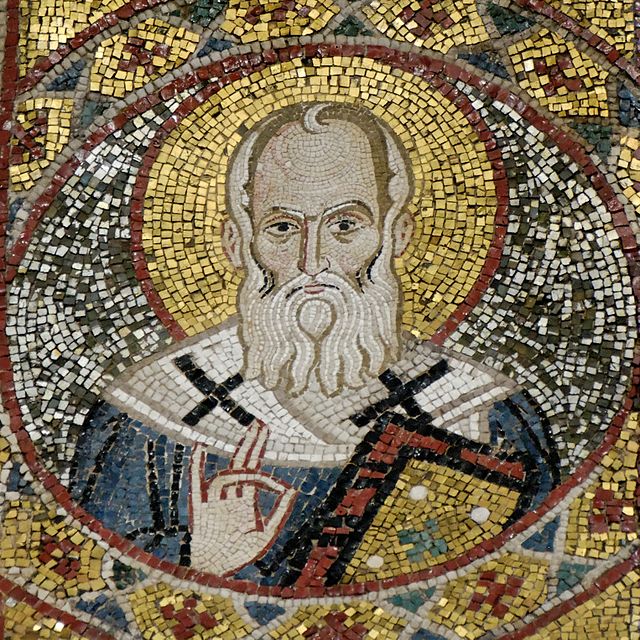
Gregory of Nazianzus: An Unhappy Faith

In the Western church, there’s a prevailing sense that a right faith is a happy one. A lot of today’s bestselling Christian pastors/authors have founded their churches on the idea that God wants you to be happy. But is that the faith that has been handed down to us by Christian tradition? Or is it something else? In an age in which the average person is a functional materialist (only believes in what they can see), have we ceased to believe that we can find fulfillment by following the plans of a transcendent being? Is the shallow feeling of happiness so enviable in our age because it’s the closest thing our culture can get to a sense of spiritual fulfillment?

I don’t know. Clearly those pointed questions say how I feel, but rather than circle back around to conversations about secularism, I want to investigate a bigger problem with the Cult of Happiness: it’s built on straw. Life stinks sometimes. People get sick. Your friends die. You step in a puddle and get wet socks. Life just ain’t always great. Rather than try to pretend we can get through it without being sad, why not just acknowledge unhappy feelings and grow in spite of them? Not only do we see that repeatedly in Scripture (see the Psalms and Jesus for some prime examples), but we see that in the writings of one of the greatest saints of all times: Gregory of Nazianzus.

Those of you that have followed me for a while may remember my previous entries on Gregory of Nazianzus. His poetry is just magnetic to me. Beyond it’s beauty and theological content, he’s not afraid to express himself. Gregory is downright miserable at times. Translator Peter Gilbert goes so far as to suggest he might be diagnosed as clinically depressed if he were alive today (On God and Man, 2). This is the faith of one of the saints that helped us understand the divinity of the Holy Spirit, and it wasn’t a particularly happy one.

Just look at this heartrending selection from On Human Nature:

…I keep an unchanging bent, while we rush
upon the sword in suicidal madness, like the swine.
What’s in fact the good of life? God’s light? But then
hateful and jealous darkness keeps me from it.
Nothing’s of any use to me. And what is there of no use to the wicked?
If only they were equally endowed,with troubles especially!
I lie helpless. Divine terror has bowed me…

93-99

YIKES!

The full poem is long, so I’ll give a little context to that excerpt: the poem opens with Gregory racked with anxiety, asking himself the big question: who am I (line 25). On one hand, Christ died to mingle his essence with the divine and lead him on towards holiness. He knows that! But on the other hand, he doesn’t feel particularly blessed. He describes himself as “a nothing… pommeled down by ills like a thing compacted” (line 43). In old age, his body is betraying him. It’s an “enemy that never lets up warring” (59-60), and he feels like he’s “carrying a corpse… locked in the hateful chains of life”(65). Where is this joy that was promised? Will it come? Was there a point to any of this?

Those of us hoping for a happy ending don’t exactly get one. He concludes his quest: “now’s a fog, but afterwards the Word, and you’ll know all, whether by seeing God or eaten up by fire… I headed home, laughing at my self-estrangement… heart in anguish smoldering,” (127-128, 130-133). This is not a happy man, but it’s still a faithful man. He ends this poem specifically because he knows he needs to trust God, even in his misery:

Stop. Everything is secondary to God. Give in to reason.
He did not create me in vain. I am turning
my back upon this song.

123-126

God didn’t create him for nothing. He moves forward in hope, even if he doesn’t feel particularly happy in the given moment.

This poetry is grim, and yet, I find it strangely compelling. It’s honest. I’ve felt these feelings. I’d go so far as to say that existential crises, self doubt, and unfathomable pain are near-universal experiences in this life. When I think about the preachers that are chasing happiness, I can’t even fathom them validating these kinds of emotions as legitimate. “God doesn’t want that for you! Seek joy!” But that advice denies the pain that we all know is real. Anyone who has lived knows that it’s painful sometimes. A saintly faith isn’t one that ignores the deep pains of the world. It’s one that sees the pain and weeps without giving up faith in God. Gregory knew pain. The psalmists felt pain. Jesus felt pain. The faith that’s been passed down all these thousands of years is a hard one sometimes. That’s ok. It’s part of the journey. To quote Rainer Rilke,

Let everything happen to you: beauty and terror.
Just keep going. No feeling is final.
Don’t let yourself lose me.

Go to the Limits of Your Longing

We seek fulfillment in our eternal God, not a dopamine rush that might get us through another work week. When things are bad, it’s okay to be sad. It’s not a lack of faith; it’s honesty. We have to remember that God didn’t create us in vain and keep trudging on our way, trusting that in the end, God knows what he’s doing.

What We Fight is So Tiny: Trust and Rainer Rilke

“God has a plan for all of us.”

That’s a truth that exists in my brain that occasionally gets dredged up when I’m talking about theology, but I don’t think I really know it in my heart. Not when it matters, anyway. When life gets frustrating, I lose myself to anxiety, stress, and disappointment. God’s plan may be a theory I’m aware of, but it’s not a reality I’m living into. To put it in meme terms:

It’s not all that Christian of me.

I’ve been wondering, “How can I trust more when things are going wrong?” This poem by 19th century Austrian poet Rainer Rilke told me exactly really helped me reframe things:

The Man Watching
Rainer Maria Rilke

I can tell by the way the trees beat, after
so many dull days, on my worried windowpanes
that a storm is coming,
and I hear the far-off fields say things
I can’t bear without a friend,
I can’t love without a sister.

The storm, the shifter of shapes, drives on 
across the woods and across time,
and the world looks as if it had no age:
the landscape, like a line in the psalm book, 
is seriousness and weight and eternity.

What we choose to fight is so tiny! 
What fights with us is so great. 
If only we would let ourselves be dominated
as things do by some immense storm, 
we would become strong too, and not need names.

When we win it’s with small things, 
and the triumph itself makes us small. 
What is extraordinary and eternal
does not want to be bent by us. 
I mean the Angel who appeared
to the wrestlers of the Old Testament:
when the wrestlers’ sinews 
grew long like metal strings, 
he felt them under his fingers 
like chords of deep music.

Whoever was beaten by this Angel 
(who often simply declined the fight) 
went away proud and strengthened
and great from that harsh hand, 
that kneaded him as if to change his shape. 
Winning does not tempt that man. 
This is how he grows: by being defeated, decisively, 
by constantly greater beings.

Gorgeous. One line that especially stands out to me: “When we win, it is with small things, and the triumph itself makes us small.” My worries are so irrelevant in the grand scheme of things. Christians throughout time have been subject to starvation, torture, and the threat of death, and they trusted God. Here I am, terrified about tiny things. I’m fighting over details, and that fighting makes me small. What would it take to give up my fighting and surrender to something far greater? To willingly be defeated by God and trust that it’s for my benefit?

I also love Rilke’s tone. It is, to quote the poem itself “seriousness and weight and eternity.” In contrast to so many modern preachers that portray the life of faith this carefree and delightful romp, Rainer doesn’t shy away from the challenge of faith. God will demand everything. He is the storm on the horizon. His angels will handle your sinews like strings. God is terrifying. The solution isn’t resisting the storm; it’s giving in.

We won’t be the same after the encounter. Jacob, the patriarch that he’s referencing, walked with a limp after his wrestling match. I doubt he wanted a limp, but he got one. He wrestled with the divine, and he was transformed. Not in the way he expected, mind you, but he trusted that this new self was a better self. So many of the heroes of faith were transformed through events that I can’t imagine them asking for. Abraham was asked to sacrifice his son. Noah was asked to watch a civilization-ending flood. Elijah hid while he was hunted by the authorities. Jeremiah the prophet was thrown into a cistern. Even Jesus, the grand revelation of God himself, was crucified. God’s action isn’t all sunshine and roses. It’s scary, but we have to trust that it’s good.

Rainer challenges us to trust with the full knowledge that it won’t end up the way we sinful beings would like. The only victory worth having is our own defeat. I only hope I can stop trying to squeeze out victories over tiny things and start losing the battle that matters.

Sanctify this Work: George Herbert’s The Altar

I ran across the poet-priest George Herbert for the first time this week, much to my delight. I’d heard of John Donne (of Batter My Heart, Three-Person’d God fame), but I had no idea that there was a whole group of 17th century English poets that had an interest in religious writing! Apparently, they’re called the metaphysical poets. Not all of them cover religious topics like Donne and Herbert, but a hearty chunk of them did. The idea of the poet-priest was popular in that day!

George Herbert was kind of a hotshot in his younger years. He went to school to become a priest, but ended up becoming the public orator at Cambridge, serving in parliament, and personally knowing the king. After the king died, he quietly left the political scene and finally got ordained. He served 2 rural churches and wrote poetry until his death at age 39. His poetry career wasn’t some way he secretly tried to stay in the limelight; he sent his poems to a publisher when he was on his deathbed for them print if they thought it might “turn to the advantage of any dejected poor soul.”

I’m astounded at his humility. He mingled with some of the most elite Englishmen of his era! To turn around and take a job as a rural priest where the churches are so small that you’re expected to cover two of them? That’s a massive shift. But he seems to have enjoyed it. He wrote a manual to help country priests, A Priest to the Temple, which speaks of the job in the highest possible terms:

The countrey parson is exceeding exact in his life, being holy, just, prudent, temperate, bold, grave in all his wayes.

George Herbert, A Priest to the Temple, Ch. 3

That doesn’t sound like someone that’s inwardly miserable. It sounds like someone who genuinely believes they’re doing something of the utmost importance. He may have left the world’s seat of power, but to him, the rural pastorate seemed every bit as glorious as what happened in the king’s court.

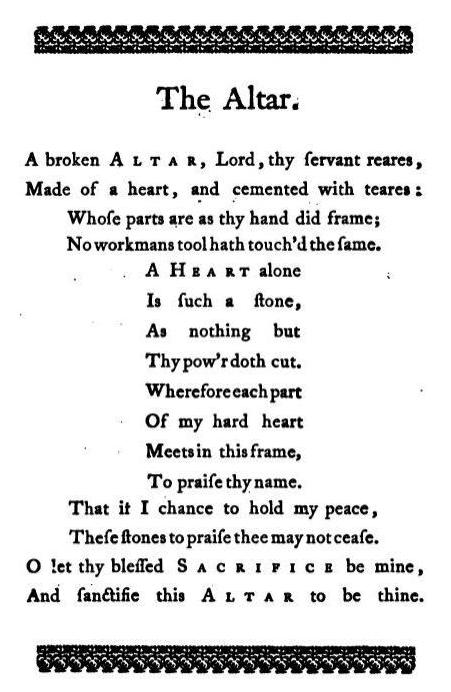
In any case, today I just wanted to look at his famous poem, The Altar. It’s been running through my head all week, and it’s really been inspiring me to think about work differently (this poem was printed in an era where the letter s often looks a lot like f, so read accordingly):

It’s a gorgeous poem. It’s rare to see linguistic and visual artistry paired so seamlessly. Different disciplines are all too often siloed, robbing us of possibilities like this. The particular line that I keep coming back to is, “sanctify this altar to be thine.” What a bold request. Obviously, it works in the context of the poem to refer to his heart, but since the poem is in the shame of an altar, it works on another level: Herbert is asking God to sanctify his work itself! He gave of himself and his time to create this poem, and now he asks God to bless it.

I don’t know how often I consider my work something to lay at the feet of God. I’m usually caught up in thinking about how many people will like it, or if it will make me look impressive or silly or whatever else. But if I sincerely give something my all and dedicate it to God, wouldn’t that be blessingworthy? Even if the world hates it, I have to imagine he’d enjoy it, and what matters more than that? No wonder George was so humble. He was serving the world, but working for the approval of an audience of one.

Life After Injustice in the Church

In a tearful, faltering, sobbing voice, the man cried out, “What should I say to my boy if I took money from you for our shame?”

Captain Snegiryov, Brothers Karamazov

Captain Snegiryov isn’t a major Brothers K. character at all.  He is publicly beaten by the hotheaded Dmitri Karamazov for no particular reason and yanked around Town Square by his beard.  All the townspeople laugh at the sight, except for the captain’s son.  He begs the crowd for help with tears in his eyes before kissing Dmitri’s hand and begging for mercy.  When Alyosha Karamazov, Dmitri’s kind brother, finds out what happened, he tries to make amends with Captain Snegiryov.  The man is poor.  He lives in a wretched shack.  Half of his family has disabilities, and none of them are capable of working.  200 rubles would change his life, and Alyosha (who runs in some particularly wealthy circles) wants to help… but the scene ends in disaster.  The captain realizes that taking money from one of the wealthy Karamazovs after his humiliation would prove to his son that the rich can do whatever they want to the poor, and justice is dictated by the powerful.  In a deeply conflicted moment, he throws the money on the ground at Alyosha’s feet and storms away in tears.  His integrity demands he not accept their money, but that same sense of integrity has doomed him and his family to a life of poverty.

His cry for justice resonated with me this week as I’ve been pondering how we address injustice in our churches.  Anybody who’s been in a church knows that sin happens, often in a way that never gets addressed.  Time passes and circumstances improve, tempting us to move on from our frustration and live into the new, comfortable norm.  But should we?  Does forgiveness involve letting go of injustices that will never be accounted for?  Or is accepting the new post-frustration reality the equivalent of taking our 200 rubles and selling out? 

A few asides before I investigate: I want to avoid the standard response of, “well, if mistakes were made in the church, you should seek out a leadership position and do your best to make sure they don’t happen again.”  Churches are massive entities, often with deeply entrenched power structures, and change takes years of work to realize.  Being wronged shouldn’t condemn the victim to years of work in the hope of making a difference.  And what about people whose talents lie elsewhere?  Should they be pressed into leadership because they were sinned against?  I hope not.  I also recognize that as a person in church leadership, I’ve made wrong choices. Not all of my decisions were the right ones, or even fair ones for that matter, and it definitely frustrated people. Leadership is hard.  Every decision has the chance of being unpopular or erroneous.  I hope the ones that I’ve made haven’t pushed anyone out of churches I’ve served in, but I am as much a perpetrator of injustice as I am a victim. I don’t get to rail against the authority, since I’m a part of it.

Onward to the question!

It’s not that sin within the institutional church is especially rare.  Gobs of famous saints were persecuted by other Christians.  There’s St. John of the Cross (thrown in prison), John Chrysostom (exiled), Evagrius Ponticus (anathematized after death and followers persecuted) , John Calvin (exiled, attacked), Martin Luther (exiled, anathematized, attacked)… you get the picture.  Churches are supposed to be beacons of hope!  The hands and feet of God!  The joy and goodness of the future on Earth now!  But here are some of our famous saints, beaten down by the very hands that were supposed to hold them up.  Some of the frustration can obviously be chalked up to the fact that they were usually persecuted by people who didn’t recognize them as properly Christian, but that doesn’t change the fact that institutional churches (full of people that bare the title ‘Christian’) have historically caused a great deal of injustice against the very people that they now recognize as worth listening to.

What do we do with the memory of injustice after we are hurt?  How do we honor our integrity while moving on?

All of this got me to go pick up Martyrs Mirror.  I stumbled across this Anabaptist classic during a day of community service about 10 years back.  I was assigned to washing windows throughout the town with a Mennonite lady.  I wasn’t much good at washing windows.  I swear I tried my best, but I was a 21 year old guy with a messy apartment and she had spent over 10 years as a housekeeper.  As you can imagine we had different standards of cleanliness.   I’d see a spotless window and she’d see a mess. In any case, we got to chatting as she politely redid my work, and somehow she brought up Martyrs Mirror.  I told her I’d never heard of it and she insisted that every Mennonite household owned one before sharing some stories from it.

It’s turned out to be a great tool to help work through some of this.  The early Anabaptists (a broad category of Christians including modern Mennonites and Amish) were pretty much killed by everyone when they first popped up in Reformation-era Europe.  It didn’t matter if you were Lutheran, Calvinist, or Catholic; you probably hated Anabaptists.  Martyrs Mirror is their book of remembrance.  Here, they weaved together the accounts of their persecution with the historical stories of persecution from Christian tradition, both in the institutional church and outside of it.  On one page, there’s someone who died for witnessing their faith in a region where Christianity was punishable by death.  On the next, you’ll find someone who was destroyed from within the church for getting behind an unpopular doctrine or making the wrong enemies.  They moved beyond the triumphal stories of people who won handily in the church through sheer prestige and charisma (lookin’ at you, Augustine) and sought out the stories of the wronged to find solidarity.  In these pages, there’s no sense that good theology or good people will win the day.  If anything, bad theology and bad people win far more often than you’d hope!  Real Christians face real pain, both in the church and outside it. Faith isn’t always about thriving materially in this world, so much as witnessing beautifully to it.

The intro cuts right to the core of the work:

Most beloved, do not expect that we shall bring you into Grecian theatres, to gaze on merry comedies or gay performances… True enough, we shall lead you into dark valleys, even into the valleys of death (Ps. 23:4),where nothing will be seen but dry bones, skulls, and frightful skeletons of those who have been slain…Yet to look upon all this will not cause real sadness, for though the aspect is dismal ac-cording to the body, the soul will nevertheless rejoice in it, seeing that not one of all those who were slain preferred life to death, since life often was proffered them on condition that they depart from the constancy of their faith.

Martyrs Mirror, 10

You’re not about to get your happy worlly show.  That’s right out.  Instead, you’ll get something morbid: death.  But this death is livelier than anything that Homer could churn out.  This is the vital death of Christ that we have the privilege of living out.

The imagery moving forward is distinctly triumphal.  These are heroes, fighting in glorious combat, seizing the ultimate prize. At one particularly noteworthy part, they reference “the knight of Christ” (no idea who he is) who was killed.  The resulting theological poem, Accolade to a Champion, is downright Arthurian:

Climb up your golden height, champion of the band of holy souls, who followed God’s red banner of blood, in oppression and in the midst of misery; where naught but the smoke and vapor of human burnt sacrifices ascended to the clouds; yet thou, hero, didst go before them, yea, didst fight thy way through the strait gate to the wide Heaven.

Martyrs Mirror, 11

It’s worth mentioning that Anabaptists are traditionally peace churches.  All violence is considered to be a sin.  It’s better to die than to kill.  Here, traditional heroic imagery of the brave knight is subverted to make the murdered victim the hero of renown.  It’s certainly not an unheard of stylistic choice, but it seems especially powerful when it’s used by someone for whom violence was never an option.  You know that at they genuinely believe, even in tremendous suffering, that “all things work together for good to them that love God,” (Rom.8:28).

There’s a million martyr stories in this book, but one that I’ve always held up as particularly awesome (and that the window washing Mennonite particularly enjoyed) is the story of Dirk Willems.  Dirk got arrested for being an Anabaptist in the Catholic Netherlands.  He managed to escape the prisons by making a rope out of bed sheets, and he was running across a frozen lake to his freedom with a guard hot on his heels.  Dirk was so malnourished from his time in prison that he could run across the ice without trouble, but the guard had eaten well while Dirk starved.  The ice broke beneath him, and he fell in, screaming for help.  Dirk heard the guard’s cry for help and turned around. He pulled the drowning guard out of the freezing water.  His choice to help was a costly one: he was recaptured, tortured, and burned at the stake. He saved the man who doomed him.

There’s not many stories that illustrate injustice as well as this one, but Dirk isn’t remembered because the Catholic Church must now be punished, or because Anabaptists are now obligated to create structures that somehow correct the problems that occurred in this instance.  The remembrance isn’t a burden; it’s a joy.  Dirk was a hero.  We remember him because we hope to be like him, and ultimately, like Jesus.

What do we do with our injustices?  How do we remember them?  Maybe we don’t.  We remember the good that was done in spite of the evil that was wrought.  That’s not to say we’re barred from seeking change or finding a new community to be with if the hurt is too much to bear, but we can’t count on the institutional church to be just! It is limited by ignorance, sin, and flaws just as much as anything in this world.  The only way to move forward after injustice is the hardest way of all: be the Christian we’re meant to be.  Forgive the sinners. Shine with all the holiness that God offers and know that regardless of what our church did or what it does in the future, we are free to be what God called us to be: a saint.

Becoming God: Gregory Of Nazianzus and Theosis

Gregory’s poetry is inseparable from theosis.  If you can’t quite remember what that is, or don’t know, theosis is the Eastern Christian doctrine that the ultimate goal of humanity is to become God.  If your heresy alarm is going off, don’t worry.  Nobody is becoming a lightning-bolt flinging god in and of themselves.  It’s more nuanced than that.

A lot of the nuance comes down to understanding essence and energy.  Humanity is supposed to become a part of God’s energy (his action in the world), but is incapable of becoming a part of his essence (his core being). Consider the classic example of the sun.  Can you see the sun?  No, actually.  You can’t see it at all. You can see the sun’s rays.  The sun is that burning ball of gas that sends off the rays of light that we see.  All the same, when we look up at the sky, we don’t say that we see the sun’s rays of light.  We say that we see the sun!  The essence of the sun would be that burning ball of gas, while the rays would be the energy of the sun.  Both are considered “the sun,” but one is the sun proper, while the other is actually the product of the sun’s action that is tied to it’s identity.

Consider God to be like the sun.  God’s essence is that is so holy and beyond our understanding that we can’t look at him directly (Exodus 33:20).  We can’t be this all-powerful, all-holy, pure being! That is for God and God alone. But sometimes we might say, “I saw God today in that person’s actions!”  We didn’t see the burning, mind-blowing essence of God; we saw his energy, or the action of God throughout the world.  Through theosis we become God, but we don’t become his essence.  As creations, we participate in God’s energy, and thus become him since his action in the world is a part of who he is.

As cheesy as it is, we are not the Son.  We are the Son’s rays of light (which are a part of the Son).

It’s a very participatory understanding of God, and one that’s thoroughly ancient.  For example, Athanasius (the guy who usually gets credit for establishing that Jesus is actually God) coined the popular phrase: “God became man so that man might become God.” (54:3, On the Incarnation). 

Gregory’s writing is absolutely soaked in the same logic.  For example, who could read this line from On the Son without hearing the logic of Athanasius?

through Christ’s sufferings, you may become God hereafter (48-49, On the Son)

Similarly, his poetry on the Father and the Holy Spirit both include references to humanity’s ultimate theosis:

Oh Spirit of God, may you waken my mind and tongue
As a loud-shouting clarion of truth, so that all
may rejoice who are united to the entire Godhead. (23-25, On the Father)

God’s gift [is] his own divinity. (On the Holy Spirit, 54)

To properly understand the Triune God, he expects people to understand how they’re being asked to become a part of it. You can’t know God without knowing how he’s inviting you to join the divine life.

The theme of theosis isn’t limited to those God-centric poems either. In considering the world and humanity’s ultimate journey towards heaven, he writes:

Of these worlds, the first-born was that other heaven,
The region of those who bear the divine, perceptible to minds only,
All-luminous; To it the man of God wends his way from here
Later, once he’s perfected as god, purified in mind and flesh. (95-96, Concerning the World)

Again and again, waves of theosis crash over the reader.  We are expected to become one with God. 

Why is it so hard to imagine someone saying this in a Western church today?

I’ve seen a few writers attempt to answer that question by blaming the way Westerners think about knowledge.  Western knowledge is often understood to be knowledge about something.  This type of knowledge is a dispassionate, supposedly objective, factual sort of understanding. Science textbooks are full of this kind of knowledge.  For example, if I look up knowledge about an apple, I might learn where it best grows, what it’s Latin name is, and how many of them were sold commercially last year.  All of this is technically true, but removed from the more intimate knowledge that comes from a genuine, firsthand experience with an apple. People who have knowledge of an apple know what it tastes like, they know the tension of an apple’s skin beneath their teeth, and they remember the shine that reflects off an apple as it’s held up to a light.  You can’t find that on Wikipedia!  That’s a different kind of knowledge; knowledge that is usually relegated to poets and artists. It might even sound more like feelings than art, but both are valid ways of gaining knowledge about something. Westerners just favor knowledge about over knowledge of.

If the apple feels to far removed from relational knowledge that you need to consider in Christianity for a being such as God, just think about how you could know a friend in the same ways: “my friend has brown hair,” (knowledge about) or “my friend is delightful,” (knowledge of).

In any case, the claim that has been made that Westerners are so concerned with knowledge about (represented by scholastic theology) that they have little interest in direct knowledge of God (as reflected by mystics and monks). Since theosis is an experiential, intimate knowledge of God, it wouldn’t really appeal to the Western mind as a worthwhile, valid source of theology.

I think that claim is completely wrong. I would even go a step further and claim that it’s biased enough that it was probably written by an Easterner that was explaining the importance of their traditions without full knowledge of vibrant Western Christian traditions.  We have no shortage of influential mystics (Julian of Norwich, Bernard of Clairvaux, St. John of the Cross, etc.) and I’ve met people that passionately seek God without any scholastic bent.  There are whole traditions that (sadly) actively deride an academic approach to faith!  And even if there were some hint of truth to the claim, I do believe that knowledge about God in the scholastic sense is important.  We need both types of knowledge to really thrive as Christians. Pitting one against the other isn’t helpful. To use the example of an apple again, if I only had personal knowledge about apples, I probably wouldn’t be able to grow apple trees.  I wouldn’t know the proper climate, anything about how they’re fertilized, or the best variety to grow for my region.  If I’m really desperately passionate about apples, both kinds of knowledge are crucially important.  The same is true with knowledge about people.  I know what it’s like to spend an evening with my wife.  If, however, I forget her birthday because I don’t value knowledge about her, then I’m going to guess our relationship will suffer for it.

No, the “Westerners don’t appreciate personal knowledge” explanation both derides some very good sources of knowledge and doesn’t speak to the vibrant Western sources of spirituality that actively exist.

My guess is that a large amount of it comes down to language and culture.  The essence/energy distinction sounds very platonic (something derived from the works of the Greek philosopher Plato) and understandings about theosis flourished in places that had close contact and influence from Greek culture and writings (Russia, Greece, etc.). Could it be that an idea with roots in Greek thought made more sense to places influenced accordingly?

The West wrote and spoke in Latin.  The essence/energy distinction was not only unexplored; mindsets shaped by Greek words and philosophies were less common.  Things simply were what they were!  God was God, and not-God was not-God.  Essence defined identity; energy translated as something like “action,” and it was not linked with identity.  The creature-creator distinction ended up being considerably sharper as a result.

Of course, the energy-essence distinction wasn’t officially given as a teaching until the 12th century, but words usually bubble up out of pre-existing logics that require definitive explanations.  And here we see Gregory talking about theosis readily, and he’s all the way back in the fourth century! The Greek language and mindset made theosis reasonable.  The Latin language and mindset made it sound heretical.

In any case, it’s a teaching that inspires me.  It’s intimate.  It’s close beyond close.  To imagine that I might not just achieve a certain level of goodness, but might reflect the actions of God so well that he and I are inseparable?  It captures the idea of being transformed by the Holy Spirit so perfectly. The fact that the guy who helped establish Jesus’s divinity (Athanasius) and one of the fighters for the Godhood of the Holy Spirit (our dear Gregory) are both onboard makes it seem like a crucial truth that we’ve forgotten. Were we made to become divine?

What would it take to make full use of the doctrine of theosis in Western churches?  And is that something we should be aiming for?  It’s a doctrine that is complicated for the Western mind, but one that illustrates the closeness of God and the importance of our transformation so well.  At minimum, I love that Gregory’s forcing me to consider a divine destiny for humanity, and, even with my little explanation, I keep pondering why it’s so hard for us to imagine.