That OLD Church Music: Psalms

The split between contemporary and traditional worship is one of the great dividers of Protestant churches in our time.  If we’re being honest, a great deal of that split comes down to music.  Do you prefer singing soft rock from Christian radio stations?  Or do you prefer classical hymns from around the year 1700 until around 1970?  For a lot of people, the answer to that question determines what kind of service they’re going to be looking for.  But what is there for people that like the oldies?  I’m talking about traditional traditional music.  No, not that newfangled Gregorian chant.  I mean that really old stuff.  I’m talking about the psalms.

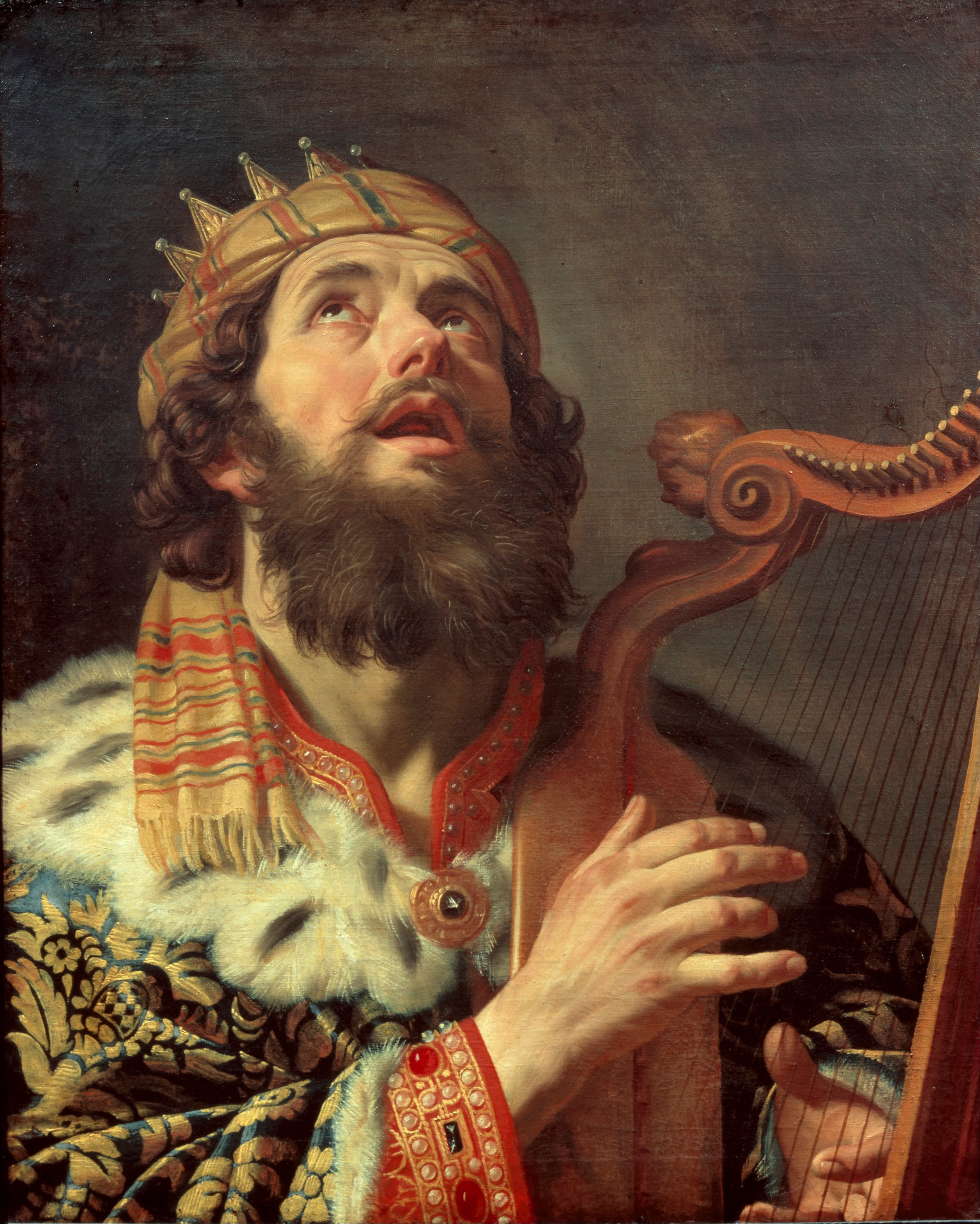
The English word “psalm” comes from the Greek word psalmos which was a type of sacred song that was sung to a harp.  In Hebrew, the book of Psalms is called tehallim.  It comes from the same root as the word “Hallelujah” (hll are the three letters both words are built around), and it means “praises.”  These aren’t poems.  They’re songs.  They’re meant to be sung during worship, usually by chant (which was the easiest way to get large groups to sing a song together before sheet music was widely available).  Not only were the psalms sung in Jewish worship (including during the time of Jesus), but they were so important to early Christians that a fair few councils in the first thousand years of Christianity went out of their way to encourage people not to sing anything other than the psalms of the Bible.  For example, canon 59 of the Council of Laodicea (held in 363 AD) reads, “No psalms composed by private individuals nor any uncanonical books may be read in the church,” (trans. Schaff).  That’s not to say you can’t find any hymns from these eras.  You certainly can, but mature Christians leaders were constantly calling Christians back to the basics.  Sing the psalms.  Before you start singing anything else, sing the psalms.

The particulars of congregational worship became less of a concern of the average person in the Middle Ages.  Every song (be it psalm or hymn) was sung in Latin, which the average person didn’t speak.  They couldn’t join in because they didn’t even know what was being sung.  Choir monks handled the singing duties on their behalf.  For the early Protestants, the Reformation wasn’t just about taking back the Bible; it was about taking back worship for the average person.  While some groups favored the use of hymns (Lutherans), Reformed and Anglican Christians stuck to the Book of Psalms.  It wasn’t until the 18th century that writers like Isaac Watts popularized and spread what we think of today as hymns in English-speaking countries.

That sense that we ought to be singing the psalms is pretty rare today.  While some of us favor guitars and some favor organs, there aren’t many that are particularly interested in singing psalms.  Which is a real shame!  For thousands of years, the psalms were the mainstays of Christian worship.  And why?  Did our ancestors lack the lyrical creativity that we have?  Were they too dull to come up with any real hit songs?  No!  They sang the Psalms because they didn’t think you could do any better than Scripture.  As great as hymns like A Mighty Fortress is My God (that one happens to be my favorite) might be , they’re not Scripture.  If there’s one little piece of worship music that sticks in a person’s head in a given week, why not have it be one of the songs that Jesus sang?  Why not have it be a psalm?

But what about our hymns?!?  What about trendy, newfangled pieces like “Rock of Ages” and even trendier pieces like “In Christ Alone”?  Is it time to get rid of them?  Of course not.  And if we’re being honest, I don’t think that’s a realistic fear at this point.  These are the songs we know.  We love them, and they’re quite good.  We don’t have to abandon them.  We could, however, afford to add the older oldies to our mix.  Take a minute today and find an arrangement of a psalm that you like.  Youtube is full of them.  There are orchestral arrangements, contemporary pieces, and even chants.  You’ll find something that you can enjoy.  Not that you’ll enjoy it all, of course, but you probably don’t like everything on the radio or in the hymnal either.  Even if it takes a few minutes, take the time to do it.  The psalms are your spiritual heritage, and they were made to be sung.  Give them a try!
Come, Holy Spirit by Ambrose (Modernized)

I’ve written previously about how old hymns are cool and it’s a shame more people don’t get the chance to sing them. One of the biggest barriers to enjoying these old hymns is their tune. No matter how theologically rich the lyrics might be and how cool the historical circumstances were, people aren’t going to enjoy a hymn if they don’t know how to sing it. I say this as someone who has been on both sides of the problem. I’ve pulled the most amazing worship music out of the dark corners of the world to share with my congregation and watched as they’ve sadly muddled through the thing, wondering why I picked something so weird. I’ve also been in the pews, desperately trying to figure out how on earth this weirdo song we’re singing this morning goes, wishing they’d have just stuck with “Amazing Grace.” New songs are hard, and new songs that are off the beaten path are even harder still. If we’re going to reintroduce some forgotten classics, we need a way to make them a little more familiar.

Back in the early days of hymnals, this wasn’t a problem. Hymnals were basically a book of poems with recommended tunes. In worship, you matched up a good tune to a good poem and BOOM! You had a hymn. So why not do that today?

This Pentecost, I reworked Ambrose’s classic hymn “Come, Holy Spirit” (Nunc Sancte nobis Spiritus) to the tune of “My Hope is Built on Nothing Less” (aka “Solid Rock”) and it was shockingly natural. I did have to tweak it in parts, add a line, and make a chorus, but I was delighted with how well it went on Sunday. For anyone looking for an ancient hymn that’s singable for Christians today, here you go!

An Odd Mix of Joy and Sorrow: Christ Jesus Lay in Death’s Strong Bands

A few weeks back, I wrapped up a class about hymns at the church.  We looked back at how music was used in worship throughout the ages and looked at some particularly famous hymns along the way.  If you’re interested in that kind of thing, we used the book Then Sings My Soul: Book 3 by Thomas Nelson, which is not only approachable and concise, but does a nice job of blending history and music. 

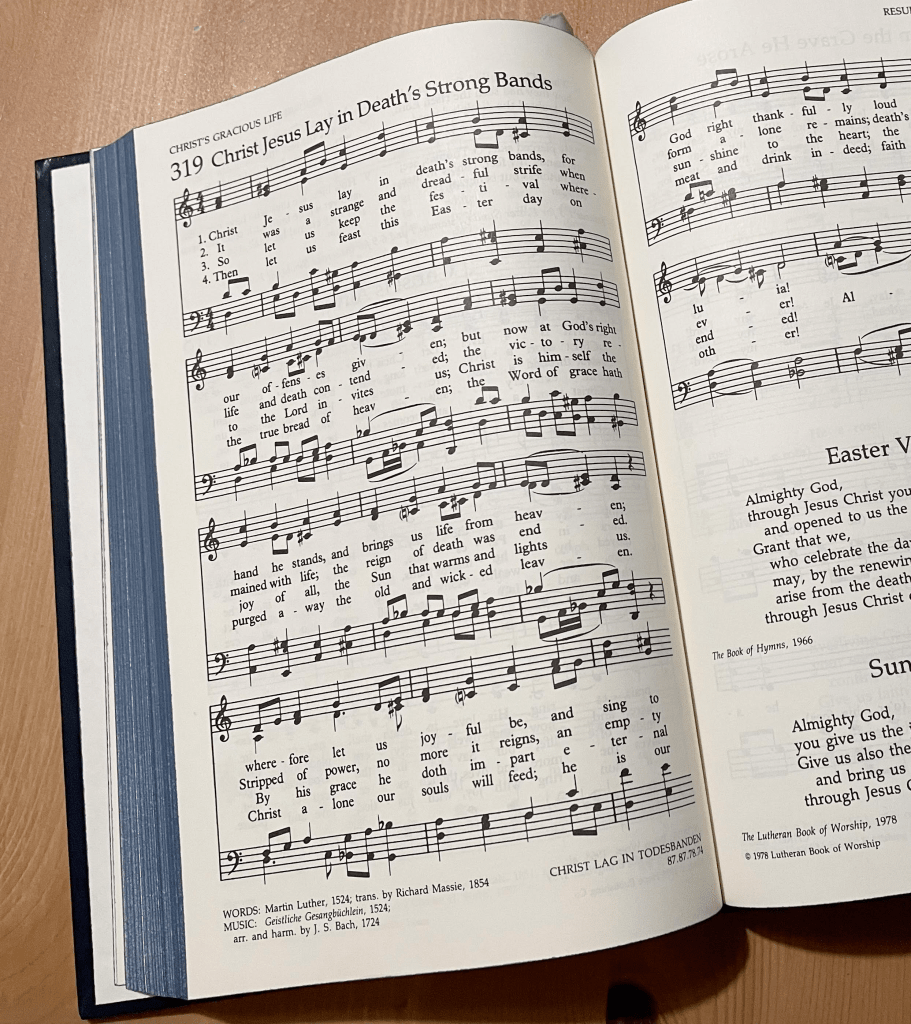
There’s one hymn that really stuck with me from that class: “Christ Jesus Lay in Death’s Strong Bands” by Martin Luther (sheet music and full copy of the lyrics here).  I have no idea how common this hymn is among Lutherans.  For all I know, they sing it every week.  Goodness knows Methodists know more than their fair share of Charles Wesley hymns.  However common it might be in other traditions, it was totally foreign to me, which means I could appreciate just how weird (and wonderful) it was. Here’s a great rendition by Concordia Publishing House:

First off, it’s an Easter song in A minor.  Who writes an Easter song in a minor key?  Easter is a celebration!  It’s glorious!  I don’t expect sad music!  But here’s Death’s Strong Bands, full of melancholy, proudly announcing Easter.  It’s a mix of joy and sorrow that I didn’t expect on Easter.

The lyrics have that same tension.  Just look at verse 1:

Christ Jesus lay in death’s strong bands
for our offenses given;
but now at God’s right hand he stands
and brings us life from heaven.
Therefore let us joyful be
and sing to God right thankfully
loud songs of alleluia! Alleluia!

The first two lines are intensely melancholy, so much so that I’m surprised by the heavenly triumph that follows! And before you say, “Hold on, Vincent!  What if Martin Luther was only saying something like ‘Christ died for us,’ in the first verse?  That could certainly be considered joyful,” hear me out.  The whole hymn vacillates between triumph and sorrow:

  • Verse two is about how all of humanity was enslaved to sin and death (mournful)

  • Verse three is about Jesus destroying death and taking its crown (triumphal)

  •  

    Verse four is about the “strange and dreadful strife” when good and evil fought and good won (triumphal, but with mournful undertones)

  • Verse five compares Jesus to the paschal lamb that died so his blood could save others (could be played either way; suffering love is a complex theme)

  •  

    Verse six and seven switch into high celebration, explicitly saying that it’s Easter and we should remember it with food, drink, and celebrations (highly triumphal)

When I talked to the class about this particular hymn, it turned out to be a lot less popular than I expected.  The most popular complaint was that it was just too gloomy to sing on Easter and too perky to sing on Good Friday. Maybe it could fit in on a Palm/Passion service? But even then you’d have to cut out the verse that explicitly says it’s Easter. It came off like a hymn with some problems that would need solved before it saw it’s day in Sunday worship.

Apparently the people who compiled the United Methodist Hymnal felt the same way.  They cut verses two, three, and five, removing the themes of death, sin, and atonement (the stuff we usually associate with Good Friday). What’s left is significantly more triumphal. Given that verse six and seven are the only two “very triumphal” verses, the percent of the hymn dedicated purely to celebration rockets up from 28% pre-edit to 50% post-edit. This is a common edit of the hymn shared by most mainline denominations and a few evangelical ones.

I can’t help but feel we’re losing something with edits like this. The tension between joy and sorrow and the battle between good and evil are what made the song interesting to begin with! If we ditch that, what are we left with? A weird, subpar Easter hymn that’s arbitrarily in a minor key. Gross. But I get what they were trying to do! They wanted to tip the balance between joy and sorrow in favor of joy! They wanted to resolve the tension and make it a little more Eastery! But resolving that tension made it boring and odd.

If were going to give it some tweaks to help it find a place in worship, a better solution (in my mind) is showcased by efforts like the band Koine. Rather than remove the tension between the celebratory stuff and the mournful stuff, they leaned into that tension. They removed verses 6 and 7 (the explicit references to Easter) and basically turned it into a Good Friday hymn:

Now that’s worth singing!  The minor key makes sense.  I get it.  The sweetness of salvation and the bitterness of Christ’s death are properly intermingled.  It feels a lot more loyal to Luther’s original intent as well. I can’t fathom someone asking him if they could ditch the stuff about Christ’s death and sin and him saying, “Oh, for sure!  Now that I think about it, it was a little gloomy.”  Not a chance.

I do have to admit that the original draft is definitely an odd hymn and a tough sell for Easter.  I almost wonder if you could split the verses and make two versions: the Good Friday edit would have verses 1 through 5, and the Easter Sunday edit would have verses 1, 6 and 7.  If you sang those different versions on their appropriate days during Holy Week, it might give a sense of continuing work that works really well. But maybe I’m working too hard to make an odd hymn work.  Or maybe I’m not properly appreciating what Martin did in the first place! Either way, this hymn’s mix of joy and sorrow hit me just right. I’ll keep pondering this hymn for weeks to come.