What Do We Mean By ”Apocrypha?”

It’s so important to know what a word means before you start disagreeing with someone about it.  I remember a whole debate that I had with an old roommate about the ethics of punching someone that was “imminently” about to attack one of your friends or you.  I insisted that you should always try to de-escalate things first while he insisted that it was unethical to let someone get punched because you weren’t willing to step in.  We went back and forth and back and forth for about an hour, much to the annoyance of his girlfriend.  It wasn’t until we started roleplaying different scenarios (yes, it went that far) that we realized that the way that we were defining “imminent” was very different.  I assumed that the hostile party had just started to become erratic and hostile, showing their fast escalation towards an attack, while he assumed that they were already deeply hostile and were literally about to throw a punch.  When we recognized the difference, we realized we didn’t disagree at all on any point, much to the continued annoyance of his girlfriend, who took the opportunity to say, “You two are so stupid.  I’ve been saying this all along.”  We weren’t arguing about ethics; we were arguing about a definition.  Unclear terms are the real culprit behind a lot of disagreements.

One theological term that is infamously unclear is “apocrypha.”  The word is varyingly defined as…

•Those extra books the Catholics have (Tobit, Judith, Maccabees 1 and 2, etc.)

•Any ancient Christian-y book that didn’t make it into the Bible (Book of Jasher, Book of Adam and Eve, Book of Enoch, etc.)

•Helpful ancient books that wise Christians know about (The Epistles of Clement, Shepherd of Hermas, etc.)

•Harmful ancient books that are mostly heretical (Gospel of Thomas, Gospel of Judas, Acts of Paul and Thecla, etc.)

That boils down to two key factors that our word is trying to get at: canonicity and doctrine.  First, it might be an attempt to discuss the canonical status of a book.  Maybe someone is trying to say it’s only canonical for Roman Catholics (or “deuterocanonical” to Protestants).  That’s one option.  But it might also be saying that a book is flat out non-canonical.  Or maybe the key concern isn’t about canonicity, but about the doctrine presented in a particular book.  That doctrine could be sound without being a piece of Scripture, or it might be horrendously heretical.  Again, the term can mean either of these things.  It’s saying something about canonicity and/or doctrine… but what exactly?  The vagueness in the term isn’t a modern invention;  it’s baked into the term from the earliest days of the Church.

Factor One: Deuterocanonical vs. Purely Non-Canonical

A fair understanding of the first factor (canonicity) can be uncovered by just looking at the meaning of the word “apocrypha”.  It comes from the Greek word ἀπόκρυφα (apokryphos), which means “hidden” or “secret.”  The word was originally used by ancient Christians (or heretics) to refer to books that were wise, but had somehow been obscured because they represented a threat to authority.  It should be obvious how often this term was used by heretics to introduce “sacred” literature that violated church doctrine.  It’s not hard to find early Church Fathers railing against apocryphal books, meaning those things that were obviously non-canonical and harmful.  A good example can be found in that famous hunter of heresy , Irenaeus, when he’s against the Gnostics:

“[T]hey adduce an unspeakable number of apocryphal and spurious writings, which they themselves have forged, to bewilder the minds of foolish men, and of such as are ignorant of the Scriptures of truth.”

Irenaeus, Against Heresies, (1, 20, 1)

Cleary, he uses the word to warn Christians about harmful, non-Canonical books.  Another good example comes from that rhetorician of Carthage, Tertullian, in his Treatise on the Soul.  He notes that some philosophers arrived at partial truths about the world by using non-Christian sources such as Greek myths, but it doesn’t concern him because they don’t actually seem to hold those myths in particularly high esteem:

“[T]hese philosophers have also made their attacks upon those writings which are condemned by us under the title of apocryphal, certain as we are that nothing ought to be received which does not agree with the true system of prophecy, which has arisen in this present age; because we do not forget that there have been false prophets, and long previous to them fallen spirits, which have instructed the entire tone and aspect of the world with cunning knowledge”

Tertullian, A Treatise on the Soul, 2

Again, apocryphal here means any book that’s not a canonical part of Christian scripture.  Clearly that is indeed a valid, historic, Christian use of the term. 

At the same time, we can find Church Fathers that use the term to refer to just the opposite on this particular axis!  Some use it to refer to consent that would go on to be accepted in the Catholic canon and not the Jewish or Protestant canon.  For those that might be unfamiliar with this kind of so-called “apocryphal” content, the Catholic Bible contains a number of additions in the Old Testament that don’t appear in the Jewish or Protestant Bibles.  Why?  Early Christians often spoke Greek and consequently read Scripture from a Greek copy of the Old Testament called the Septuagint.  The Septuagint contained seven extra books (Tobit, Judith, 1 and 2 Maccabees, Wisdom, Sirach/Ecclesiasticus, and Baruch) and a few additional chapters in the books of Daniel and Esther.  Even though a broad segment of Greek speaking Jews that used the Septuagint for Scripture readings also considered this content legitimate, ultimately the authorities in Israel neither used it nor considered it canonical.  As time went on, Jews used the content less and less, returning to the Hebrew Scriptures, and Christians used it more and more.  Eventually, there was debate in the Church about it.  Why were Christians using versions of the Jewish Scriptures that the Jews didn’t actually think was canonical?  Why use the septuagint at all instead of something that would have circulated in the region that Jesus actually lived?  Should the church remove that extra content that had been used for generations?  Or did it still count as sacred Scripture?   In his Letter to Africanus, the ever-abstract and theological genius, Origen, argued for the legitimacy of the story of Susanna (a story from the additional chapters in Daniel):

But probably to this you will say, Why then is the History not in their Daniel, if, as you say, their wise men hand down by tradition such stories? The answer is, that they hid from the knowledge of the people as many of the passages which contained any scandal against the elders, rulers, and judges, as they could, some of which have been preserved in uncanonical writings (Apocrypha).

Origen, Letter to Africanus, 9

A word that was elsewhere used to condemn non-canonical writing is now used to point at the additional Septuagint literature as actually purer, uncorrupted, Scripture, hidden away from the tyranny of Israelite authorities.  You can see that from the earliest days of the faith and in the highest circles of authority, the word is used in multiple senses to talk about the canonicity of sacred writings.

Factor Two: Safe or Dangerous Doctrine

We’ve seen how the term historically was used in different circumstances to refer to different aspects of a document’s canonicity, but that’s not all it could do!  Apocryphal could also be a way to discuss expectations for the reliability of a document’s doctrine.  Obviously, Irenaeus and Tertullian used the term to refer to books that were actively heretical and not worth reading, and Origen used it to refer to books that should be considered canonical and are doctrinally pure, but we can also find people that use the term to refer to things that aren’t dangerous, per se, but don’t have any claim towards anything resembling canon.

The compiler of the Vulgate, Jerome, is a perfect illustration of this still further way of using the word “apocryphal.” In the fourth century, Jerome was debating the details of the emerging Christian canon, and he objected to the inclusion of both deuterocanonical content and certain other books that had arisen popularly in key Christian communities.  He listed the Old Testament books he thought ought to be canonical (identical to the modern Protestant and historic Jewish canon), and then makes this note:

Whatever falls outside these must be set apart among the Apocrypha.  Therefore, wisdom, which is commonly entitled Solomon’s, with the book of Jesus the son of Sirach, Judith, Tobias, and the Shepherd are not in the canon.

Jerome, Preface to the Books of Samuel and Kings

At first glance, this appears to be little more than a further exploration of canon.  Jerome is condemning the Catholic epistles to a non-canon status, just like Irenaeus and Tertullian did with dangerous books.  But Jerome doesn’t have that same attitude of suspicion and frustration when regarding these books.  To the contrary, he seems to like them.  He occasionally quotes them in his other writings.  Jerome has the utmost respect for some of these documents that he’s calling apocryphal; he just doesn’t think they’re canonical.  That’s a far cry from Tertullian and Irenaeus’s use of the term, which was essentially “horrible heresy carriers.”  He uses the term “apocryphal” to refer to books that have positive, doctrinally-sound additions to the Christian life.

To recap, we’ve established that even from the beginning of the church, the word “apocryphal” could refer to a writing that is either canonical or deuterocanonical/Catholic, or it could be a reference to the reliability of the doctrine within a non-canonical book. It’s a broad, flexible term! And it get’s thrown around pretty readily among church people that are exploring non-canonical writings enough that it causes issues from time to time.  When you’re talking with fellow Christians about apocrypha, just remember how much history this particular term has and be careful to define what you mean when you use it. It might just save you an argument.
What Did Jesus Write in the Dirt in John 8:1-11? Big Name Theologians Weigh In

While poking around some different articles on the treatment of women in Leviticus, I stumbled across some wacky interpretations of what Jesus wrote in the sand in John 8:1-11. Let me refresh your memory on that passage (with a verse from chapter 7 to make sure we don’t start in the middle of a sentence):

53 Then they all went home,

but Jesus went to the Mount of Olives.

At dawn he appeared again in the temple courts, where all the people gathered around him, and he sat down to teach them. The teachers of the law and the Pharisees brought in a woman caught in adultery. They made her stand before the group and said to Jesus, “Teacher, this woman was caught in the act of adultery. In the Law Moses commanded us to stone such women. Now what do you say?” They were using this question as a trap, in order to have a basis for accusing him.

But Jesus bent down and started to write on the ground with his finger. When they kept on questioning him, he straightened up and said to them, “Let any one of you who is without sin be the first to throw a stone at her.” Again he stooped down and wrote on the ground.

At this, those who heard began to go away one at a time, the older ones first, until only Jesus was left, with the woman still standing there. 10 Jesus straightened up and asked her, “Woman, where are they? Has no one condemned you?”

11 “No one, sir,” she said.

“Then neither do I condemn you,” Jesus declared. “Go now and leave your life of sin.”

What did Jesus write? It’s important enough that it’s referenced twice at crucial story moments, but apparently not important enough to tell us anything about it. I’ve heard people say he was writing a passage from Leviticus 20 indicating that BOTH people were supposed to be stoned, revealing that they would be breaking the law if they stoned her because they failed to produce both parties. Others have said that he was writing the names of every accuser along with the sins that they had recently committed. I’ve even heard that he drew a line in the sand for people to cross if they felt they were worthy. There are a lot of takes out there, but most of them aren’t really founded on much apart from one person’s random guesswork. What have the major theologians of the Christian tradition said about the writing in the sand?

Naturally, I started with Augustine (because you can never go too far wrong with Augustine). Luckily for me, he preached a series of sermons about the book of John and his take was customarily good. He suggested the trap the Pharisees laid was in making Jesus choose between gentleness and justice. If Jesus approved of the women’s death, he’d be the guy that condemned peasant women and his popularity would suffer. If he didn’t approve of her death, he was speaking against God’s justice and was officially a transgressor of the law! Jesus navigates the dilemma with his typical craftiness by taking neither option. But what about the finger writing?

You have heard, O Jews, you have heard, O Pharisees, you have heard, O teachers of the law, the guardian of the law, but have not yet understood Him as the Lawgiver. What else does He signify to you when He writes with His finger on the ground? For the law was written with the finger of God; but written on stone because of the hard-hearted. The Lord now wrote on the ground, because He was seeking fruit. You have heard then, Let the law be fulfilled, let the adulteress be stoned. But is it by punishing her that the law is to be fulfilled by those that ought to be punished? Let each of you consider himself, let him enter into himself, ascend the judgment-seat of his own mind, place himself at the bar of his own conscience, oblige himself to confess… Each looking carefully into himself, finds himself a sinner. Yes, indeed. Hence, either let this woman go, or together with her receive ye the penalty of the law… [H]aving struck them through with that dart of justice, [Jesus] deigned not to heed their fall, but, turning away His look from them, “again He wrote with His finger on the ground.” 

Augustine, Sermon on John Chapter VII. 40–53; VIII. 1–11

Brilliant! Rather than focus on non-existent content, he’s looking at the symbolism of the act itself. Why would Jesus write on the ground? Because God wrote the law on stone the first time, and now he’s writing on the ground. This is the same dust that people were created from. Were they fertile enough to bear fruit after all these years? Or were their hearts still hard as the rocks that the commandments were once written on? He even returns to his idea of gentleness by indicating that Jesus didn’t stare them down after the incident, shaming them for their sin. He just keeps writing. Really nice work here.

Other patristic authors are less worthy of sharing. John Chrysostom has a sermon series on John that deliberately skips over this particular story and a lot of ancient theologians (especially in the East) follow suit, leading some to believe that they had copies of John that didn’t contain these verses. In Against the Pelagians, Book 2, Jerome suggests Jesus was writing out the names of the accusers to to fulfill Jeremiah 17:13 “Those who turn away from you will be written in the dust,” (a passage which seems to have been intended to be more poetic than literal). By and large, Augustine’s logic seems to have been attractive. Thomas Aquinas carries it forward to the Middle Ages in his mega-commentary Catena Aurea and includes support from Venerable Bede and Alcuin of York to back him up.

In the Reformation, John Calvin comes out swinging against Augustine and approaches the story without interest in allegory:

By this attitude he intended to show that he despised them. Those who conjecture that he wrote this or the other thing, in my opinion, do not understand his meaning. Nor do I approve of the ingenuity of Augustine, who thinks that in this manner the distinction between the Law and the Gospel is pointed out, because Christ did not write on tables of stone, (Exodus 31:18,) but on man, who is dust and earth. For Christ rather intended, by doing nothing, to show how unworthy they were of being heard; just as if any person, while another was speaking to him, were to draw lines on the wall, or to turn his back, or to show, by any other sign, that he was not attending to what was said. Thus in the present day, when Satan attempts, by various methods, to draw us aside from the right way of teaching, we ought disdainfully to pass by many things which he holds out to us.

John Calvin, Calvin’s Commentary on John 13:1-11

Gone is the speculative symbolism! Instead, we have a Jesus that’s just not listening. Pharisees are coming around, asking questions that they already know the answer to, and Jesus just starts doodling in the sand. That’s how little he cares what they have to say. When he says “Let he who is without sin throw the first stone,” Calvin reads that as a deliberate reference to their own sinfulness. They know they aren’t being sincere. They’re scheming, conniving, wretched men trying to kill someone to prove their own point. It’s not that the law isn’t legitimate; it’s that they aren’t being legitimate, and they know it. Again, Calvin is sticking to the Scripture pretty thoroughly and avoiding wild speculation about the writing. Well done.

The Reformation seems to be a bit of a hinge in historical interpretation. After the Reformation, commentaries that I can find seem to take a more practical approach to the matter. The symbolic dimension is swallowed up by the practical. Some lean more heavily on WHY he wrote (to avoid meddling in politics, to calm people down, etc.) while others focus on WHAT he wrote (names, sins, passages of the law, etc.). John Wesley is one of the better big-name interpreters to marry the practical and the symbolic, but his notes are still ruthlessly pragmatic:

God wrote once in the Old Testament; Christ once in the New: perhaps the words which he afterward spoke, when they continued asking him. By this silent action, he,

1. fixed their wandering, hurrying thoughts, in order to awaken their consciences: and,
2. signified that he was not then come to condemn but to save the world.

John Wesley, Wesley’s Explanatory Notes on the New Testament, John 8:1-11

Obviously there are oodles of others well worth reading, but these were the ones that I thought were worthy of lifting up. They’re all respected enough for their words to carry weight, and each seems to represent the general stream of mainstream interpretation within their era.

Ultimately, I’m really pleased with what I found. I expected to find some really wacky stuff, but a shocking majority of commentators avoided wild speculation about the specifics of the writing and interpreted in light of the information that they had, rather than what they didn’t have. Frankly, that was my bias from the outset. If the Bible doesn’t say what Jesus wrote, it couldn’t have been all that important to the story (sorry Jerome). But really, it was phenomenal to see all the directions people went with it. I have a soft spot for that symbolic dimension. It emphasized the weight of each action within the passage in a way that was far beyond the mundane. So what did he write? Beats me. As much as I like Augustine, I’ll side with Calvin for the sheer delightful possibility of Jesus rolling his eyes and playing tic tac toe against himself in the dirt while they were trying to talk to him.

Heroes of Old… and Me! Jerome’s De Viris Illustribus

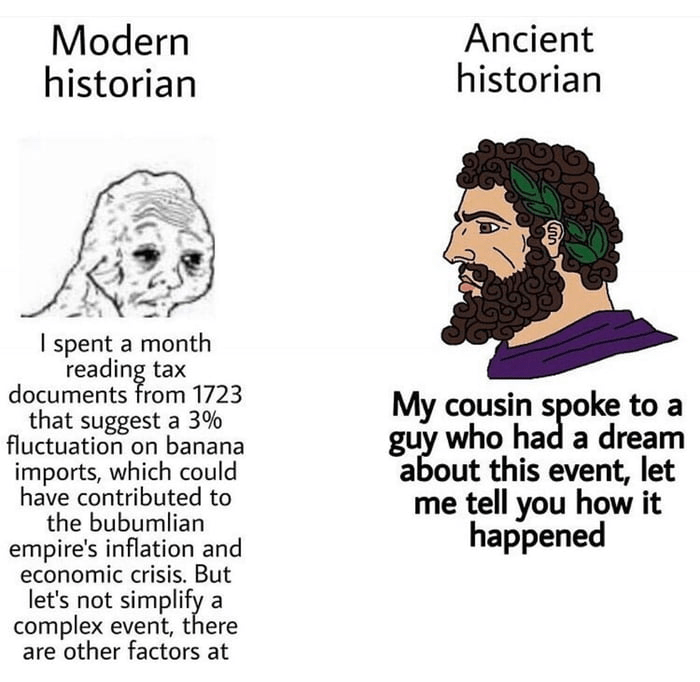
While I was doing a little more digging on Polycarp, I ran across an account of him in Jerome’s De Viris Illustribus (aka On Illustrious Men). According to Jerome, Polycarp was a student of the Apostle John, which delighted me to no end. What a neat little detail! The Biblical era is so often made it’s own little self-contained thing, so when you see those moments where apostles interacted with the generations that followed, it just makes their work seem infinitely more real. They weren’t just storybook characters; they actually lived, met people, taught them, and made leaders in the early Church. Of course, it’s not undisputed. As with all ancient history, some people think it’s true, and some people think it’s false. This particular claim has some heavy hitters weighing in behind it (Tertullian, Irenaeus, Eusebius, and Jerome) and the timelines totally line up, but ancient history is always a little sketchy. There just aren’t those ironclad sources that you have today. This meme sums it up nicely:

The sources we have in this case are a little stronger than a cousin’s friend’s dream, but you get the picture. Modernity favors exactitude, whereas ancient history is full of legends. Me? I think it’s reasonable to say that Polycarp and John met. Polycarp was a notable bishop in modern Turkey that lived through the first and second centuries. John the Apostle would have been alive and in modern Greece. It makes sense that they would have interacted. Between the timeline, the geography, and the sources, it works.

But that wasn’t the only treat in De Viris Illustribus. It had a few other treasures that are worth sharing, one which is Jerome trying to determine the authorship of various Biblical books. De Viris Illustribus is basically a who’s who of people who wrote noteworthy books for the Church. Naturally, Jerome starts with the New Testament writers, which quickly leads to conversations about who wrote what. After all, how can you bring up Paul and his writings without saying what he wrote? So did Paul actually write Hebrews? Did Peter write 2 Peter? Jerome doesn’t seem to buy either. Which is kind of nice, actually. Even though Jerome isn’t 100% sure about the authorship, he still considers the books canonical and crucial for Christians. In the modern era, questions about authorship often feels like a litmus test to see if you’re really a real Christian. It’s nice to see that things aren’t always as black and white as we think. Great saints have asked questions that we might reject offhand today. Maybe we can afford to be a little gentler when such matters come up.

I also just appreciated the nature of the book itself. Like I said, it’s a list from a big-shot theologian saying who wrote things worth your attention in the Church world. That’s something that’s shockingly rare in the modern era! If you don’t go to seminary, you may not know who is worth reading and who isn’t. I remember being a new Christian and just kind of buying Christian books at random, hoping that they were legit. A lot of what I got wasn’t worth reading. People need to know who is worth engaging with! And Jerome doesn’t pull any punches either. This isn’t a little list of authors who are comfortable and safe. There are heretics on this list! There are non-Christians! Mind you, he tells his readers why each source is worth reading and warns them about what they are, but the point stands that he’s not just filling people up with his own ideas. He’s preparing them for a greater conversation in the world at large.

Finally, I think it’s just nice to have a list of heroes. Some of the details in here are a blast! For example, he says that James the Just prayed so often that his knees “had the hardness of camel’s knees,” (Ch. 2). He says that Ignatius of Antioch’s last words before he was martyred in the arena were “I am the grain of Christ. I am ground by the teeth of the wild beasts that I may be found the bread of the world,” (Ch. 16). Polycarp is said to have met one of the first big heretics of the Church (Marcion) while they were both trying to prosthelytize in Rome and their meeting sounds like something straight out of a movie. Marcion walks up to him and asks, “Do you know us?” Polycarp responds “I know the firstborn of the devil,” (Ch. 17). Not only are these great Christians and great thinkers, but they ooze personality. Jerome even adds himself to the list as the final person of note, which is hilarious. I’d call him out for being cocky, but since his writings have survived since the fourth century, I have to admit that he wasn’t wrong.

In any case, it was a joy finding this old list of heroes worth reading. Feel free to check it out here if you demand more, or make your own list. Share it with your fellow Christians at church! Who knows how it might help someone? But a word to the wise: probably don’t add yourself as the last person on the list.

Through the Eye of an ACTUAL Needle: The Fake Gate Theory

Matthew 19: 23-24 famously reads:

Then Jesus said to his disciples, “Truly I tell you, it is hard for someone who is rich to enter the kingdom of heaven. Again I tell you, it is easier for a camel to go through the eye of a needle than for someone who is rich to enter the kingdom of God.”

There are two popular interpretations for the phrase “eye of a needle.” The first theory is that it is a reference to the tiny hole at the top of a sewing needle. Simple enough. The second theory is that it is a reference to a gate with the name “the eye of the needle” that was in first century Jerusalem. The gate was so small that anyone that hoped to get a camel through would have to take all of their baggage off the camel, get it down to its knees, and kind of shimmy the camel through the tiny opening.

You can see why this is important for Bible readers. Either Jesus is saying that it is impossible for a rich man to get into Heaven, or he’s saying that it’s really challenging for a rich man to get into heaven. There’s a big difference between impossible and barely possible. So which is it? Is it hard or impossible? What is the eye of the needle?

After a little research, I wasn’t able to find a trustworthy modern commentary that genuinely advocated for the gate theory. In varying detail, they all disproved it with archaeology, translations from the Greek, interpretive history, and the plain sense of the story. That being said, I didn’t find a single place that really poured out all of the evidence for the reader’s consideration (especially when it came to the history of interpretation). So here we go! This is my attempt to round up all of that evidence and hand it over to you.

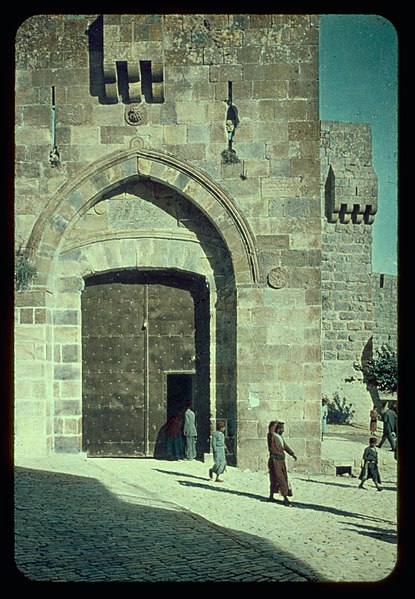
The archaeological evidence for the gate theory is pretty poor. There’s no legitimate evidence of a gate known as the “eye of the needle” gate existing in Jesus’ lifetime. I would cite something, but you can’t cite evidence proving a lack of evidence! A quick google search reveals that even modern claims about eye of the needle gates in Jerusalem are dubious at best. There’s one small Orthodox church that claims that they have the actual gate that Jesus was referring to (which looks suspiciously like a hole in an old wall). There’s also a handful of travel blogs from people that claim they went to the eye of the needle gate. None of these claims are citation-worthy. Church websites often make dubious claims (see my article about fake quotes from famous saints for more church website sins) and the travel blogs pictures feature people smiling by a variety of totally different “eye of the needle” gates. Were there gates in different times and locations referred to as eye of the needle gates? Yes. There’s gates like that in German castles from the Middle Ages and obviously a handful in Jerusalem today that claim to be eye of the needle gates. That being said, there’s no record of a gate being referred to by that title until after the year 1000. In first century Jerusalem, there is absolutely no evidence that such a gate existed. Strike one.

The Greek manuscript makes the gate theory even less viable. If the “eye of a needle” was the name of a specific gate or a reference to a type of gate, that would make the language a title. You’d have to use the same words, “eye of the needle,” every time you talked about it because you’re not actually talking about eyes and needles; you’re talking about a type of gate known as an eye of the needle gate. The story comes up three times in the Gospels (Matthew 19, Mark 10, Luke 18) and each author uses slightly different words for this phrase. Matthew calls the eye of a needle the “trypēmatos rhaphidos” (τρυπήματος ‘ῥαφίδος), while Mark calls it the “trymalias tēs rhaphidos” (τρυμαλιᾶς τῆς ‘ῥαφίδος). Both are using the same word for needle (referring specifically to a tailor’s needle), but they’re using different language to talk about the eye of that needle. Luke not only adds a third option for the eye, but uses the word for a surgeon’s needle rather than the word for a tailor’s needle: trēmatos belonēs (τρήματος βελόνης ). If they’re trying to use a title for a specific kind of gate, they’re all over the map! Two of the three of them are using the wrong words to refer to that gate. If, on the other hand, they’re talking about needles and the tiny holes in them, the differences in their accounts present no problem. Strike two.

Now to the history of interpretation. Most commentaries I looked at claimed that the gate theory was a legend from the Middle Ages, but there wasn’t much detail provided beyond that. I saw a lot of people throw around dates like the 9th century (maybe), the 15th century (definitely wrong), and the 19th century (right out), but few provided direct quotes from their sources, much less cited sources at all.

The oldest reference I could find that’s absolutely airtight comes from Thomas Aquinas’ megacommentary, Catena Aurea. It packed great quotes from multiple noteworthy church fathers into one convenient commentary. In the section on Matthew 19, he provides the following commentary from Anselm of Canturbury:

It is explained otherwise; That at Jerusalem there was a certain gate, called, The needle’s eye, through which a camel could not pass, but on its bended knees, and after its burden had been taken off; and so the rich should not be able to pass along the narrow way that leads to life, till he had put off the burden of sin, and of riches, that is, ceasing to love them.

Anselm of Canterbury as cited in Catena Aurea, Thomas Aquinas, CCEL Edition.

I can’t find a primary source from Anselm on this one, nor can I find anyone else who was able to track one down, so we’ll just have to take Thomas’s word for it. Anselm wrote in the early 12th century, so there’s definitely an uncomfortable gap here. Sources legitimately interested in uncovering the source of the theory often quote this as the its first official appearance, and I have to agree. I can’t find an earlier source than Thomas quoting Anselm. Did Anselm say it? Probably. Did he get it from someone else? I have to imagine he did. Someone that spent most of his life in England seems an unlikely candidate to start spouting off about gates in Jerusalem.

There are some people that point to an eastern bishop from the 11th century named Theophylact as the actual originator of the gate theory. If he did, it’s bizarre that he didn’t write it down anywhere and actively contradicted himself in writing. Here’s what he says on the matter in his commentary on Matthew:

As long as a man is rich and he has in excess while others do not have even the necessities, he can in no way enter the kingdom of heaven. But when all riches have been shed, then he is not rich and so he can enter. For it is just as impossible for a man with wealth to enter the kingdom of heaven as it is for a camel to go through the eye of a needle. See how Christ first said it was difficult to enter, but here that it is completely impossible. 

Theophylact’s Commentary on Matthew, Ch. 19, trans. Christopher Stade.

You can hear where he gets a little close: “when all riches has been shed, then he is not rich and so he can enter…” If there was a tiny gate where you had to get all of your gear off your camel and shimmy it through, the process might be something like that. But note that he still definitively says that it is impossible for a rich man to enter. Theophylact is describing the process of a rich person becoming poor, not talking about unpacking your camel for the sake of a narrow gate. Just to cover our bases, let’s see what he says about the same story in Mark 10:

Understand ‘hard’ here to mean ‘impossible’. For it is impossible for the rich man to be saved. This is clear from the example which the Lord gives, saying, ‘It is easier for a camel to go through the eye of a needle, than for a rich man to enter into the kingdom of God.’ For it is impossible for a camel to go through the eye of a needle.

Theophylact’s Commentary on Mark Ch. 10, trans. Christopher Stade.

Yeah, this guy is absolutely not the originator of the gate theory. Some people just misread his commentary on Matthew. This is why primary sources are so critical: because people don’t always say what others claim they did.

There are a number of proto-claims that come way closer to the gate theory than Theophylact did. For example, check out this commentary from Jerome (a Roman theologian from the 4th century):

By this saying it is shown to be not difficult but impossible. For if, in the same way that a camel cannot pass through the eye of a needle, so a rich man cannot enter into the kingdom of heaven, then no rich man will be saved. But if we read Isaiah, how camels of Midian and Ephah come to Jerusalem with gifts and offerings, and those that were previously bent and distorted by the depravity of vices entered the gates of Jerusalem, we will see how even these camels to which the rich are compared, when they have laid aside their heavy burden of sins and the crookedness of their whole body, they can enter through the narrow and strait road that leads to life.

Jerome’s Commentary on Matthew, trans. Scheck, 220-221.

Like Theolphylact, Jerome EXPLICITLY says that it is impossible. Buuuut there is that passage in Isaiah (60:6) where camels with loads of fancy gifts and people who were bent and distorted get into Jerusalem. Sooo maybe rich people can get in too if they lay aside their riches and vices? A bit of a comforting stretch for a passage saying that something is impossible. In his commentary, John Broadus goes so far as to suggest that Anselm got the idea from a misreading of Jerome’s fanciful explanation. A bit of a stretch, I think, but the connection between proto-claims like this and the gate theory are definitely real.

There’s a definite instinct in the history of this passage to try to soften the blow. Whether the eye of the needle is made a gate, the camel is made a rope (a suggested mistranslation that’s just not viable, as you can tell from the simple fact that no reputable Bible translates it that way), or the reading of the story is followed up with long statements about how being rich is actually fine if you manage to resist the allure of your riches (Clement of Alexandria among others), there are a lot of people that want this to be a little easier to swallow. Which is surprising, because all of this evidence pales in comparison with the words of Jesus in the following verses (Matt 19: 25-26):

When the disciples heard this, they were greatly astonished and asked, “Who then can be saved?”

Jesus looked at them and said, “With man this is impossible, but with God all things are possible.”

Jesus literally says that the point of bringing up the whole camel and needle thing in the first place was to say that it is impossible. He’s intentionally using an absurd image to talk about something that can’t happen! If his words aren’t enough to put the final nail in the coffin of the gate theory, I don’t know what would be.