United No More

The United Methodist Church was, in hindsight, a pretty bad name for our denomination. I can’t count the number of times that there was something controversial going on in a conference and someone would say, “UNITED Methodist?!? Why are we called united? We’re NOT united at all!” Which is fair. When you’re a part of a massive entity that’s been struggling to identify what exactly it is for as long as anyone can remember, having a name that begins with “united” must seem pretty silly. But that word didn’t get there because we were so wildly harmonious! We were named “United” Methodists because of a church merger. The Evangelical United Brethren Church and the Methodist Church came together in 1968 to create the United Methodist Church. “United” is a nod to the EUB side of the merger.

The EUB was a much smaller church than the MC. Previously EUB congregants represented about 7 percent of total UMC congregants after the merger. That being said, this all happened the zenith of Methodist power in the United States, so the EUB’s membership was still nothing to sneeze at. There are quite a few denominations around today that wish they were as big as the 750,000 member EUB church! Sizes aside, the goal of the merger was to forge a marriage of equals. There was this great ecumenical hope that more and more churches would find common ground and come together, so nobody wanted to kill that enthusiasm by creating the appearance that the MC gobbled up the EUB. Again and again during the merger, people sought out ways to ensure that EUB distinctives and heritage would be protected going forward.

But did it work? Not really. The fact that the average person doesn’t know why “united” is in the name is pretty clear evidence of that. And why should they know that? Who cares about some boring ‘ol historical details. As long as a fact sounds like an answer to a trivia question, it’s going to seem trivial in people’s hearts and minds. Education about the Evangelical United Brethren Church are still requirements in United Methodist seminaries, but again, as long as it’s kept safely in the Methodist History section, it’s not going to become something that pastors make use of in their ministry. John Meunier recorded a little piece of a General Conference petition on his blog that specifically laments several ways in which the Methodist side of the merger hasn’t honored the full heritage of the EUB. Unfortunately, the original source that he linked to has since been removed, so a big thanks to him for preserving this little piece of history:

A widespread, but largely overlooked obstacle to being an inclusive church is the omission of United from our church name and the name of our people. The Methodist Church ceased as an organization on April 23, 1968, as did The Evangelical United Brethren Church (EUB). On that date, The United Methodist Church was born, a new church created by the marriage of the two former bodies. This was the  intention of the Plan of Union. When the word United is omitted, it suggests that the marriage was a pretense and that the union was, as some disappointed former EUB’s have termed it, a hostile corporate takeover.

Since 1980, the General Conference has declared that omitting United from our church name is “unacceptable usage.” Yet the practice continues in conversation and in print. Former EUB’s are not being oversensitive about a few syllables. When Methodist is used in place of our proper name, it becomes, to them, a painful reminder of more than a dozen serious betrayals of the spirit of union and inclusiveness:

1. Glorifying Wesley and Asbury, while ignoring or belittling the inheritances from Otterbein, Boehm, and Albright.
2. Abandoning beloved EUB institutions, including Westmar College, Otterbein Press, Kamp Koinonia, and the Church and Home magazine.
3. Cutting off EUB clergy widows from their only pension income, the dividends from Otterbein Press.
4. Repeated attempts to close United Theological Seminary.
5. Identifying Heritage Sunday with Aldersgate Sunday in 1976 and 2004.
6. Removing the EUB Hymnal from circulation and canceling its status as an official United Methodist hymnal in 1972 .
7. Including only two EUB hymns in the 1988 United Methodist Hymnal.
8. Replacing “debts” or “sins” in the Lord’s Prayer with “trespasses.”
9. Excluding the EUB service of infant dedication from The Book of Worship.
10. Restoring the Lovely Lane Chapel while leaving the EUB birthplace, the Peter Kemp Farmhouse, just a few miles away, to the fickle mercies of a secular economy bent on commercial expansion.
11. Suppressing the fact that the twin flames in the cross-and-flame emblem represent the Methodist and EUB traditions and that, when depicted correctly, the two flames are equal in size.
12. Closing a disproportionate number of former EUB churches (28 percent of those closed between 1975 and 1985).
13. Representing an ash-less Ash Wednesday, the EUB practice and the universal Protestant practice before 1970, as “un-United Methodist.”

2012 UMC General Conference Petition, as cited by John Meunier at
https://johnmeunier.wordpress.com/2012/02/23/an-eub-laments/

As I’m headed to the Global Methodist Church, I’m leaving the “United.” Which is ironic. From what I can tell, the EUB was more evangelical than the Methodist Church and had distinctly less modernist influence, but now their name has been claimed by the faction that they would have least agreed with! Oh, politics. Either way, popping that word in front of the denominational name didn’t preserve any heritage. We have the opportunity to honor our theological history in more than name; we can actually know it. But it’ll take work! We need to know about more than John Wesley. Yes, I get it, he’s the guy that started the thing. Nobody is downplaying that. But where did Wesley get his much of his theological outlook? Jacob Arminius. Who helped Wesley get Methodism going in the colonies? Thomas Coke and Francis Asbury. Who wrote the famous covenant prayer he adopted? Richard Alleine. Who helped get the Gospel to German-speaking populations in the colonies? A disgraced Mennonite bishop, Martin Boehm, and a Reformed missionary, William Otterbein. And who literally helped spread Methodism among German-speakers when the actual Methodists didn’t allow preaching in German? Jacob Albright.

Of course, we also have a million ecumenical saints going back to the very beginning of Christianity to learn from and celebrate, but it’s worth noting that Global Methodists have some really cool heritage that a lot of us don’t even know about. We lost the name, but let’s not lose the treasures that history has for us.
Going Global

For about a year now, I haven’t posted all that often on the ‘ol bloggerino. Some of that was because I had just moved and was settling into a new job (which I wrote about here), some of it was because I just had a son (which ironically was a couple days before the entry on birthdays, which I didn’t plan at all), but the biggest reason was because of what’s been going on in the United Methodist Church. The church split in a super-political mess and evangelicals and traditionalists left and started a new denomination: the Global Methodist Church.

Unsurprisingly, a guy who regularly blogs about classic theology is very much a theological traditionalist, so I found myself navigating the tricky politics in all of this. I led a church through a discernment process to see if they wanted to leave. I constantly stayed up-to-date on the circumstances as they unfolded and shifted. I managed the gross politics of it all. Needless to say, it was really stressful and hard. Frankly, I don’t plan on writing about the specifics of it here anytime soon, if ever. It was ugly and there’s no immediate need to relive it. A quick google search will help you discover just bad the politics of leaving the UMC were/are. There are already very skilled people with a greater knowledge of the political circumstances than myself writing about this, so I’ll leave it to them.

But why didn’t I write anything about historic church splits? After all, I did a ton of research on the topic of church splits in America over the past hundred or so years. There were several times I wanted to blog about it, but it would have been pretty imprudent to openly talk about church splits with an orthodox/traditionalist bias when I was still working for the United Methodist Church. There were even a couple articles that I posted that I ended up taking down, just because I knew that if a congregation member stumbled across them and felt that they reflected my own opinion too clearly, it might cause trouble down the road. I had to play my hand close to my vest until their discernment process was done. If they wanted out, I’d help them navigate the process. If they didn’t, I’d head out on my own. Sadly, the final vote from church members ended with them choosing to remain United Methodist (they needed 66.6% to leave and only managed 62%), so I had to say goodbye and move on to the Global Methodist Church.

I won’t pretend it wasn’t a terrifying transition. So many of the churches that leave the UMC are able to do so because a supportive pastor helps guide them through the disaffiliation process. It only takes 34% of people to block a disaffiliation vote, and if the pastor isn’t interested in helping you leave, drumming up 34% tends to be pretty doable (if they even present disaffiliation as an option to them in the first place). I wasn’t sure if there would be an open church that I could get a job at, but God is good. Not only were there multiple opportunities available, but one of them was perfect. Sometimes, you just go to a place, meet the people and realize, “Yeah, this is it.” I’m off to Kenton, Ohio to work with Walnut Grove GMC, and I’m incredibly grateful to God for that opportunity.

It’s been a hard year, but I’m a few weeks away from being a part of a new denomination with a new church and a new future, and I’m so excited. The simple fact that clergy are actually expected to affirm the Apostle’s Creed, the Nicene Creed, and the Chalcedonian definition is music to my ears, but on top of that, language in church law concerning Scripture is elevated, language concerning tradition is more reverent, church rites have been rewritten to be in-line with historic norms, there are more listed reference documents for historic orthodoxy, and the church bureaucracy is slimmer. I’m happy as a clam (assuming, of course, that clams are pretty darn happy on the whole).

For those reading this that are United Methodist, no hate. I’m dear friends with many of you and have grown a lot during our time together. That being said, we know we believe different things. It’s time to go our separate ways. I’m sure we’ll still be friends and learn from each other, but we’ll have more integrity working seperately than we would together.

For those that are looking to jump ship and haven’t made it quite yet, hang in there and keep excited. It’s worth it.

For those that aren’t Methodist at all and are wondering why they should care about this, just remember that for Christians in any denomination under the sun, orthodoxy has a cost. No matter what tradition you’re in, no matter how sure you are that it could never happen there, it absolutely can. A friend told me that when he joined the UMC, he warned them that he would resign if they ever changed the definition of marriage in church law. Everyone laughed because “it could never happen here.” They were wrong. There is, as good ‘ol Dietrich Bonhoeffer taught us, a cost to discipleship. That cost is fighting for the faith. Don’t shrink away from heresy and call it “a matter of opinion.” Confront it with love and compassion. Correct it if you can. Leave if you must. But don’t give up. It’s worth it to keep the truth that was entrusted to us by God.

As hard as the battles can be, there comes a day when the battles end and you can beat your swords into plowshares. I found that ending, and I pray that you do too.

Birthdays in Job?

I hadn’t thought a lot about birthdays and the Bible. I had heard some vague rumblings that birthdays were a pagan custom that was imported to the faith at a relatively late date and I uncritically accepted that and moved on. Imagine my surprise when I got to John Calvin’s eleventh sermon on Job and he spoke AT LENGTH about the Scriptural, spiritual value of… birthdays?

The origin of celebrating birthdays was the fact that the ancient fathers knew that it was right to give thanks to God and that this day was a solemn time every year for blessing God openly. Yes, for if we have lived some years of our lives, even though we are to remember God’s benefits incessantly, it is nonetheless good that, on the day we entered the world, there be a perpetual reminder to say, ‘A year has passed. God has brought me this far. I have offended him in many ways, and I must now ask him for forgiveness. But especially has he granted me great grace. He has always assured me of the hope of the salvation he has provided, and he has delivered me from many dangers. So I have to remember that, and now that I have entered upon another year, it is fitting that I prepare myself for God’s service, for the bad periods I have gone through have shown me how much I need his help and how I would have been a hundred thousand times lost without him.’

John Calvin. Sermons on Job – Volume 1: Chapters 1-14 (Kindle Locations 2362-2369). The Banner of Truth Trust. Kindle Edition.

All of this comes in reference to the third chapter of Job when Job cries out, “May the day of my birth perish!” To be clear, Calvin isn’t suggesting that’s an explicit reference to a birthday celebration. In context, it’s obviously a reference to the original day of Job’s birth. Calvin is arguing that the day of our birth is a sacred gift. On that day, God imprinted his image on us and honored us with the gift of life. From then onwards, he nurtured us with sustenance and care. We should hold the memory of such a day as holy and never speak ill of that event. Honoring its anniversary is a tradition passed down from ancient times that has sacred value. He admits that pagans twisted birthday celebrations to be something primarily about self-indulgence and that all too often, that’s what birthdays end up being. But the core of the tradition is beautiful because it’s about honoring God and acknowledging what he has given.

So John Calvin thought there was a biblical aspect to birthdays. I was shocked! But even if he’s dealing with an indirect reference in this case, Job 1:4 says that Job’s children feasted together on their birthdays in the NIV translation. Not the translation I was most familiar with, but certainly one that holds a fair amount of weight. Even beyond that, a solid chunk of commentators agree that the best understanding of this passage is that Job’s children were celebrating birthdays (John Hartley’s commentary, Pulpit Commentary, Elicott’s Commentary, etc.). Clearly, this isn’t a wild minority viewpoint. A chunk of legitimate theologians believe that birthday celebrations are biblical!

So are there other references to faithful people having birthdays in the Bible? Well, first off, let’s take care of the obvious references. In Genesis 40, Pharaoh has a (somewhat infamous) birthday that involved executions. To give some background, Joseph had previously met Pharaoh’s chief cupbearer and told the cupbearer that he’d be restored to his previous standing and the baker that he would be executed. The prophecy comes to pass on Pharaoh’s birthday. Unfortunately, the exonerated cupbearer doesn’t remember that Joseph’s prophecy and so Joe ends up stuck in jail for a few more years. The other obvious example of a birthday isn’t much better. Matthew 14 and Mark 6 both refer to King Herod’s birthday, on which he allows a beautiful young girl to wish for anything. She wants John the Baptist’s head, and he reluctantly delivers. You can definitely see why birthdays have negative cultural connotations for some readers. But there are a few more references worth delving into.

In the Jewish Encyclopedia (archived online here), Adler and Roubin argue for a few other passages being indicative of birthday celebrations. Hosea 7:5 has a festival called “the festival of our king,” or “the day of our king.” The king gets really drunk that day. They argue that a remembrance of the day of his coronation would be a more somber affair (judging from the notes Josephus left in Antiquities), but a birthday would fit the description reasonably well. They also point to Jeremiah 20:14 in which Jeremiah cries out, “Cursed be the day I was born!  May the day my mother bore me not be blessed!” On one hand, this is an obvious example of Hebraic parallelism (saying the same thing twice for poetic effect), but asking that the day of his birth “not be blessed” does suggest that doing something to bless that day was a custom, which would line up very clearly with Calvin’s argument for a day of remembrance and prayer. Genesis 24 also refers to Isaac’s day of weaning, which was cause for a great feast. Rashi, perhaps the most famous Jewish commentator of all time, holds that children were weaned at 24 months and references Talmud tractate Gitten 75b as proof. This establishes that, at absolute minimum, there was a customary celebration of the second birthday, which may well have led to future remembrances as well.

There does seem to be a reasonable amount of weight against birthdays as well. First off, let’s acknowledge the bad arguments. A lot of the arguments against birthdays in that you’ll find across the internet comes from bizarre speculation. Weird websites argue that all birthdays come from this cult or that cult and gift-giving is representative of making sacrifices to false gods. There’s a mysterious lack of citations in all this, which makes sense. Birthdays aren’t really “from” any particular place, as far as I can tell. A handful of cultures all developed some form of commemorating the day of their birth, and there’s even certain eras where such celebrations gain popularity and others where they lose it depending on cultural trends. For example, Professor Howard Chudacoff argues that the modern American birthday rituals took shape in the 19th century when standardized education made age a more important factor in a young person’s life (which helps explain why there’s still an active copyright on the shockingly young song, “Happy Birthday”). All of that to say, it’s more complicated than some of the poor arguments make it out to be.

But let’s evaluate the good anti-birthday arguments. If we look to that ancient Hebrew historian, Josephus, in Against Apion book 2 chapter 26, he argues that Jews do not celebrate birthdays because they don’t want to drink to excess and want to live sober lives. Early Christians also appear nervous about birthdays. Origen definitively comes down as anti-birthday, saying in his Homily on Leviticus:

Not one from all the saints is found to have celebrated a festive day or a great feast on the day of his birth. No one is found to have had joy on the birth of his son or daughter. Only sinners rejoice over this kind of birthday. For indeed we find in the Old Testament Pharaoh, king of Egypt, celebrating the day of his birth with a festival, (Gen 40:20) and in the New Testament, Herod (Mark 6:21). However, both of them stained the festival of his birth by shedding human blood. For the Pharaoh killed “the chief baker,” (Gen 40:22) Herod, the holy prophet John “in prison.” (Mark 6:27) But the saints not only do not celebrate a festival on their birthdays, but, filled with the Holy Spirit, they curse that day.

Homily on Leviticus VIII, trans. Barkley

It does seem likely that early Christians carried the same discomfort towards birthdays that Jews of their time did. Judging from a handful of secondary sources I got my hands on, some of that Christian discomfort tended to uniquely focus on Roman and Greek religious practices that were incompatible with Christianity (the act of honoring birthday spirits and the like). As time went on, those associations dimmed and birthdays didn’t seem as threatening as they once were.

So were birthdays an alarming heathen practice throughout the entirety of Bible that the people of Israel had to resist? Or is Calvin right? Was some memorial of the day of one’s birth both reasonable and respectful and twisted only by heathen influences? I think the attitude towards birthdays likely depends on the era you’re looking at. There were a lot of groups in that region throughout history that celebrated birthdays in some way, shape, or form (Greek, Egyptian, Roman, Arabs, etc.) It would be odd for that to have been permanently and absolutely resisted as evil, especially when we take some of Adler and Roubin’s references into account. While far from airtight, they establish that there’s precedent for the idea of something like birthdays in Israel, depending on the timeframe you’re looking at. Were Job’s kids celebrating birthdays? They very well may have been, especially when you consider that Job and his family did not live in Israel and were probably used to different cultural norms. That being said, by the time you get to the New Testament era, it seems clear that the dominant Greco-Roman understanding of birthdays (along with some historical bad influences) left a distaste for them among devout Jews and Christians that wore off over the coming centuries. Ultimately, I think Calvin has a leg to stand on when he’s talking about the potential scriptural value of birthdays. Which is just a delight. Next time you have a birthday, you can rest easy knowing that you’re not secretly engaging in wild pagan idolatry.

Translation and the Gospel

A few years back, I read a really helpful article by a sociologist about different cultural communication styles.  Communicational norms were rated on two axes: direct-indirect and formal-informal.  The first axis (formal-informal) is mostly about structure.  Formal communication involves certain levels of decorum, contains some form of hierarchy, and moves at a slower pace.  Informal communication is freer and quicker, but it leaves a little more room for error.  The other axis (direct-indirect) has a little more to do with efficiency and manners than form.  A direct communicator says exactly what they mean, but it’s not always pretty.  An indirect communicator dances around the point a bit, but they don’t run much of a risk of offending anyone.

Everyone has their own expected style of communication based on the norms that they’ve worked within, but when we enter areas with other dominant communication styles, we have to pay really close attention.  It’s easy to misunderstand or be misunderstood!  An example that was offered up involved a German analyst that was working at a British company. His manager stopped by his desk one day and asked if he’d ever considered doing his reporting a little differently.  The analyst said no.  The manager gave a bit of a sigh and wandered away.  A week passed.  New reports were filled out.  The manager was back at his desk.  “Hmm, I really do imagine we’d all be able to read the reports much more quickly if the format was a little different.  Have you ever thought about that?”  The German admitted that he hadn’t thought about that before and went back to work.  The manager walked away.  Again, reports were filled out.  Again, they were the same.  The manager come to the worker and told him that he would have to be let go.  He was shocked!  Why?  The manager told him that he’d been asked repeatedly to change the way he was reporting and he had failed to do so.  The German was legitimately baffled and insisted that he’d never once been asked to change the report!  He’d only been asked if he had considered alternative methods.  It seemed like a really theoretical question to him, but to the British manager, he was practically barking orders.  The German was used to a much more direct style of communication (as Germans tend to be), while the British manager had a comparatively more indirect way of communicating (as is the norm for many Brits).  In this case, the difference in expectations cost the German his job.

Was the story true?  No idea.  It certainly could have been.  And I think it highlights how important recognizing communication styles can be.  Not that this particular model is the end-all be-all of communication styles.  There are all kinds of models out there.  This one seems considerably less arbitrary than some others, but I’m sure there are alternatives worthy of consideration and more axes you could add.  Either way, it made me think of my work in ministry and how I communicate effectively (or ineffectively) because of these expectations.

My speech style tends to be informal-indirect.  This was the dominant way of speaking in the region I grew up (central Ohio), and I think it’s relatively common throughout the midwest.  To us, informal language shows that you don’t think you’re better than anyone else.  You’re just a regular person trying to get a message across without any bells and whistles.  Formal communication seems comparatively stifling.  For example, when I worked in banking, I remember people sending e-mails that said, “Please advise on this project’s status,” and rolling my eyes.  They could  have just swung by my desk and asked, “Hey, what’s going on with this?”  I’m no grand vizier.  No “advising” seemed necessary.  As for the indirectness, it just seems so much more polite than the alternativve.  If you dance around the point just a smidge, you can say something without stepping on any toes.  For example, if you asked if I wanted a slice of pie that you brought over, I might say, “That pie looks phenomenal!  I wish I had room in my stomach, but if I ate one more piece of pie, I’d burst.”  That means no.  Further asking will not result in a new answer.

My move to Appalachia has thrust me into a region where the most common communication style is a little different.  The dominant axis of communication down here is informal-direct, and my words require some translating at times.  I remember someone asking me in my first few weeks if I wanted them to do some task around the church that I didn’t really want them to do.  I responded with the perfect informal-indirect response: “Gosh, I love your energy!  We need more of that kind of passion!  And you’re looking to address something that’s so needed around here.  My only concern is… is this the right time for that?  Because if we do the right act at the wrong time, it may well be worse than no action at all.  Why don’t we hold on that for a while and wait until we can really find that perfect opportunity.”  

The poor congregant just kind of stared at me.  “Soooo… you want me to do it next week then?”

Someone else in the room translated for her: “He says he doesn’t want you doing that.”

I was horrified.  How rude!  I didn’t say that!  I mean, I did, but I danced around and made it way prettier.  A “no” in such uncertain terms was practically a gunshot in my mind, but the congregant didn’t seem to mind.  “Oh, ok,” she responded.  And she went about her day as though nothing had happened.

There’s been a few occasions like that where what I say requires translation from a native speaker.  Which leaves me excited as I’m digging into Schleiermacher’s “On the Different Methods of Translating.”  This is a classic in translation theory and theology.  He opens by acknowledging that translation is far more than just switching one language to another:

Are we not often compelled, after all, to translate for ourselves the words of another person who is quire like us, but of a different temperament and mind?  …Occasionally we must translate even our own words, when we want to make them our very own again.  And this skill is practiced not only for the purpose of transplanting into foreign soil what a language has created in the fields of scholarship and the rhetorical arts, thereby expanding the horizon of power of the mind, but it is also practiced in business transactions between individuals of different nations, and in diplomatic exchanges of independent governments, in which each is accustomed to speak in its own language to ensure strict equality without making use of a dead language.

”On the Different Methods of Translating,” (ironically) trans. Waltraud Bartscht, Theories of Translation, 36-37.

Translation is a vast project of getting an idea to one person to another in a comprehensible way.  How do we do it well?  What are its boundaries?  And is he stretching the word “translation” further than it should be stretched?

There are massive implications here for our Bibles.  More importantly, I think there are massive implications for the way we share our faith.  Are we “translating” Christianity to each person when we share the Gospel, seeking to explain it in a  way that both honors the original intent, yet can exist within the region’s dominant social imaginary?  What constitutes a valid translation of the Gospel message and when has someone left the original intent so far behind to appeal to the dominant social imaginary that their “translation” ceases to be legitimate translation?

Engaging Existentialism with Sartre

People tend not to give their ideological opposition fair representation in arguments.  I remember a VERY Methodist professor at Duke Divinity School that would rail against Calvinism on a weekly basis.   I’m not sure most of the students in his class knew what Calvinists really were, but that didn’t stop him from explaining why they were wrong.  To all listening, the primary characteristics of a Calvinist appeared to be intellectual cruelty and absurdity.  Had any of us ever met a real Calvinist after his class, it’s safe to say they wouldn’t have recognized them, much less have been able to meaningfully debate them.  And why?  Because we didn’t actually know what they stood for.  We didn’t know what they believed in their words.  We only knew them through a lousy argument about how dumb they were.

It’s so important to actually know what people we disagree with actually believe.  More than that, I think it’s important to hear it in their own words.  Even a bad idea can contain a shocking amount of beauty. And what better school of philosophy for a pastor to explore than existentialism?  It tends to be seen as the most popular anti-Christian ideology in pop culture. Is that wrong? I don’t think so. Existentialist dogmas tend to be about as far as you can possibly get to Christian ones. There are almost no commonalities to build upon in dialogues with one another. It’s easy to hold them up as the thing that we ought not to be, but how often do we really sit down and listen to them? Sure we don’t agree. We know that. But how can we offer a meaningful and fair critique unless we really know what it is that they believe?

I stumbled across At the Existentialist Café by Sarah Bakewell a few weeks ago, and what an absolute treat it’s been.  It’s a history of modern existentialism, but the way she presents everything is so engaging.  She takes extra care to talk not just about ideas, but people.  Who were these thinkers?  Why did they believe what they believed?  What were their weird little eccentricities?  It’s so much easier to remember people and what they stood for when they’re such vivid characters in your mind. That being said, the challenge of the book is that it throws a LOT of people at you relatively quickly, which lowers your odds of fully remembering anyone.  So, I’m taking my time with it. I’m reading some primary sources from people that seem like they’re worth remembering.

I’m starting with Jean-Paul Sartre’s book, Nausea, which I found by starting with his cornerstone work Being and Nothingness, realizing that it seemed really unpleasant, and googling “easiest fun book to read by Jean-Paul Sartre.”  I mean, the guy was a novelist and a philosopher, so leaning more on the novelist side to enjoy his stuff feels intuitive.  I’m still working through it, but there can be no doubt that Sartre can write beautifully.  For example, take his description of a conversion experience. He recognizes that things his life have shifted and he’s pondering why that is when he stumbles onto an answer:

I think I’m the one who has changed: that’s the simplest solution.  Also, the most unpleasant.  But I must finally realize that I am subject to these sudden transformations.  The thing is that I rarely think; a crowd of small metamorphoses accumulate in me without my noticing it, and then one fine day, a veritable revolution takes place. 

Nausea, Sartre, p. 4- 5 (New Directions, 2013)

Strangely, I can relate to that conversion experience more than I can most Christian ones.  There’s this pressure to have a clear, obvious moment where you have a divine experience that brings you to faith.  I don’t doubt that some people have the privilege of these sorts of experiences, but many do not, ESPECIALLY not in their early days of faith.  I’ve sometimes felt obligated to carve out a grander narrative so people aren’t disappointed.  I have a hard time keeping my own conversion myths straight when I do dabble with them. Little details never seem to line up from one telling to the next. One time, it was all because I was asking questions. The next, it’s because I loved my mother. The time after that, it becomes a sort of rediscovery of my childhood faith. Which is true? All of them, I suppose. And none of them. The true story is hard to pin down. Conversion was transformation little by little until… I’m not even sure!  I don’t know the moment when I officially moved from one to the other.  I could throw some options out there, but the simple truth is that a great deal of moments went into the creation of a “veritable revolution” in my life.

***Sidenote: Why do Christian conversion stories so often feature encounters with the divine? Is it to establish that God is real? That we have a relationship with him? Probably. Relationship with God over theory about God. But I didn’t get any good divine experiences until a ways down the line, so I maintain a little less grand conversion stories are totally valid.***

Back to Sartre! Another major theme he’s exploring is adventure.  What makes an adventure?  Can one really have an adventure?  That’s what he’s sought out all his life, to be a man of adventure, and he’s had many travels and experiences that might qualify as such, but he wonders, are they actually legitimate adventures?  Or can they only really be adventures in hindsight?  For example, when he traveled around the world, almost any exotic location started to seem like just one more plot of land in a matter of weeks.  The newness would wear off and the adventure would just turn out to be a continuation of regular life.  Similarly, he remembers a time that he was robbed and fought off the mugger.  What a daring tale!  But was it an adventure?  How could it have been?  He didn’t even know it was going to happen when he set out that morning.  You ought to set out to have adventures, not just declare something to be so after the fact.  But there’s the problem: when he sets off to have an adventure, he ends up just living regular life, and when he recalls adventures, he rarely knew he was about to have one.  One morning after a dreadfully long passage detailing every tiny bit of a relatively boring evening that he was reveling in, he writes:

What disgusts me is having been so sublime last evening.  When I was twenty I used to get drunk and then explain that I was a fellow in the style of Descartes.  I knew I was inflating myself with heroism, but I let myself go, it had pleased me.  After that, the next morning I felt as sick as if I had awakened in a bed full of vomit.  I never vomit when I’m drunk but that would really be better.  Yesterday I didn’t even have the excuse of drunkenness.  I got excited like an imbecile.

Nausea, Sartre, p. 94

Who among us hasn’t had an evening where we felt like a grand adventure was unfolding?  Where we feel like a big hero. In those moments, time is passing in such a way that things feel incredibly meaningful! But when we look back… we just went out to eat with a friend. How ridiculous! What a perfect insight into people. I imagine this sort of thinking will blossom into a greater emphasis on our perception of events, rather than the events themselves. I’m eager to see what I’ll think when I get there, but in the meantime, I’ll be darned if he didn’t write it beautifully.

A fun start to Sartre. Even if I don’t subscribe to his philosophy, he writes beautifully and there’s a lot of insight to be enjoyed. More to come!

Beyond the Mundane: William Carlos Williams and John Heath-Stubbs

A friend and I have a standing engagement to read poetry together and judge which poet is better (using the very precise metric of whatever we happen to enjoy in a given week). Each week, we each pick a new poet to do battle. Not that there’s any sense of competitiveness. We often pick poets we’ve never heard of before. Who cares? It’s just a silly excuse to hang out and read stuff. But this week, I’ve found one of the most imbalanced matchups so far: William Carlos Williams vs. John Heath-Stubbs. I can’t fathom giving William Carlos Williams a vote, but not for the reasons you might think.

I’m sure many of you are familiar with William Carlos Williams. He wrote the famous poem This is Just to Say:

I have eaten
the plums
that were in
the icebox

and which
you were probably
saving
for breakfast

Forgive me
they were delicious
so sweet
and so cold

This is Just to Say, William Carlos Williams

I hadn’t looked at this one since high school, but here it is again. Here’s another of his, Danse Russe:

If I when my wife is sleeping
and the baby and Kathleen
are sleeping
and the sun is a flame-white disc
in silken mists
above shining trees,—
if I in my north room
dance naked, grotesquely
before my mirror
waving my shirt round my head
and singing softly to myself:
“I am lonely, lonely.
I was born to be lonely,
I am best so!”
If I admire my arms, my face,
my shoulders, flanks, buttocks
against the yellow drawn shades,—

Who shall say I am not
the happy genius of my household?

WCW

Now, WCW’s opponent is someone I’m sure most of you haven’t heard of: John Heath-Stubbs. Who on earth is that? I didn’t even know who he was before I stumbled onto him. He’s much less famous and considerably more contemporary, but here’s a little selection:

In the middle of the world, in the centre
Of the polluted heart of man, a midden;
A stake stemmed in the rubbish

From lipless jaws, Adam’s skull
Gasped up through the garbage:
‘I lie in the discarded dross of history,
Ground down again to the red dust,
The obliterated image. Create me.’

From lips cracked with thirst, the voice
That sounded once over the billows of chaos
When the royal banners advanced,
replied through the smother of dark:
‘All is accomplished, all is made new, and look-
All things, once more, are good.’

Then, with a loud cry, exhaled His spirit.

Golgotha, John Heath-Stubbs

And, at the risk of posting altogether too much poetry, here’s another that’s indicative of his style:

The Old Swan has gone. They have widened the road.
A year ago they closed here, and she stood,
The neighborhood houses pulled down, suddenly revealed
In all of her touching pretentiousness
Of turret and Gothic pinnacle, like
A stupid and ugly woman
Unexpectedly struck to dignity by bereavement.

And now she has vanished. The gap elicits
A guarded sentiment. Enough bad poets
Have romanticized beer and pubs,
and for those whom the gimcrack enchantments
Of engraved glass, mahogany, plants in pots,
Were all laid out to please, are fugitives, doubtless,
Nightly self-immersed in a fake splendour.

Yet a Public House perhaps makes manifest also
The hidden City; implies its laws
of tolerance, hierarchy, exchange.
Friends I remember there, enemies, acquaintances,
Some drabs and drunks, some bores and boors, and many
Indifferent and decent people. They will drink elsewhere.
Anonymous, it harboured
The dreadful innocent martyrs
Of megalopolis- Christie or Heath.

Now that’s finished with. And all the wide
And sober roads of the world walk sensibly onwards
Into the featureless future. But the white swans
That dipped and swam in each great lucid mirror
Remain in the mind only, remain as a lost symbol.

The Old Swan, John Heath-Stubbs

I’ll be the first to admit that Heath-Stubbs isn’t my ideal cup of tea.  Golgotha, for instance, has some clumsy-sounding alliteration (“gasped up through the garbage” and “discarded dross” are a bit much for my taste).  The Old Swan seems to play to his writing strengths a little more, but I recognize that it’s a poem that may stick in my mind because I can relate to the circumstances. Not everyone can, and I’m sure some people would just find it dull. All of that to say, I’m not arguing that John Heath-Stubbs is some kind of perfect paragon of poetry (points off for alliteration; it’s a bit much for my taste). I do, however, think that his work is infinitely preferable to that of William Carlos Williams.

At first, I didn’t really get what WCW was doing at all. Why the jaunty plum poem? Why the weirdo dancing guy? So I read up a little on his goals. Williams wanted to uncover the poetic spirit of the everyday life and the beauty of American language as it was genuinely spoken. No traditional prose was needed. Nothing fancy. Nothing extraordinary. Instead, just look to the ordinary and see it for what it is. Cut away all the unnecessary ideas about what poetry is supposed to be and what fancy words should be used and you’re left with an honest statement of what is. While all of WCW’s work doesn’t conform to this methodology (American Imagism), most of his famous stuff seems to (This is Just to Say, Danse Russe, The Centenarian, Between Walls, etc.). To WCW, what is poetry? It’s a note that you left to your wife explaining where the plums have gone. It’s a broken bottle in a parking lot. Poetry is nothing pretentious. It’s just life! Simple, beautiful life.

Now when we look at the selections from Heath-Stubbs, what do we see? Not a glorification of the mundane, but a yearning for something just beyond the mundane. Why is an old pub worth remembering? Because that place was different somehow. It was a place where community was possible between radically different people. It was a place of ideas and chatter. It may have reeked of a tacky faux-elegance, but both it and everyone there aspired to something more than what was. Even his more straightforward poem of the two, Golgotha, looks at what humans are through deep metaphorical, religious language. We have this brilliant depiction of Adam, the heart of what humanity is, discarded each person’s heart, buried in a trash-heap. He’s crying out to be created properly. Something beyond has to rescue him. What is poetry to Heath-Stubbs? It’s capturing something more. There’s something juuuust beyond our eyes. Can we see it directly? No. Can we fully understand it? No. But if we use the right words and look in the right places just right, we might get a peek of this thing that’s better than all that we’ve made.

Ultimately, I see two styles: one content with what is, and one that looks beyond what is to see what really is. One is glorifies the mundane, while the other sees the mundane as something that beckons them onward. William Carlos Williams would see a pub and write a poem about a fun moment that occurred at that pub or a beer glass that gets a special sheen on it when seen in a particular light. Heath-Stubbs sees a pub and he sees the glories of Heaven.

To be clear, I don’t think William Carlos Williams is some kind of despicable hedonist. I just think he’s missing out. I think the simple, self-contained pleasures are just a shallow taste of what lies beyond them. To paraphrase Saint Augustine in On Christian Teaching, every thing exists either as something to be enjoyed or something to be used. “Toenjoy a thing is to rest with satisfaction in it for its own sake.” (I.4), whereas to use something is to find whatever you’re looking for through its proper use. To be clear, there’s nothing wrong with using things in Auggie’s model. After all, God is the only real end for our desire. Nothing else will fully satisfy us! Even people are meant to be used as means to the end of enjoying God. That’s why we ought to talk to people and care for them; we enjoy God through them. William Carlos Williams spends a lot of time on plums and tiny, self-contained ideas. He’s enjoying the thing. I wish he would move past enjoying the plum to enjoy the God that we can know through it.

God is Red: Zhang Yinxian and True Discipleship

Back when I was first trying to find good books about Christianity, I went to my local library and grabbed whatever was on the shelves. One of those books happened to be Liao Yiwu’s God is Red, a series of interviews with people who endured persecution in communist China around the time of the Cultural Revolution. It made quite the impression on me. Specifically, the story of Zhang Yinxian was one that I never forgot.

Zhang was an orphan that became a nun at the cathedral of Dali in the Yunnan province. That church was MASSIVE. There were over 400 that lived in the church complex and thousands who came from throughout the province to worship. All of that changed when the communists took over. Church property was confiscated. Worshipers renounced their faith to avoid punishment from the government. Out of thousands who worshiped, only three remained faithful: Zhang, her Aunt Li, and Bishop Liu.

They were beaten. They were imprisoned. They were released as pariahs at the bottom of the social ladder with few opportunities to avoid poverty. On top of all that, they had to endure mass denunciations. They would be trotted out in front of crowds that would spit at them and scream about how narrow-minded and backwards they were and how they were leeches on society. They endured all of that for thirty-one years.

In 1983, the Communist Party changed policies. Certain religions were now acceptable. People could worship freely. Church property would gradually be returned. Zhang, Li, and Liu were given modest apartments… but that wasn’t enough for them. They went to the local statehouse and started a hunger strike until they got their church back. The people that passed by them weren’t sympathetic: “You oughta be grateful for what you got! Be more patriotic!” But they stayed and they prayed and waited. A government official spoke with them and told them that they’d get their church back but these sorts of things took time. They said, “Thank goodness, because we’re hungry and we can’t eat until we have our church back. Here’s to hoping its soon!” The official got furious and called them greedy for demanding a massive building for just three people. They just said that it wasn’t for them; it was for God. They wanted to go to his house and worship him.

After 31 years of persecution, they got their church back. Thousands once worshiped there, but after thirty-one years of persecution, only three remained. There may have been a big crowd at that sanctuary, but there were only three real disciples.

Would I have been one of those three? I hope so, but I also know that I can’t fathom how hard it would have been to endure. Only an unshakable faith can endure trials like that, and an unshakable faith doesn’t just spring up by accident. It takes deliberate training and constant nurture. How can we help make disciples like Zhong, Li, and Liu? And how can we become disciples like that? I don’t know. But that mental image of little old Aunt Li getting spat on and screamed at while she loved Jesus has certainly stuck with me. Here’s to hoping I can be as faithful as she was.

What Did Jesus Write in the Dirt in John 8:1-11? Big Name Theologians Weigh In

While poking around some different articles on the treatment of women in Leviticus, I stumbled across some wacky interpretations of what Jesus wrote in the sand in John 8:1-11. Let me refresh your memory on that passage (with a verse from chapter 7 to make sure we don’t start in the middle of a sentence):

53 Then they all went home,

but Jesus went to the Mount of Olives.

At dawn he appeared again in the temple courts, where all the people gathered around him, and he sat down to teach them. The teachers of the law and the Pharisees brought in a woman caught in adultery. They made her stand before the group and said to Jesus, “Teacher, this woman was caught in the act of adultery. In the Law Moses commanded us to stone such women. Now what do you say?” They were using this question as a trap, in order to have a basis for accusing him.

But Jesus bent down and started to write on the ground with his finger. When they kept on questioning him, he straightened up and said to them, “Let any one of you who is without sin be the first to throw a stone at her.” Again he stooped down and wrote on the ground.

At this, those who heard began to go away one at a time, the older ones first, until only Jesus was left, with the woman still standing there. 10 Jesus straightened up and asked her, “Woman, where are they? Has no one condemned you?”

11 “No one, sir,” she said.

“Then neither do I condemn you,” Jesus declared. “Go now and leave your life of sin.”

What did Jesus write? It’s important enough that it’s referenced twice at crucial story moments, but apparently not important enough to tell us anything about it. I’ve heard people say he was writing a passage from Leviticus 20 indicating that BOTH people were supposed to be stoned, revealing that they would be breaking the law if they stoned her because they failed to produce both parties. Others have said that he was writing the names of every accuser along with the sins that they had recently committed. I’ve even heard that he drew a line in the sand for people to cross if they felt they were worthy. There are a lot of takes out there, but most of them aren’t really founded on much apart from one person’s random guesswork. What have the major theologians of the Christian tradition said about the writing in the sand?

Naturally, I started with Augustine (because you can never go too far wrong with Augustine). Luckily for me, he preached a series of sermons about the book of John and his take was customarily good. He suggested the trap the Pharisees laid was in making Jesus choose between gentleness and justice. If Jesus approved of the women’s death, he’d be the guy that condemned peasant women and his popularity would suffer. If he didn’t approve of her death, he was speaking against God’s justice and was officially a transgressor of the law! Jesus navigates the dilemma with his typical craftiness by taking neither option. But what about the finger writing?

You have heard, O Jews, you have heard, O Pharisees, you have heard, O teachers of the law, the guardian of the law, but have not yet understood Him as the Lawgiver. What else does He signify to you when He writes with His finger on the ground? For the law was written with the finger of God; but written on stone because of the hard-hearted. The Lord now wrote on the ground, because He was seeking fruit. You have heard then, Let the law be fulfilled, let the adulteress be stoned. But is it by punishing her that the law is to be fulfilled by those that ought to be punished? Let each of you consider himself, let him enter into himself, ascend the judgment-seat of his own mind, place himself at the bar of his own conscience, oblige himself to confess… Each looking carefully into himself, finds himself a sinner. Yes, indeed. Hence, either let this woman go, or together with her receive ye the penalty of the law… [H]aving struck them through with that dart of justice, [Jesus] deigned not to heed their fall, but, turning away His look from them, “again He wrote with His finger on the ground.” 

Augustine, Sermon on John Chapter VII. 40–53; VIII. 1–11

Brilliant! Rather than focus on non-existent content, he’s looking at the symbolism of the act itself. Why would Jesus write on the ground? Because God wrote the law on stone the first time, and now he’s writing on the ground. This is the same dust that people were created from. Were they fertile enough to bear fruit after all these years? Or were their hearts still hard as the rocks that the commandments were once written on? He even returns to his idea of gentleness by indicating that Jesus didn’t stare them down after the incident, shaming them for their sin. He just keeps writing. Really nice work here.

Other patristic authors are less worthy of sharing. John Chrysostom has a sermon series on John that deliberately skips over this particular story and a lot of ancient theologians (especially in the East) follow suit, leading some to believe that they had copies of John that didn’t contain these verses. In Against the Pelagians, Book 2, Jerome suggests Jesus was writing out the names of the accusers to to fulfill Jeremiah 17:13 “Those who turn away from you will be written in the dust,” (a passage which seems to have been intended to be more poetic than literal). By and large, Augustine’s logic seems to have been attractive. Thomas Aquinas carries it forward to the Middle Ages in his mega-commentary Catena Aurea and includes support from Venerable Bede and Alcuin of York to back him up.

In the Reformation, John Calvin comes out swinging against Augustine and approaches the story without interest in allegory:

By this attitude he intended to show that he despised them. Those who conjecture that he wrote this or the other thing, in my opinion, do not understand his meaning. Nor do I approve of the ingenuity of Augustine, who thinks that in this manner the distinction between the Law and the Gospel is pointed out, because Christ did not write on tables of stone, (Exodus 31:18,) but on man, who is dust and earth. For Christ rather intended, by doing nothing, to show how unworthy they were of being heard; just as if any person, while another was speaking to him, were to draw lines on the wall, or to turn his back, or to show, by any other sign, that he was not attending to what was said. Thus in the present day, when Satan attempts, by various methods, to draw us aside from the right way of teaching, we ought disdainfully to pass by many things which he holds out to us.

John Calvin, Calvin’s Commentary on John 13:1-11

Gone is the speculative symbolism! Instead, we have a Jesus that’s just not listening. Pharisees are coming around, asking questions that they already know the answer to, and Jesus just starts doodling in the sand. That’s how little he cares what they have to say. When he says “Let he who is without sin throw the first stone,” Calvin reads that as a deliberate reference to their own sinfulness. They know they aren’t being sincere. They’re scheming, conniving, wretched men trying to kill someone to prove their own point. It’s not that the law isn’t legitimate; it’s that they aren’t being legitimate, and they know it. Again, Calvin is sticking to the Scripture pretty thoroughly and avoiding wild speculation about the writing. Well done.

The Reformation seems to be a bit of a hinge in historical interpretation. After the Reformation, commentaries that I can find seem to take a more practical approach to the matter. The symbolic dimension is swallowed up by the practical. Some lean more heavily on WHY he wrote (to avoid meddling in politics, to calm people down, etc.) while others focus on WHAT he wrote (names, sins, passages of the law, etc.). John Wesley is one of the better big-name interpreters to marry the practical and the symbolic, but his notes are still ruthlessly pragmatic:

God wrote once in the Old Testament; Christ once in the New: perhaps the words which he afterward spoke, when they continued asking him. By this silent action, he,

1. fixed their wandering, hurrying thoughts, in order to awaken their consciences: and,
2. signified that he was not then come to condemn but to save the world.

John Wesley, Wesley’s Explanatory Notes on the New Testament, John 8:1-11

Obviously there are oodles of others well worth reading, but these were the ones that I thought were worthy of lifting up. They’re all respected enough for their words to carry weight, and each seems to represent the general stream of mainstream interpretation within their era.

Ultimately, I’m really pleased with what I found. I expected to find some really wacky stuff, but a shocking majority of commentators avoided wild speculation about the specifics of the writing and interpreted in light of the information that they had, rather than what they didn’t have. Frankly, that was my bias from the outset. If the Bible doesn’t say what Jesus wrote, it couldn’t have been all that important to the story (sorry Jerome). But really, it was phenomenal to see all the directions people went with it. I have a soft spot for that symbolic dimension. It emphasized the weight of each action within the passage in a way that was far beyond the mundane. So what did he write? Beats me. As much as I like Augustine, I’ll side with Calvin for the sheer delightful possibility of Jesus rolling his eyes and playing tic tac toe against himself in the dirt while they were trying to talk to him.

Recovering the Sacred: C.S. Lewis, Philip Rieff, and the Cleveland Museum of Art

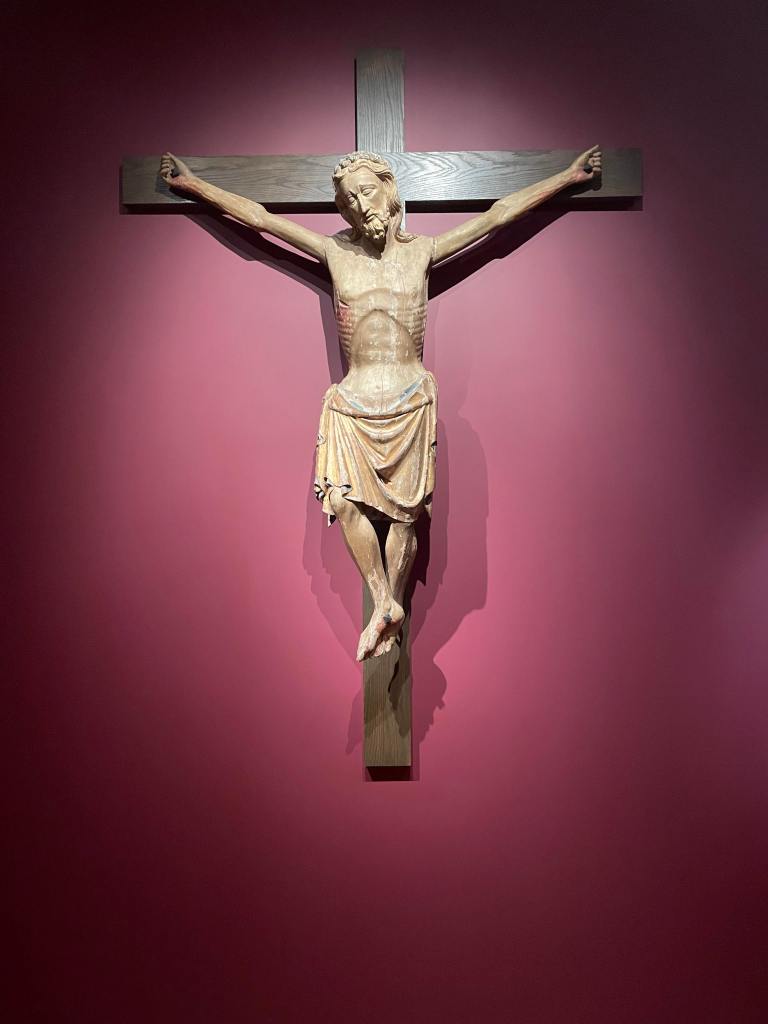
A while back I wrote about my visit to the Cleveland Museum of Art and my reaction to all of their Mary-oriented medieval art. Today, I want to think about the bigger journey that gallery was a part of. As I walked through the museum, it was wildly apparent that the artistic ideal of society was deteriorating as each age passed. For example, let’s look at something from the medieval exhibit:

Crucified Christ, late 1300s

The point of the piece is immediately apparent: this is what the world is all about. Not only does it clearly present an ideal in the person of Jesus and the event of his crucifiction, but you can tell it’s a piece that the public was intended to interact with. It belongs in a church with people worshipping nearby. This is a sign intended to draw people’s minds to the highest understanding of perfection. It’s not a particularly unique piece for the era. The medieval galleries were stuffed with reliquaries, altars, and religious paintings. I can’t help but be staggered by the sheer level of devotion towards the sacred that people were expressing.

Now let’s look at something from the modern gallery:

Metal Fence, Cady Noland

What’s being conveyed? Certainly nothing positive. It’s a critique. Perhaps something like “Why build fences when you could build bridges,” “America is built on keeping others out,” “we need to knock down exclusionary structures,” etc. There’s no positive statement being made. There’s no indication that there’s a sacred ideal. If anything, it’s just the opposite. The plaque that accompanies this particular piece indicates that the author intended it as a critique of the history of the United States. This is a piece specifically intended to tear down images of the sacred. It’s definitely not beautiful. There’s also no possible way that a piece like this could be identified as an artistic endeavor outside of a museum. If you popped this in a community center, people wouldn’t stop to admire it. They would assume you were doing construction and avoid that part of the building! This is a piece intended for appreciation by cultural elites, not everyday people. Again, this example is anything but unique for the modern gallery. You have your fences, you have your baby carriages full of spray-painted phalluses, conglomerations of nude body parts, etc.

All of this is what came to mind as I read through C.S. Lewis’s A Confession:

A Confession
I am so coarse, the things the poets see

Are obstinately invisible to me.
For twenty years I’ve stared my level best
To see if evening–any evening–would suggest
A patient etherized upon a table;
In vain. I simply wasn’t able.
To me each evening looked far more
Like the departure from a silent, yet a crowded, shore
Of a ship whose freight was everything, leaving behind
Gracefully, finally, without farewells, marooned mankind.

Red dawn behind a hedgerow in the east
Never, for me, resembled in the least
A chilblain on a cocktail-shaker’s nose;
Waterfalls don’t remind me of torn underclothes,
Nor glaciers of tin-cans. I’ve never known
The moon look like a hump-backed crone–
Rather, a prodigy, even now
Not naturalized, a riddle glaring from the Cyclops’ brow
Of the cold world, reminding me on what a place
I crawl and cling, a planet with no bulwarks, out in space.

Never the white sun of the wintriest day
Struck me as un crachat d’estaminet.
I’m like that odd man Wordsworth knew, to whom
A primrose was a yellow primrose, one whose doom
Keeps him forever in the list of dunces,
Compelled to live on stock responses,
Making the poor best that I can
Of dull things . . . peacocks, honey, the Great Wall, Aldebaran,
Silver weirs, new-cut grass, wave on the beach, hard gem,
The shapes of horse and woman, Athens, Troy, Jerusalem. (Poems, p. 3-4)

Right out of the gate, Lewis is striking out at the people who are deconstructing classic visions of beauty. T.S. Eliot’s The Love Song of J. Alfred Prufrock is put on blast because there’s nothing sterile or dead about the evening sky. The evening is beautiful, melancholy, and momentous, but certainly not sterile. All these other popular poetic metaphors are equally unfitting. People keep taking these visions that should be massive, beautiful, even transcendent, and warping them into things that are mundane and ugly. The leading poets seem intent to warp the things that once inspired us into things that should disgust us.

As someone particularly fond of William Blake, I couldn’t help but think of him. He was one of the great masters of subverting the sacred. Take, for example, his poem Infant Sorrow:

My mother groand! my father wept. 
Into the dangerous world I leapt: 
Helpless, naked, piping loud; 
Like a fiend hid in a cloud. 

Struggling in my fathers hands: 
Striving against my swaddling bands: 
Bound and weary I thought best 
To sulk upon my mothers breast.

This was part of a collection called Songs of Innocence and of Experience. It was a two part collection. In Songs of Innocence, he presented the beautiful ideal of something, and in his later Songs of Experience, he warped it to show how a world-weary mind mind might experience the same circumstance. In this case, we have birth. Is there a miracle of life? In one sense, sure. But in another, there is the horrible burden of life.

The longer he writes, the clearer that basic motif becomes. The Marriage of Heaven and Hell blurs the lines between the sacred and the profane to suggest that both good and evil, in their own way, are sacred. Devils and angels both have wisdom that we need to learn from. He even creates his own mythology and writes grand creation stories about the history of the world. He portrays God the Father (especially as seen in the Old Testament) as hideously oppressive and in constant war against the great spirit of artistic inspiration and human freedom. What was once sacred is now profane as Blake’s spirit of freedom descends upon the world.

That’s exactly what we have in the contemporary art gallery. We have people eager to call what was once sacred profane. Any sense that something is beautiful or worthy of particular praise is dangerous. Who is one person to tell another what is beautiful? To restrict in any way is wrong. That is the great truth in our era.

It pairs perfectly with the famed sociologist Philip Rieff’s critique of modern culture. Historically, a massive part of culture has been that series of restrictions placed on us (via both taboo and law) in the hopes of helping us live a good life. Do you want to be like Jesus? Then don’t sin. Do you want to honor the gods? Then don’t forget your sacrifices. By coming together around one great vision of purpose and orienting ourselves towards that vision, meaningful community is possible and visions of the sacred are kept. Modern culture, however, no longer has a meaningful vision of the sacred apart from autonomy from all external obligations. People do not long to be a grand embodiment of the good so much as they long to be free to do what they please. Under these circumstances, discussions of good or evil becomes almost laughable because so few people aspire to become more than what they already are:

Evil and immorality are disappearing… mainly because our culture is changing its definition of human perfection. No longer the Saint, but the instinctual Everyman, twisting his neck uncomfortably inside the starched collar of culture, is the communal ideal , to whom men offer tacit prayers for deliverance from their inherited renunciations.

The Triumph of the Therapeutic, 6.

What we end up with is what Rieff calls an anti-culture. It can’t bind together or orient people towards a vision of the good life. The only thing really binding us together is mutual disgust at the thought of people telling us how to live, be the source older visions of natural law, religious obligations, or something else entirely. To paraphrase another great thinker, Stanley Hauerwas, the modern story is that we have no story except the story we choose for ourselves (Community of Character, 84). We end up rudderless in a life without meaning, desperately trying to create meaning for ourselves while knowing we just made it all up.

And what of the great thinkers and artists? Historically, their efforts were part of what bound us together. Buonarroti’s Creation of Adam, the icon Christ Pantocrator, the stained glass of Sainte-Chapelle and other great works served the public by bringing them together to aspire to be like God. Today’s intellectual class does not feel the same burden:

I suspect the children of Israel did not spend much time elaborating a doctrine of the golden calf; they naively danced around it, until Moses, their first intellectual, put a stop to the plain fun and insisted on civilizing them, by submerging their individualities within a communal purpose. Now, although there is some dancing again, the intellectuals mainly sit around and think in awe about the power and perversity of their instincts, disguising their rancorous worship of self in the religion of art.

The Triumph of the Therapeutic, 7.

While Rieff’s Moses seems a little elitist for my taste, I think there’s truth to what he’s trying to get at. We live in a world without a sense of the sacred with intellectuals and artists that would rather root out any remaining bits of transcendence than attempt to build anything that points to more than our own disenchantment and appetite.

That’s what I see Lewis lamenting here. The threads that have bound our culture together are unraveling. The waterfall is no longer a sign to point our eyes to God, so much as a mundane thing that might remind us of sex. The glaciers are no longer a sign that we are tiny, limited things in the world, so much as they are reminders of garbage. We have lost the sense that the world is pointing to something greater, and so historic memory of the sacred becomes bizarre. All we can do is ironically poke fun at the old world and trudge through our flattened-out world in frustration and disappointment.

But Lewis points to a solution: don’t give in. Don’t be someone who loses your sense of wonder. Be fascinated by the things that others think dull. Look at fresh cut crass and delight. Observe the miracle of honey. Taste it and be satisfied. Be astounded by the great cities of Jerusalem and Athens and the ideals they represent. Don’t lose hope, and don’t start defining yourself by opposition. Yes, he is absolutely being critical of his rivals in this poem, but the great hope he points to is not in opposition. That was Blake’s hope. “Opposition is true friendship,” he wrote (MHH20; E42) and eternal opposition seems to be the best that the modern anti-culture of self-gratification can offer. Don’t be like that. Be amazed. Rejoice in old stories about satyrs, magic, miracles, and devils. Recover the sacred, which never abandoned us even as we attempted to abandon it. Live a life defined by hope and beauty. Be the dunce in the eyes of the elites, “for the foolishness of God is wiser than human wisdom,” (1 Cor. 1:25).

C.S. Lewis’s Nerdy Poetry: The Country of the Blind

Most of my experience with C.S. Lewis comes from those approachable classics that sit on many a Christian’s bookshelf: The Screwtape Letters, Mere Christianity, A Grief Observed, The Great Divorce and a few others. Only recently have I started to see the more academic, professorial side of him. Books like The Discarded Image: An Introduction to Medieval Literature are way more intense than Narnia, and frankly, they’re a bit of a slog. And now, I found out the man wrote poetry! Not just any poetry either. He wrote the nerdiest poetry you’ll ever find. These poems were not intended for general audiences. They’re just a smart guy playing with ideas in verse. If you enjoy them, great! If you don’t get ’em or don’t like ’em, I don’t think he would particularly care. My current success rate of “getting” his poetry is about 70%. Some of them are loaded with mythology and theory that I’m not familiar with (especially the Greek mythology, which he clearly loves), but the ones that I do get are brilliant. I thought I’d share a couple of them on here along with my thoughts as I work through them.

The Country of the Blind
Hard light bathed them-a whole nation of eyeless men,
Dark bipeds not aware how they were maimed. A long
Process, clearly, a slow curse,
Drained through centuries, left them thus.

At some transitional stage, then, a luckless few,
No doubt, must have had eyes after the up-to-date,
Normal type had achieved snug
Darkness, safe from the guns of heavn;

Whose blind mouths would abuse words that belonged to their
Great-grandsires, unabashed, talking of light in some
Eunuch’d, etiolated,
Fungoid sense, as a symbol of

Abstract thoughts. If a man, one that had eyes, a poor
Misfit, spoke of the grey dawn or the stars or green-
Sloped sea waves, or admired how
Warm tints change in a lady’s cheek,

None complained he had used words from an alien tongue,
None question’d. It was worse. All would agree ‘Of course,’
Came their answer. “We’ve all felt
Just like that.” They were wrong. And he

Knew too much to be clear, could not explain. The words —
Sold, raped flung to the dogs — now could avail no more;
Hence silence. But the mouldwarps,
With glib confidence, easily

Showed how tricks of the phrase, sheer metaphors could set
Fools concocting a myth, taking the worlds for things.
Do you think this a far-fetched
Picture? Go then about among

Men now famous; attempt speech on the truths that once,
Opaque, carved in divine forms, irremovable,
Dear but dear as a mountain-
Mass, stood plain to the inward eye.

This one especially has consumed me as of late. I can’t help but read it and think about Jesus’s response to the disciple’s question: why do you speak in parables?

13 This is why I speak to them in parables:

“Though seeing, they do not see;
    though hearing, they do not hear or understand.

14 In them is fulfilled the prophecy of Isaiah:

“‘You will be ever hearing but never understanding;
    you will be ever seeing but never perceiving.
15 For this people’s heart has become calloused;
    they hardly hear with their ears,
    and they have closed their eyes.
Otherwise they might see with their eyes,
    hear with their ears,
    understand with their hearts
and turn, and I would heal them.’ (Matt 13:13-15)

I generally assume that Jesus wants everyone to understand what he’s saying. Sure, I might rail against visions of him that are altogether too polite and soft, but by no means do I assume he would intentionally make his points opaque to keep people from understanding them. And we could go back and forth trying to soften the impact of the verse by applying different theological methodology to it (after all, it does say that they closed their eyes first), but it seems like it would be almost impossible to erase the sense that not everyone will understand what Jesus is saying and that that is intentional (John Calvin is smiling down on this paragraph, I’m sure).

Lewis’s poem is right in this same vein. We still have people that do not see, but it’s not their own willfulness or crafty parables that are keeping them from seeing. They’ve shut their eyes for so long that their biology has shifted to accommodate their decision. Even if they wanted to see, they lack the capacity. Worse than that, they refuse to confront the reality of their own blindness. They’re happy to discuss the world with the small amount of people that can still see, but only insofar as they’re treated as complete equals. Whatever is being discussed is primarily understood as a matter of internal experience, rather than external truth. “Of course, we’ve all felt like that,” they croon, completely missing the simple fact that they haven’t. Every piece of information being shared is radically different from anything they’ve ever conceptualized, but rather than admit it, they just insist that they already know and continue on.

What a tremendous way to look at the modern shift in metaphysics. I can’t help but think of it in terms of pastoral expectations as they were laid out in Andrew Root’s, The Pastor in a Secular Age. In each era, Christians have expected different things from pastors. In the medieval era, the priest had power. Even if the whole service was in Latin and you didn’t quite understand how communion worked, the popular imagination had such a strong sense of God’s action and a dynamic range of entities beyond human senses that you knew he carried power. He was the bridge between this world and the next. In a magical world, the priest stood as an obvious and clear figure worthy of your attention. With the shift to Protestantism, there was a fundamentally new way of imagining metaphysics. Suddenly, it wasn’t just the priest that was responsible for navigating the path between this world and the next; it was the individual believer. You were responsible for what you believed! You had to devote yourself to the highest ideals of Christian life and take responsibility for your own faith if you wanted to please God. Here, we see this tremendous shift towards the pastoral ideal as a professor. People like Luther and Calvin are the obvious legendary figures in this tradition, but the example Root provides is Johnathan Edwards. According to legend, Johnathan Edwards studied and prayed for thirteen hours every day. And his congregation was happy! They wanted to understand the intricacies of the world around them and the claims that were being made in the Bible, so if the pastor preached an hour long sermon that relied on multiple commentaries and theological bigwigs? Awesome! Bring it on. These were people that strove to see. They wanted to know the nature of the universe, and no watery spirituality would be an acceptable substitute.

Root details a long history of philosophical shifts that slowly lead to modernity, but as we approach our own era, the assumptions about what a pastor does have totally shifted. A pastor does not tell objective truths. That’s what math and science are for! No, a pastor works in the realm of values. They tell you how to live a good life. They help you understand who you are. They belong in the humanities section of a university, not the sciences side. Their value comes from their ability to befriend people, reflect an identity for others to consider, and build a massive church with multiple satellites to reflect the vitality of the community. The ideal pastor is a mix between an entrepreneur and an instagram influencer, encouraging us to try on a way of living that will make us happy. We moved from a world in which the Church was expected to teach objective truths about the world around us to a world in which the church was expected to help us feel subjective somethings within ourselves.

Unfortunately for moderns, Scripture is devilishly difficult to cast as something that’s primarily concerned with subjective feelings. The whole of the book bursts with objective claims about creation! And yet, religious dialogue is often dominated by what feels right and how we can live moral, decent lives. Not that either of these are inherently bad things, of course, but when they’re uprooted from the metaphysical grounding of the objective claims that surround them, they wither and shift whatever way the wind blows. Our cultural hesitance to let the audacious claims of Scripture be what they are muddies them considerably and betrays a certain unwillingness to claim them as true knowledge. Christians and non-Christians alike are put into a position where truth is what we make of it. We fail to see the reality around us because we’re so busy constructing our own narrative that suits us.

We do not see.

Even the claims in Scripture start to look less and less like truth claims and more and more like “sheer metaphors” and “myths.” What if Jesus was not actually Jesus? What if he’s only intended to be a metaphor for humanity’s capacity for good? What if Jesus’s resurrection is no longer an actual resurrection, but a symbol intended to reflect the eternal resurrection of hope and goodness in the world? That slow erosion of the claim slowly eats away at it, giving more and more authority to us and less and less to the claim itself. Symbolic meaning can always be uncovered in an objective event, but once the event or story is stripped of objectivity, not only does it lose the core of its meaning, but the possibility for symbolism becomes infinite. Without any semblance of authority, the claim exists only to allow others an opportunity to create their own meaning. The “divine forms, irremovable” that were once so obvious and clear to every eye have become “symbols of abstract thought;” ideas to toy with and little more.

The ultimate consequence is a sort of de-evolution. Lewis never was shy about suggesting that things in the premodern world were better, and here he’s said it in an incredibly direct way. The people he’s considering aren’t portrayed as the same bipartite beings that were created in Genesis: “God formed a man from the dust of the ground and breathed into his nostrils the breath of life,” (Gen 2:7). Their descriptors lack that sense of divine spark. The language surrounding the blind creatures is primitive and earthy. They are “mouldwarps” with “fungoid” ways of describing things. They lack that spirit that separates them from the plants that preceded them.

And yet, the poem isn’t just a gripe about the good ‘ol days. At least, I don’t think it is. It’s profoundly melancholy. Some of these creatures still see. They see the grandeur of the stars, the waves, the human form, and the misty dawn. But even as they see the wonders around them, they have so few to to share it with. By the eyes they were given, they are able to see tremendous beauty, but they also become the bearers of an incredible sense of loneliness. What Christian in the postmodern era has not felt like that? Who has not lamented the inability of others to see the throngs of angels singing, the cloud of witnesses watching, the divine spark that lingers in every eye, and the glory of God in every rock? But attempts to uncover the transcendent turn shallow all too quickly. Even semi-regular churchgoers are all too often concerned with mere morality and tradition than the vibrant eternity around them, frustrating the Christian all the more. To see is to be lonely and burdened. How do you awaken others to the world?

Part of me wants to cut the intensity of the poem by suggesting that the claim isn’t quite what it is. It sounds hopelessly arrogant to claim to see when everyone else is blind. To say that you understand a reality that the rest of the world can only hopelessly grasp at until they are somehow granted sight is brash! But didn’t Jesus make those claims? Isn’t that the whole of the history of Christianity? Lewis has claimed to see, and while it would be more comfortable to mask the arrogance of claiming to know truth, it’s critically important for us to let his statement stand and consider it not as arrogance, but as humility in the face of a truth beyond himself.